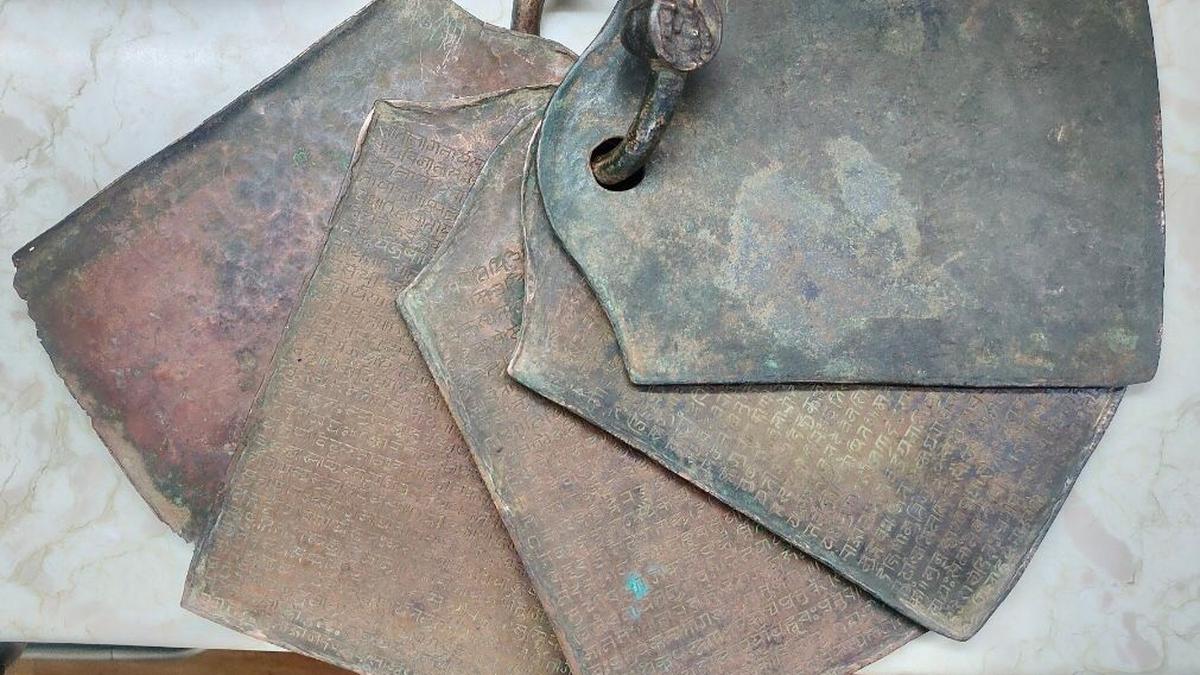
Copper plate inscription sheds light on the coronation of Vijayanagar king Devaraya I
The Hindu
Copper plate inscriptions reveal coronation date of Vijayanagar ruler Devaraya I, enriching historical understanding and legacy.
A set of copper plate inscriptions belonging to the early Vijayanagar period has shed light on the date of coronation of Vijayanagar ruler Devaraya I in what is reckoned to be one of the significant discoveries that will help historians in reconstructing the past.
The copper plates were in possession of Falcon Coins Gallery in Bengaluru, and under the custody of its managing director, Kirti M. Parekh, who brought them to the notice of the Epigraphy Department of the Archaeological Survey of India (ASI).
K. Munirathnam, Director, Epigraphy Branch, ASI, said the copper plate inscription sheds crucial historical insight into the coronation of Devaraya I. “The inscription is in Sanskrit and Kannada using Nagari characters, and the date of the coronation corresponds to November 5, 1406 CE, which was a Friday,” he said.
“The significance of this epigraph lies in its explicit mention of the date of the coronation of Devaraya I, which until now remained uncertain,” Dr. Munirathnam said.
The inscription presents the complete genealogy of the Sangama dynasty – the founders of the Vijayanagar empire. It has 179 lines and mentions the names of eight kings, including the coronation date of Devaraya I, Dr. Munirathnam said.
The inscription records that at the time of his coronation, King Devaraya I, son of Harihara, granted the village of Gudipalli, along with two hamlets, Rajendramada and Ydayapalli, and renamed the settlement as Devarayapura Agrahara.
This village, situated in Mulabagil, was divided into 61 shares and donated to several learned brahmins of different gothras and well-versed in the Vedas and various Sastras, Dr. Munirathnam said.


The government plans to amend the FCRA, introducing new regulations for NGO asset management and accountability for key functionaries.

The draft policy for “Responsible Digital Use Among Students”, released on Monday by the Department of Health and Family Welfare, has recommended that parents set structured routines with clear screen-time rules and prioritise privacy, safety, and open conversation with children on digital well-being.

Police Observer Sushant Kumar Saxena conducts surprise inspection at Shencottai police station, reviewing warrants and security arrangements ahead of elections.

Andhra Pradesh government to launch key projects in April, focusing on industrial growth and infrastructure development, says Nara Lokesh.

Lok Sabha refers the Corporate Laws (Amendment) Bill to a JPC amid opposition concerns over CSR provisions dilution.

SHG members in Kanniyakumari use snakes and ladders to raise election awareness and boost voter turnout.

Government accelerates consultations for early implementation of the Women’s Reservation Act to ensure women’s representation in 2029 elections.

CM A. Revanth Reddy distributes ₹1 crore insurance cheques to families of deceased Electricity department employees, enhancing financial security for workers.

The Bengaluru Traffic Police (BTP) registered 634 cases of drunk driving during a week-long special enforcement drive conducted across the city between March 16 and March 22.

GHMC intensifies action against property tax defaulters, seizing properties and offering a One Time Settlement scheme for payments.

CCB arrests three drug peddlers in Mangaluru, seizing ₹2.5 lakh worth of MDMA and other valuables.

TVK's 28 candidates in Puducherry include former BJP MLAs, a sitting Independent, and a retired police IG.

BRS submits notice on private member bill to Speaker