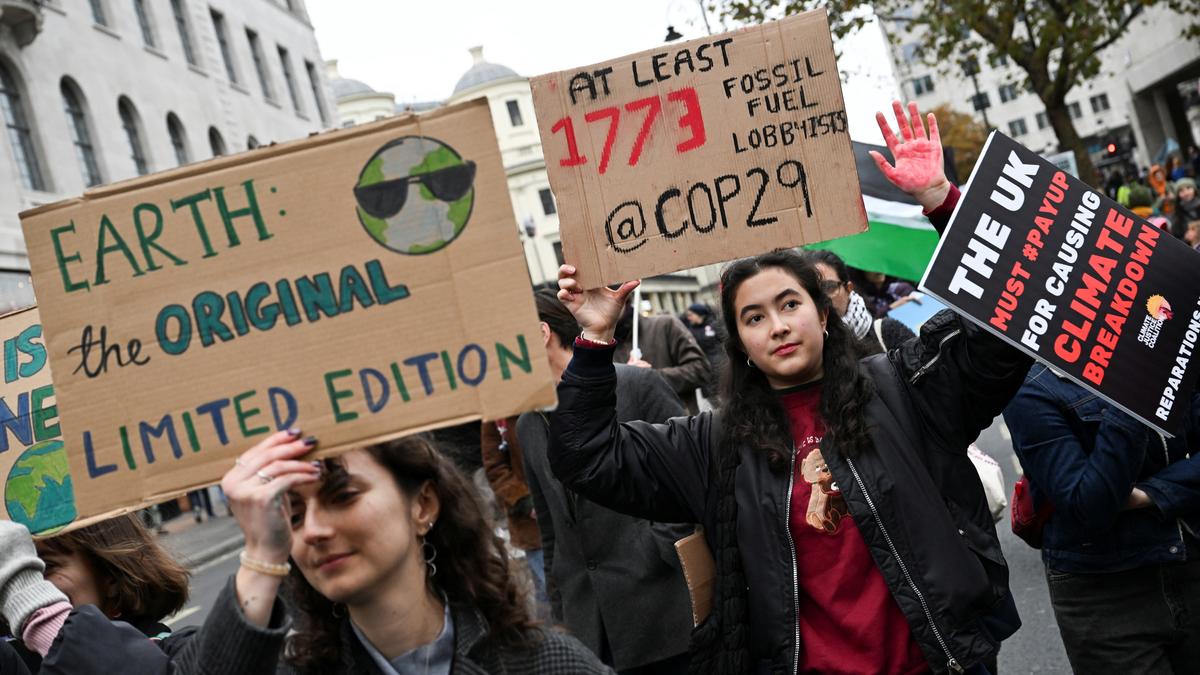
COP29 week one ends in deadlock as divisions stall climate action progress
The Hindu
COP29 summit in Baku sees deep divisions on climate finance, trade, and responsibility, hindering progress and sparking tensions.
The first week of the COP29 summit concluded in Baku without significant breakthroughs, as deep divisions between developed and developing nations stalled progress on key issues like climate finance, trade measures, and equitable responsibility for climate action.
India, representing the G-77/China and BASIC blocs, demanded accountability from wealthier countries on unmet financial commitments.
The G-77/China bloc reiterated the call for $1.3 trillion annually in climate finance, with an emphasis on grants and concessional funding to avoid burdening vulnerable economies already grappling with the impacts of climate change. “Loans make up nearly 70% of climate finance provided so far. This is unacceptable and places undue pressure on developing economies,” an Indian negotiator had asserted, urging developed nations to move away from debt-inducing mechanisms.
UN Executive Secretary Simon Stiell added to the urgency, urging G20 countries to take bolder action, warning that without it, no economy in the grouping would be spared from climate-driven economic losses.
However, his call for solidarity failed to resolve the deadlock.
Cosima Castle, of E3G’s climate diplomacy team, acknowledged the challenges posed by geopolitical tensions but underscored the potential of the upcoming G20 Leaders’ Summit in Rio de Janeiro.
E3G is an engineering and environmental consulting firm.


Trump claims “very good” talks with Iran, despite Tehran’s denial, as U.S. negotiators plan potential meetings in Pakistan.

Netanyahu discusses U.S.-Israeli military gains with Trump, emphasizing commitment to protect Israel's interests amid ongoing conflicts.

Pakistan reaffirms commitment to combat terrorism as Afghan ceasefire approaches end amid rising tensions and recent casualties.

Trump postpones military strikes on Iranian power plants for five days amid escalating tensions and ongoing diplomatic discussions.

Shorts News:Watch: NATO chief: 22-nation group forming to secure Strait of Hormuz

Saudi Aramco reduces crude supply to Asia for April, citing disruptions from the Iran-Israel conflict affecting trade routes.

Tencent launched a tool on Sunday to integrate its WeChat messaging platform with the OpenClaw agent

An Air Canada flight collided with a Port Authority vehicle at LaGuardia Airport, causing significant damage and police response.

Saudi Arabia and the UAE face missile attacks, with casualties reported and air defenses engaged amid escalating regional tensions.

Slovenia's parliamentary election results show a tight race between liberals and populists, signaling potential political instability ahead.

IEA chief warns of a potential energy crisis worse than the 1970s, with 11 million barrels lost daily amid regional conflicts.

Cuba begins restoring power after a nationwide grid collapse, affecting thousands amid an ongoing energy crisis and blackouts.

The Hindu LIVE updates on March 23 2026 on Iran-Israel war. Iran faces deadline of US President Donald Trump warning to open Strait of Hormuz