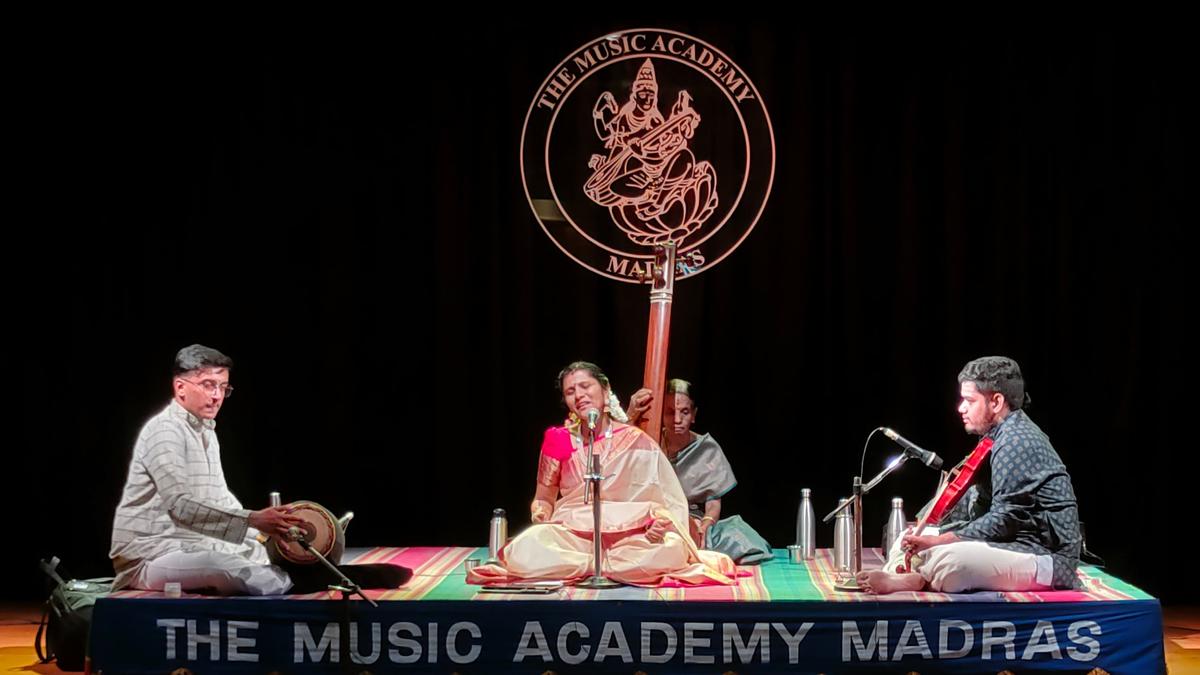
Conveying the poignancy in Bhadrachala Ramadasu’s songs
The Hindu
Shruthi S. Bhat delivers a concert dedicated to Bhadrachala Ramadasu's compositions with impressive accompaniment.
Shruthi S. Bhat made a statement with both intent and content right at the outset of her concert, which was devoted exclusively to the compositions of Bhadrachala Ramadasu. It is rare to come across a kriti in Bhairavi as the opening number of a concert, and rarer still when it includes a niraval segment. Accompanied by G. Kailasapathy on the violin and G.N. Bhuvan on the mridangam, Shruthi presented this endowment concert under the auspices of The Music Academy at the Kasturi Srinivasan Hall.
Shruthi’s voice was in fine fettle from the very first note, as she opened with the shloka ‘Srirama sitagaga’ from the saint-poet’s ‘Dasarathi Sathakam’ in Bhairavi. The full range of the raga’s facets emerged even in the short rendition, which was a prelude to the composition ‘Rama dayajudave’. The refinement lingered through the rendition of the song, particularly in the niraval and kalpanaswaras at ‘Rajeeva dala lochana’, creating immersive bhakti.
‘Bhadrasaila rajamandira’ in a lilting Kuntalavarali was sung zestfully, offering a lighter and contrasting shade. Chakravakam was the first raga Shruthi explored. While the delineation stayed true to the raga’s mood and structure, it occasionally veered into repetitive passages that could have been more tightly sculpted for greater coherence. Kailasapathy’s version on the violin complemented that of the vocalist.
Here, Shruthi narrated a moving anecdote from the life of the 17th-century composer, which related to the kriti ‘Abbabba debbalaku’ in Misra Chapu. Ramadasu, a staunch devotee of Rama, had been imprisoned by the Mughal ruler Tana Shah on charges of misappropriating funds to construct the Bhadrachala Rama temple. In this composition, he pleads with the Lord: “I promise upon your feet, please do listen. I have not laundered a single penny to anybody”. After listening to his prayers, Rama and Lakshmana appeared as messengers, paid the money, and secured Ramadasu’s release from prison. The song was rendered with the poignancy the context warrants, and the swarakalpana at ‘Prema tho’ displayed synchrony from the ensemble.
‘Hari hari nama’ in Kanada carried forward the devotional fervour leading into the main suite in Kamboji and the best-known composition by Ramadasu in the raga — the evergreen ‘Emayya Rama’ in Khanda Chapu. Shruthi began by hitting the high notes shortly before ebbing into the lower octave, and then gradually shaped the melody, revealing its splendour through gamaka-laden phrases. Kailasapathy’s presentation was equally rich with melodic depth. The rendition of the kriti was replete with Kamboji’s grace before Shruthi rounded off with niraval and swara exchanges at ‘Paramatmudu ani ninnu’ in the charanam. Bhuvan’s rhythmic support was steadfast throughout, and his tani was marked by verve and tonal precision.
A shloka, ‘Sriramachandra karunakara’, in Yamunakalyani was followed by the song ‘Naraharideva’, and the concert concluded with a mangalam in Madhyamavati.


Artist Kapila Nahender explores notions of belonging, growth and memories in her show Pockets of Resistance

BTS's comeback concert in Seoul drew over 100,000 fans, featuring their new album "ARIRANG" and a global livestream.

Prasads Multiplex Hyderabad unveiled one of India’s largest HDR cinema auditoriums, the PCX HDR by Barco

From staged funerals to rented fatherhood, Brendan Fraser turns rented intimacy into something disarmingly real in Hikari’s poignant Tokyo fable

Meet Nivrritii Mahesh, a Bharatanatyam dancer who dances with Cochlear implants

In a surprising turn of events, Urvashi theatre, one of Bengaluru’s iconic single screens, has re-opened, with the much-talked-about Dhurandhar: The Revenge running to a full house in the theatre. After the expiry of the 45-year lease, it seemed like curtains would come down on the king-size theatre but for now, it’s good news for fans.

The thrilling ‘Peaky Blinders’ finale is a farewell tour tailored for Tommy Shelby, while passing the baton to a new generation

BTS's comeback concert in Seoul drew over 100,000 fans, featuring their new album "ARIRANG" and a global livestream.

Khalid Rahman is reuniting with Malayalam superstar Mammootty after Unda (2019). The Thallumaala director has teamed up with the veteran for Mattancherry Mafia.

Bollywood actor Akshay Kumar paid tribute to the martial arts grandmaster and Hollywood’s action star, Chuck Norris, who passed away on Thursday, March 19, 2026.

Renowned Odissi dancer Madhumita Raut, aged 59, dies of cardiac arrest, leaving behind a legacy of artistic achievements.

Chuck Norris, iconic martial arts master and actor, dies at 86, leaving behind a legendary legacy and internet memes.

South African naturalist Steve Boyes speaks on ghost elephants, ancestral tracking, and Werner Herzog’s documentary exploring Angola’s elusive highland giants