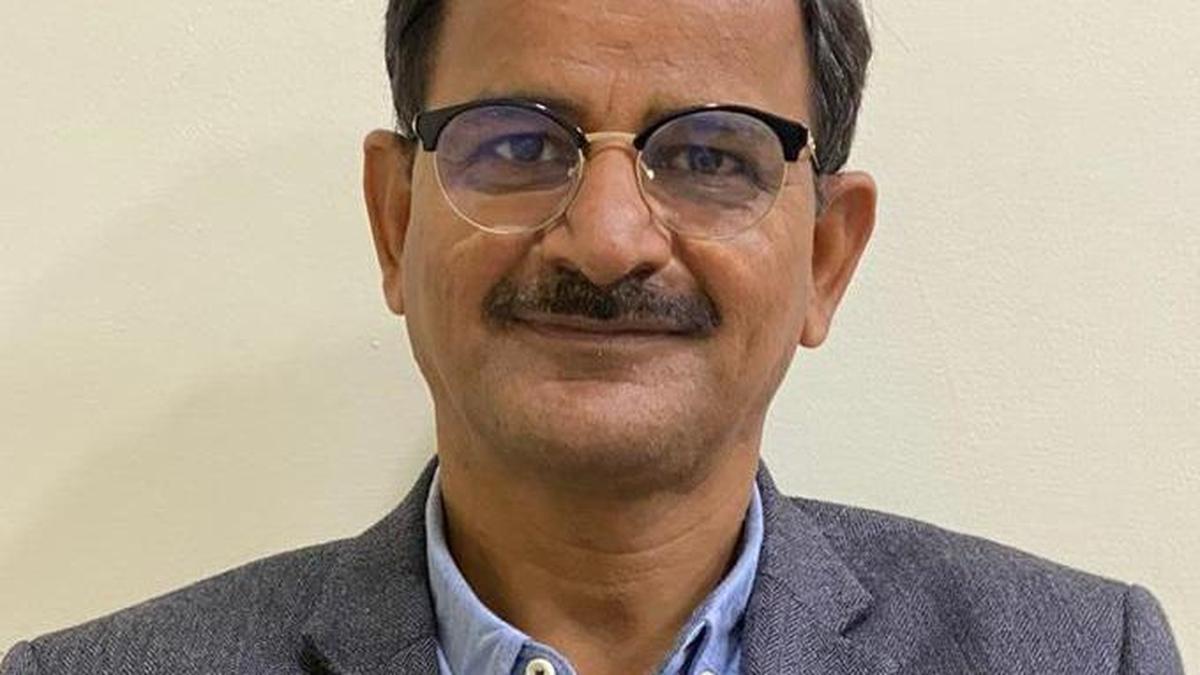
‘Completion of SYL Canal essential to resolve water dispute between Punjab and Haryana’
The Hindu
Former Haryana engineer Shiv Singh Rawat analyzes the Punjab-Haryana water dispute, highlighting legal, political, and operational challenges for resolution.
Amid the ongoing conflict between the Haryana and Punjab governments over water-sharing, former Superintending Engineer in Haryana’s Irrigation and Water Resources Department (I&WRD), Shiv Singh Rawat, offers insight into the Ravi-Beas water dispute, the legal deadlock, political polarisation, and institutional shortcomings. Excerpts:
What is the current water dispute between Punjab and Haryana?
In April 2025, Haryana reported a sharp decline in its water supply from the Bhakra dam and approached the Bhakra Beas Management Board (BBMB) to raise its allocation from 4,000 cusecs to 8,500 cusecs. The BBMB’s technical committee partially met the demand by approving an additional 4,500 cusecs for eight days. Punjab opposed the decision, claiming Haryana had already used 3.110 million acre-feet (MAF) — 104% of its sanctioned share for the depletion period (September 21, 2024-May 20, 2025). It argued that Bhakra and Pong dam levels were critically low and insisted on capping Haryana’s supply at 4,000 cusecs to protect its own agricultural needs.
Haryana countered that water reserves were sufficient and accused Punjab of making false claims. It also pointed out that Punjab had received 22% excess water over the past two decades. As tensions escalated, the BBMB sought intervention from the Central government. The Centre advised Punjab to follow the BBMB recommendation. But the deadlock continues.
What is the significance of the Ravi-Beas water dispute?
This is a long-standing inter-State conflict over the equitable sharing of surplus waters from the rivers. The dispute affects agriculture, drinking water, regional development, and political relations in northern India.
While Haryana cites historical agreements, tribunal rulings, and Supreme Court verdicts to demand its share, Punjab argues it lacks sufficient water due to rising demand and ecological degradation.


Explore how prioritizing analytics in management education enhances leadership effectiveness in today's data-driven business landscape.

Delhi High Court allows release of "UP 77" web series, affirming it is pure fiction unrelated to gangster Vikas Dubey.

Explore how ancient floods along the Vaigai river may have led to the abandonment of the Keezhadi settlement in Tamil Nadu.

A goods carrier driver without a valid license likely dozed off at the wheel. He caused a fatal accident killing a Hyderabad Traffic Police Home Guard.

Vande Bharat Express collided with an overturned autorickshaw near Varkala, Kerala; no injuries reported, driver found intoxicated.

The lowest temperature recorded in Telangana in a decade was 2.0°C

On December 23, the newly elected office bearers of the Anna Nagar Towers Club, led by its president ‘Purasai’ B. Ranganathan, who is a former MLA, met with Tamil Nadu Chief Minister M. K. Stalin and conveyed their greetings. According to a press release, besides, ‘Purasai’ B. Ranganathan, the Anna Nagar Towers Club delegation that met Stalin at Anna Arivalayam, the DMK Party headquarters, included vice-president R. Sivakumar, secretary R. Muralibabu, joint secretary D. Manojkumar, treasurer K. Jayachandran and executive committee members N. D. Avinash, K. Kumar, N. R. Madhurakavi, K. Mohan, U. Niranjan, S. Parthasarathi, K. Rajasekar, S. Rajasekar, M. S. Ramesh, R. Satheesh, N. C. Venkatesan and K. Yuvaraj. Karthik Mohan, deputy secretary of DMK’s Information Technology Wing, was present on the occasion.

Congress questions government motives behind "fatally flawed" Aravalli redefinition, citing opposition from environmental experts and potential ecological risks.

Hyderabad police and transgender community discuss concerns on livelihood, identity issues, and public complaints of extortion during events.

Vaibhav Suryavanshi becomes the youngest List A centurion and scores 190 runs off 84 balls in the Vijay Hazare Trophy.

Protests ignite in Kerala after an RSS-BJP worker allegedly assaults a children's Christmas carol group, sparking widespread condemnation.

Telangana DCA raids unlicensed medical device unit in Sangareddy, seizing ₹1.70 lakh worth of unauthorized products.

Members of the Federation of Civic and Welfare Associations of Zones 2 and 3 (Pammal and Pallavaram) of Tambaram City Municipal Corporation staged a demonstration along Radha Nagar subway recently seeking a link road connecting Radha Nagar Main Road and the footbridge on Station Border Road.