Primary Country (Mandatory)

Other Country (Optional)

Set News Language for United States

Primary Language (Mandatory)
Other Language[s] (Optional)
No other language available

Set News Language for World

Primary Language (Mandatory)
Other Language(s) (Optional)

Set News Source for United States

Primary Source (Mandatory)
Other Source[s] (Optional)

Set News Source for World

Primary Source (Mandatory)
Other Source(s) (Optional)
  • Countries
    • India
    • United States
    • Qatar
    • Germany
    • China
    • Canada
    • World
  • Categories
    • National
    • International
    • Business
    • Entertainment
    • Sports
    • Special
    • All Categories
  • Available Languages for United States
    • English
  • All Languages
    • English
    • Hindi
    • Arabic
    • German
    • Chinese
    • French
  • Sources
    • India
      • AajTak
      • NDTV India
      • The Hindu
      • India Today
      • Zee News
      • NDTV
      • BBC
      • The Wire
      • News18
      • News 24
      • The Quint
      • ABP News
      • Zee News
      • News 24
    • United States
      • CNN
      • Fox News
      • Al Jazeera
      • CBSN
      • NY Post
      • Voice of America
      • The New York Times
      • HuffPost
      • ABC News
      • Newsy
    • Qatar
      • Al Jazeera
      • Al Arab
      • The Peninsula
      • Gulf Times
      • Al Sharq
      • Qatar Tribune
      • Al Raya
      • Lusail
    • Germany
      • DW
      • ZDF
      • ProSieben
      • RTL
      • n-tv
      • Die Welt
      • Süddeutsche Zeitung
      • Frankfurter Rundschau
    • China
      • China Daily
      • BBC
      • The New York Times
      • Voice of America
      • Beijing Daily
      • The Epoch Times
      • Ta Kung Pao
      • Xinmin Evening News
    • Canada
      • CBC
      • Radio-Canada
      • CTV
      • TVA Nouvelles
      • Le Journal de Montréal
      • Global News
      • BNN Bloomberg
      • Métro
Column | Tracing Parsis and their monotheism

Column | Tracing Parsis and their monotheism

The Hindu
Friday, June 14, 2024 06:54:56 AM UTC

The Parsi community is the transition zone between the monotheistic and polytheistic mythologies of West and South Asia

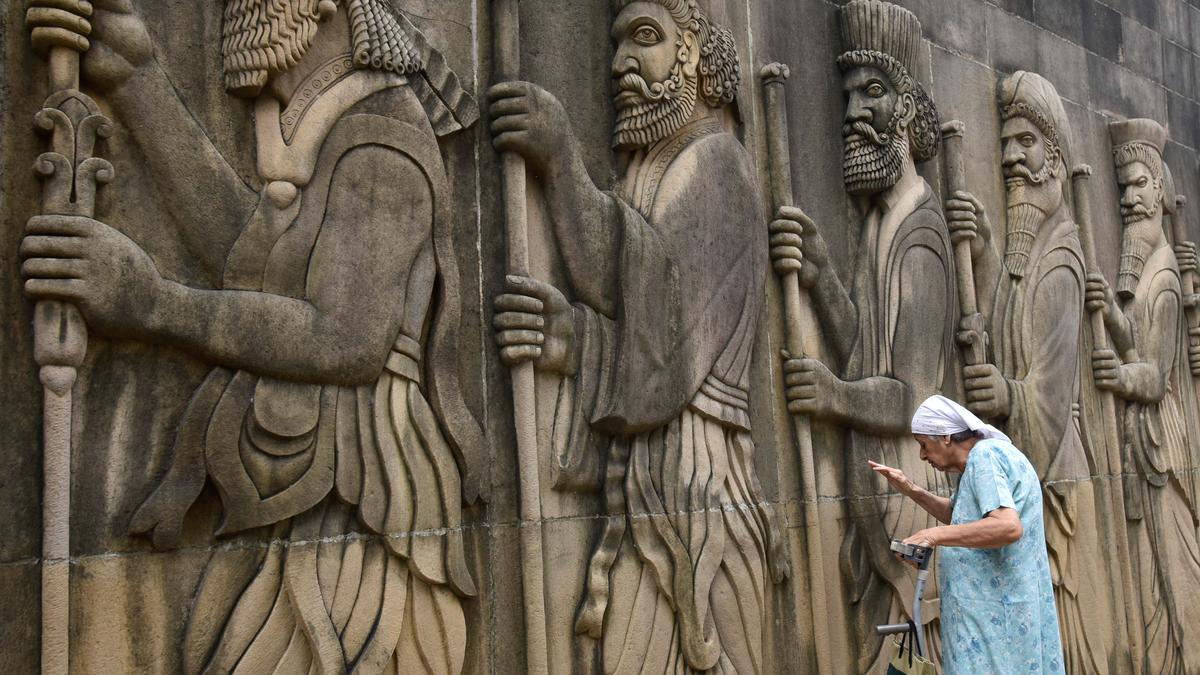
One finds the agiary on the western coast of India, in Mumbai and towns such as Sanjan and Diu in Gujarat. These fire temples of the Zoroastrians, frequented by those who call themselves Parsis or the people of Persia, are distinguished by their unique artwork that evokes memories of ancient Mesopotamia: giant winged bulls with human heads, and birds with human torso and head.

These creatures can be traced to 8th century BC Assyrian architecture in the lands we now call Iraq. They eventually made their way to Persia, by the 5 BC. The fantastic beasts combined the strength of bulls and eagles, and were seen as servants of the ‘one true God’. This was a revolutionary idea in the otherwise polytheistic and pagan ancient world.

Gods were represented by images back then, and housed in temples. But the Persians chose fire, preferably that which came from the sky as lightning, to represent the formless Ahura Mazda — the benevolent power, one who is not a jealous god, one who does not demand obedience. Persian monotheism influenced the Jewish community, which was exiled in Babylon at the time. The Jews were seeking a narrative to unite the displaced tribes, and they were inspired by Persian ideas such as Paradise, the Devil, and the Day of Judgement. Though the Jewish God would be a jealous one, seeking absolute fidelity and submission. Thus was born the Jewish Bible, which would later become the Old Testament of the Christians, and would influence stories referred to in the Quran. The world forgot the origin of these stories, but they still survive in India, a land that gave refuge to all religions. Albeit conditionally.

As per legend, and documented in the 16th century AD in works such as Qissa-e-Sanjan (Legend of Sanjan), the Parsis arrived on the Gujarat coast over a thousand years ago, seeking refuge from Arabic invaders. The local Indian kings — the Pratiharas and the Solankis — were reluctant to accept them as refugees. They were apprehensive of foreigners because they were aware of the rising tide of Islam. The refugees, however, assured the king that they would not proselytise their faith or convert locals. They would, instead, mingle ‘like sugar in milk’ — adopting the Indian way, speaking the local language, and dressing up as the natives did. Caste rules were implied.

Even today, the Parsi community has strict rules of endogamy, and non-Parsis are not allowed to enter the agiary (just as many temples forbid entry to non-Hindus). Ironically, the community owes its rise during colonial times to the fact that the British found them easier to deal with (they ate meat and eggs) than the Muslims (who they never trusted) and the Brahmins (whose caste rules they found annoying).

The 19th century saw more Parsis coming to India, particularly to Mumbai. A century later, Persia had been renamed Iran by Reza Shah, a Nazi sympathiser, who wanted to remind the world that the word ‘Arya’ was first inscribed by the Achaemenid emperor Darius the Great over 2,500 years ago, at Behistun, a large rock relief in the mountains of western Iran. The new wave of immigrants to India were called Iranis, and became famous for their cafe culture. Though they follow the same monotheistic faith and come from the same homeland, Iranis are seen as a separate community by the Parsis. Caste manifests in various ways, one could argue.

The Parsi community forms the transition zone between the monotheistic mythologies of West Asia and the polytheistic mythologies of South Asia. Genetic, linguistic and archaeological evidence now informs us that the eastern arm of the Indo-European speaking people, who domesticated the horse and invented the chariot around 2000 BC, settled in the Oxus basin around 1700 BC, where they were exposed to a thermogenic herb. They split into two groups — one went west towards Iran, and referred to the herb as ‘homa’, while the other crossed the Hindu Kush, and came east to India and called the herb ‘soma’.

Read full story on The Hindu
Share this story on:-
More Related News
Inside a scientific experiment that transformed skin cells into embryo-forming eggs Premium

A groundbreaking experiment transforms skin cells into egg-like cells, offering hope for infertility treatments amidst ethical considerations.

Niraba brings sabai grass weaving to contemporary furniture design

Discover Niraba, a collaboration merging Odisha's sabai grass weaving and dhokra craft into contemporary furniture and lighting design.

The story behind Goa’s 18-foot crochet Christmas tree

How do you create a Christmas tree with crochet? Take notes from crochet artist Sheena Pereira, who co-founded Goa-based Crochet Collective with crocheter Sharmila Majumdar in 2025. Their artwork takes centre stage at the Where We Gather exhibit, which is part of Festivals of Goa, an ongoing exhibition hosted by the Museum of Goa. The collective’s multi-hued, 18-foot crochet Christmas tree has been put together by 25 women from across the State. “I’ve always thought of doing an installation with crochet. So, we thought of doing something throughout the year that would culminate at the year end; something that would resonate with Christmas message — peace, hope, joy, love,” explains Sheena. 

Science Quiz: Remembering Max Born, quantum physics architect Premium

Max Born made many contributions to quantum theory. This said, he was awarded the Nobel Prize for physics in 1954 for establishing the statistical interpretation of the ____________. Fill in the blank with the name of an object central to quantum theory but whose exact nature is still not fully understood.

‘Moms of Kochi’ to organise Purple Carnival, a lifestyle exhibition

Join the Moms of Kochi for the Purple Carnival, a vibrant lifestyle exhibition featuring stalls, competitions, and entertainment on December 13-14.

Why human-rating matters as India prepares for Gaganyaan Premium

Human-rating emerges as a crucial process ensuring that space systems like LVM-3 can safely carry humans by adding redundancy, robust abort capabilities, and rigorous testing

The snail as a model for restoring vision in humans Premium

Discover how golden apple snails' eye regeneration offers insights into restoring human vision through genetic understanding and CRISPR technology.

Why do microwave ovens sometimes overheat water? Premium

Discover how microwave ovens can superheat water, leading to unexpected boiling when disturbed. Stay safe while heating.

Manhattan’s hot new INDN Bar: Butter chicken cocktails, keema pav, zero kids 

INDN has launched in NYC’s NoMad. Indian food goes 21+ here, with savoury cocktails, nostalgic small plates and a bar that refuses desi clichés — much to one dad’s horror

2025 to be second or third-hottest year on record: EU scientists

EU scientists predict 2025 will be among the hottest years on record, highlighting urgent climate change concerns and inadequate global action.

Tata Sierra review — The icon returns with purpose, poise and personality

Explore the complete review of the 2025 Tata Sierra, India’s reborn SUV icon. From its standout design and premium cabin to refined petrol and diesel engines, advanced tech and competitive pricing, this in-depth breakdown reveals why the new Sierra is poised to lead the midsize SUV segment.

SpaceX to pursue 2026 IPO raising above $30 billion: Report

Elon Musk’s SpaceX is moving ahead with plans for an initial public offering that would seek to raise significantly more than $30 billion and target a valuation of about $1.5 trillion, Bloomberg News reported

Aditya-L1 in a global effort reveals why the 2024 solar storm behaved unusually

Aditya-L1 and U.S. satellites uncover why the May 2024 solar storm behaved unusually, revealing significant magnetic field dynamics.

Will new Act aid India’s nuclear development? | Explained Premium

Explore the SHANTI Act's implications for India's nuclear development, replacing outdated laws and targeting significant capacity growth.

Drogue parachute deployment tests for Gaganyaan mission successful: ISRO

ISRO successfully completed drogue parachute deployment tests for the Gaganyaan mission, advancing safety for human spaceflight.

Rkive and the art of repair

Discover Ritwik Khanna's innovative repair shop Rkive in Mumbai, merging sustainability, creativity, and youthful urgency in fashion.

ISRO to launch U.S. satellite on December 24

ISRO will launch the U.S. BlueBird satellite on December 24, 2025, after postponing from the original December 15 date.

Tiffany, Swarovski and a new language of Christmas decor

Explore unique Christmas ornaments from Tiffany, Swarovski, and more, blending luxury with festive charm for your holiday decor.

Inside Copenhagen’s Alchemist: Chef Rasmus Munk on food, provocation and his India-inspired dishes

Inside Copenhagen’s Alchemist: Chef Rasmus Munk on food, provocation and his India-inspired dishes

Why has the claimed dark matter discovery sparked debate, caution? Premium

Explore the debate surrounding a potential dark matter discovery, highlighting skepticism and the need for rigorous validation in astronomy.

'Extremely exciting': the ice cores that could help save glaciers

Discover how ice cores from the Pamir Mountains could unlock secrets to protect the world's glaciers from climate change.

Why does spicy food make our nose run? Premium

Discover why spicy food causes a runny nose and how capsaicin triggers a protective response in our bodies.

How India established its first research station in Antarctica

In October this year, India announced its intention to build Maitri II, the country’s newest research station in Antarctica and India’s fourth, about 40 forty-odd years after the first permanent research station in Antarctica, Dakshin Gangotri, was established. The Hindu talks to Dr Harsh K Gupta, who led the team that established it

How is Asia-like artemisinin resistance emerging in Africa? Premium

Study reveals rising artemisinin resistance in Africa, echoing Asia's past, urging urgent action to prevent widespread crisis.

The Michelin Guide enters the world of wine with The Michelin Grappe, a new distinction

Michelin launches The Grappe, a new wine distinction, recognizing excellence with one to three grapes, starting with the Burgundy and Bordeaux regions

© 2008 - 2025 Webjosh  |  News Archive  |  Privacy Policy  |  Contact Us