Column | An accidental cruelty
The Hindu
Why healing others can come at a personal price, and words of comfort can cause more harm than good
A woman named Masarat lived in Phuphee’s village. She wasn’t originally from there, but had married the local school master. I must have been around nine or 10 when she came to the village as a young bride. I remember she gave me a handful of nuts when I went to see her with all the other children.
Every year from then on, we would hear how Masarat hadn’t been able to bear a child. Every year, someone would say she had lost another baby. Initially, people were kind and expressed the grief they felt at her misfortunes, but slowly that turned into opinions and gossip.
Over the years, you could see Masarat walk down the dusty paths of the village and the effort she put into trying to make herself smaller, so that the world might forget that she existed and offer respite in anonymity. But the world had other plans. Masarat didn’t just lose a baby year after year, she ultimately lost her name.
You see, there was another Masarat who lived in the village and whenever a question was raised about a Masarat, the next question was ‘which one?’ People would clarify with ‘yemis ne bachae chu daraan (the woman whose womb refuses to hold on to a baby)’. The other Masarat was blessed with children.
And so it was that even on the days when Masarat wasn’t grieving, a casual but telling glance from one of the villagers would remind her of everything she wished to forget.
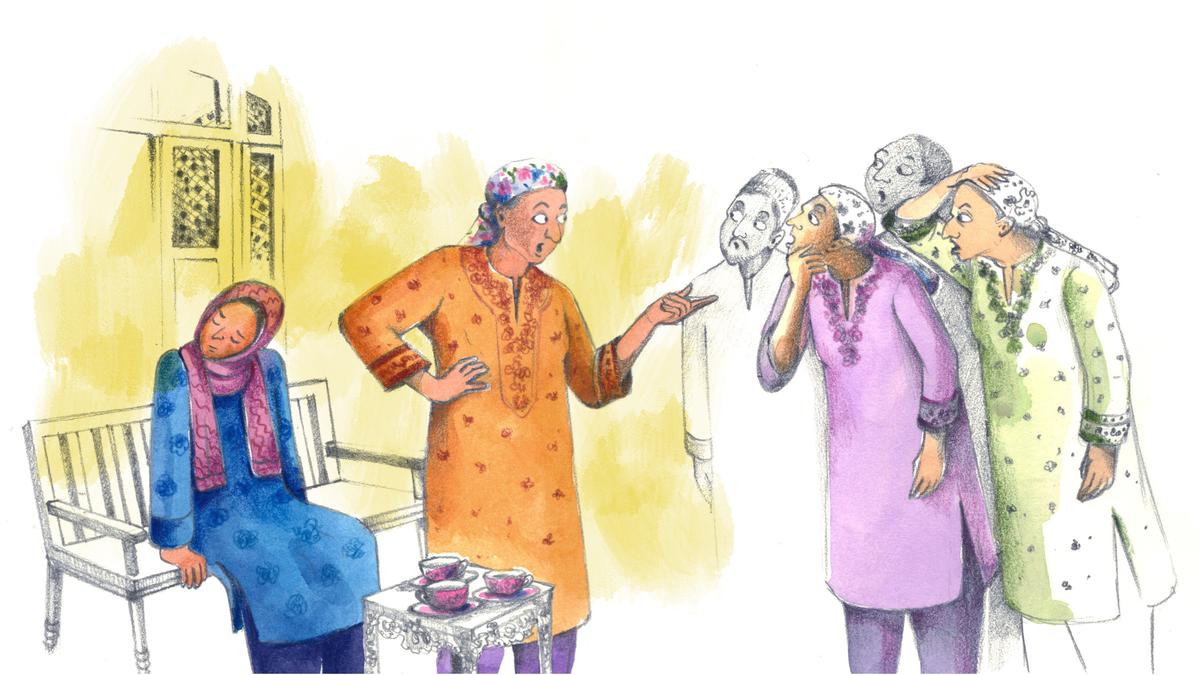
Early one afternoon in October, Masarat was carried in by her family into Phuphee’s house. She was miscarrying again, but she refused to be taken to the hospital. Phuphee brought Masarat into her room, ordered water to be boiled, and asked for towels and sheets to be sterilised. One of the helpers was sent off to get maetonji (the local English missionary nurse) and another was ordered to make nun chai (salt tea) for Masarat’s family.
I didn’t see Phuphee come out of her room for a long time. Maetonji arrived and kept bustling in and out of the room, but said nothing. A few hours later, Phuphee and matetonji came out together, and Phuphee walked her to the door. When she came back, Phuphee sat on the floor and said to Masarat’s mother, ‘Asyi karae waariyah koshish magar… (we tried a lot but…),’ and her voice trailed off. On hearing this, Masarat’s mother started wailing and beating her chest and pulling her hair.


76-year-old Kurian Jacob from Kerala triumphs with seven medals, including five golds, at the Open Masters Games in Abu Dhabi.

Explore the nature of the human mind as an emergent property of brain activity and complex neural interactions.

CERN's Large Hadron Collider discovers the Xi-cc-plus particle, enhancing understanding of quantum mechanics and baryon behavior.

Vibha Batra’s latest book, Spotless (Hachette India) is a novel in verse for young adults

In its first edition, the Madras Art Salon spotlights the works of journalist and artist Narayan Lakshman at The Botanical Club, a social space in the British Deputy High Commission, Chennai

Cholesterol enhances melanoma cell invasion by making nuclei squishier, revealing a potential treatment target in cancer progression.

The designers reinterpret the Swedish artist’s symbolic forms and colour energy through contemporary resortwear silhouettes

Discover the inspiring legacy of Bibha Chowdhuri, a pioneering woman in physics and a trailblazer in STEM history.

Discover the inspiring legacy of Bibha Chowdhuri, a pioneering woman in physics and a trailblazer in STEM history.

Ashdeen’s Spring 2026 collection features saris inspired by the designer’s Parsi gara archive

Red ochre burials, ritual markings and myths across cultures show that red repeatedly marks liminal thresholds such as puberty, sacrifice and death; anthropologists argue that the colour functions as a technology of collective ritual and value, binding communities through shared symbolic acts

India approves 23 institutions for quantum labs under the National Quantum Mission, aiming to advance quantum technology and research.

India approves 23 institutions for quantum labs under the National Quantum Mission, aiming to advance quantum technology and research.