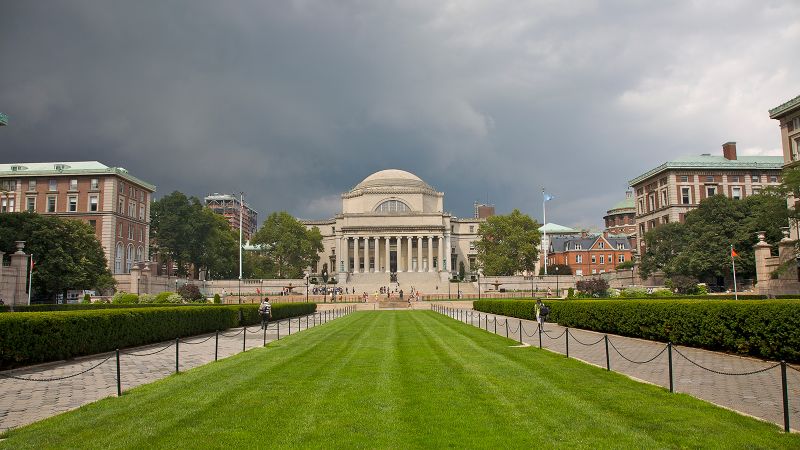
Columbia University ‘expediting’ investigation into Israeli history class disruption
CNN
The Ivy League university, an epicenter for protests last year, says it is “expediting” its investigation into a group who disrupted a class on Israeli history Tuesday.
Columbia University says it is “expediting” its investigation into a group who disrupted a class on Israeli history Tuesday. Demonstrators handed out flyers with “violent imagery” to students attending a History of Modern Israel class, the university said in a statement. It was the first day of Professor Avi Shilon’s class, and students had only just been introduced to the course when protesters – whose faces were covered and appeared to be wearing keffiyehs, a traditional Middle Eastern scarf often identified as a symbol of Palestinian identity – entered and distributed anti-Israel leaflets, student Elisha Baker told CNN. One flyer shows a burning Israeli flag underneath the words “Burn Zionism to the Ground,” and another depicts a large black boot about to stomp on the Jewish Star of David and reads “Crush Zionism,” according to pictures taken by Baker. “It was shocking for everyone in the class,” said Baker, a junior studying Middle Eastern history. “I’m still super excited for this class. It’s a shame that this incident is going to put us on edge inside the classroom.” As a result of the interruption, Columbia said it is intensifying its investigative efforts to identify the individuals involved as well as modifying its security measures. The school said it did not know if the demonstrators were students.


President Donald Trump has said ICE agents will head to US airports tomorrow amid a partial government shutdown. Follow for live updates

Cuba is working to restore the electricity supply after another island-wide blackout left more than 10 million people without power.

President Donald Trump said Sunday border czar Tom Homan will be in charge of deploying Immigration and Customs Enforcement agents to airports on Monday, with Homan telling CNN the agents will help with security at entrances and exits to ease the Transportation Security Administration’s workload.

Donald Trump wants us to believe that a deal with Cuba is close at hand. After this past week, I am not so sure.

President Donald Trump has said ICE agents will head to US airports tomorrow amid a partial government shutdown. Follow for live updates

President Donald Trump said Sunday border czar Tom Homan will be in charge of deploying Immigration and Customs Enforcement agents to airports on Monday, with Homan telling CNN the agents will assist with security at entrances and exits to ease TSA workload amid a partial government shutdown.

Janet Mills and her allies are counting on a gender gap to narrow Platner’s wide lead ahead of the June 9 primary to decide who will face incumbent Republican Sen. Susan Collins. They are betting that the unfiltered style that has brought Platner widespread attention as someone who could help Democrats reach young men will backfire with women.

Why do people “pledge allegiance” to a “state” that is no longer a state? And what spurs someone to not just attack innocent people, but to then make a statement of loyalty while doing so?

A Supreme Court case examining state deadlines for election ballots sent in the mail is just the tip of the spear in President Donald Trump’s war on mail-in voting.

As a shrinking number of Transportation Security Administration agents work to keep hourslong security lines moving despite not being paid, President Donald Trump stepped into the fray Saturday, announcing he will send Immigration and Customs Enforcement officers to airports by Monday if Congress doesn’t agree to a plan to end the partial government shutdown.

Donald Trump wants us to believe that a deal with Cuba is close at hand. After this past week, I am not so sure.

The search for missing 84-year-old Nancy Guthrie, mother of “Today” show host Savannah Guthrie, has stretched into another anguished week, with mounting pressure on investigators and a family grappling with uncertainty.

Cuba’s Ministry of Energy announced Saturday evening that entire island has suffered another electrical blackout, leaving more than 10 million people without power.