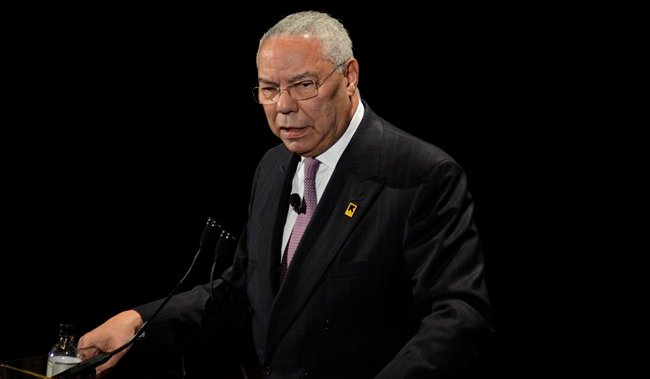
Colin Powell’s mixed legacy in the Black community
Global News
Powell, who died Monday of COVID-19 complications, spent 35 years in the Army and rose to political prominence under Republican presidents
As an American leader, Colin Powell’s credentials were impeccable: He was chairman of the Joint Chiefs and secretary of state. But his legacy as the first Black person in those roles is murkier, with some African Americans saying that his voice on their behalf could have been louder.
Powell, who died Monday of COVID-19 complications, spent 35 years in the Army and rose to political prominence under Republican presidents Ronald Reagan and George W. Bush. His stature fueled persistent speculation that he would one day run for president as a member of the GOP.
Through it all, Powell never seemed entirely comfortable talking about race, said Kevin Powell, a New York-based writer and rights activist who is not related to Colin Powell.
“I think that’s why a lot of Black folks never saw him as a leader. There was never a sense that Colin Powell was one of us,” said Kevin Powell, who met him in the 1990s, when he was often discussed as a potential presidential candidate.
Colin Powell later became disenchanted with the GOP and endorsed Democrats for president, starting with Barack Obama. Powell also called then-President Donald Trump a national disgrace and said he no longer considered himself a Republican following the Jan. 6 storming of the Capitol.
“By the time the Bush years were over, in 2009, he was largely invisible in a lot of things that happened — Trayvon Martin, Ferguson, George Floyd,” said Kevin Powell, who also is Black. “It was clear that the party he was part of was moving right. I don’t recall him ever saying this party has become nothing more than race mongers.”
But Powell’s dignity and composure should not be interpreted as any indication that he failed to understand the struggle of his people, according to Sam Riddle, an Army veteran and Detroit-based political activist.
“He personified a quiet inner strength that we knew he held on the battlefield for America and for Black Americans,” said Riddle, who also hosts a Detroit talk radio show. “The bullhorns we can use can be simply quiet competency, integrity and perseverance.”


NATO’s top commander, Gen. Alexus Grynkewich, confirmed earlier Friday that the alliance has pulled several hundred personnel out of Iraq and relocated them to Europe.

The Epstein files revealed consistent communication between the royal and Epstein, including after he was convicted of child sex trafficking offences in 2008.

Prime Minister Mark Carney endorsed a statement after it was released by allies Thursday, expressing willingness to contribute to efforts to reopen the Strait of Hormuz..

James 'Jimmy' Gracey was reported missing after he didn't return to the short-term rental where he was staying with friends during spring break.

The Mina Al-Ahmadi refinery in Kuwait, which can process some 730,000 barrels of oil per day, is one of the largest in the Middle East.

U.S. intelligence, military and law enforcement officials unanimously agreed that an intelligence assessment doubting a foreign role in the 'Havana syndrome' should be withdrawn.

The federal Conservatives accuse the government of being too secretive about the war and point out that Canada's allies are sharing such information openly at daily briefings.

Canada is amongst several nations who 'condemn in the strongest terms recent attacks by Iran on unarmed commercial vessels in the Gulf.'

Gas prices in Canada have been climbing sharply since the Iran war began, but how much higher they could go is unclear as consumers struggle with the higher cost of living.

The Oscar-winning actor has denied all allegations against him and maintains that the incidents raised in the lawsuits either did not happen or were consensual.

European leaders have deflected entreaties from U.S. President Donald Trump to send military assets to secure the Strait of Hormuz.

All six crew members of a KC-135 Air Force refueling aircraft were killed last week in a plane crash over friendly territory in western Iraq, supporting operations against Iran.

U.S. Director of National Intelligence Tulsi Gabbard testified that the regime remains intact and Tehran and its proxies remain capable of attacking U.S. and allies' interests.