Coimbatore summer camp guide 2025: Robotics, rifles, and more
The Hindu
Robotics, rifle shooting, Krav Maga and more: Some of the unique summer camps of Coimbatore in 2025
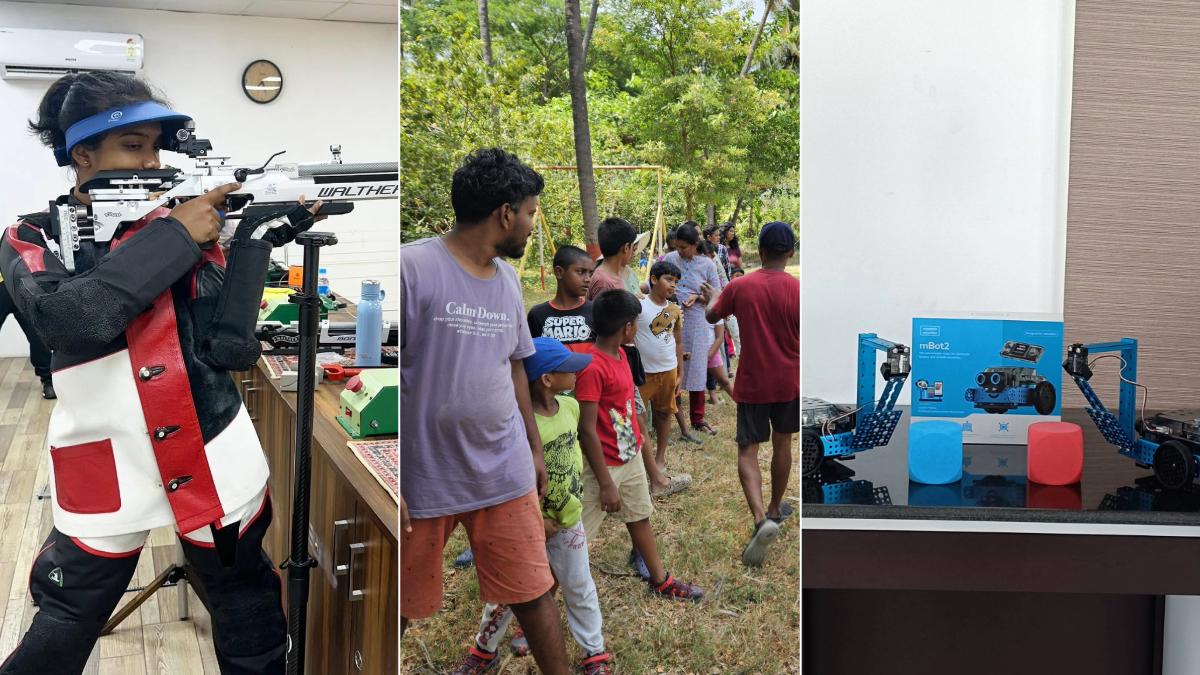
At Insight Rifle Club on Avinashi Road, summer is not just about play; it is about poise, precision, and personal growth. Their shooting summer camp, running from May 3 to 9, welcomes children aged nine and above into the world of air rifle shooting with a clear focus on safety, discipline, and individual development.
“When we first started, we had just four or five enrolments,” recalls Sindhu Parthasarathy, Chairperson of the club. “Today, we receive about 30 to 40 kids each summer, and most of our batches are definitely occupied.”
The camp is led by experienced professionals, including Sindhu herself — a multiple-time national shooter — and a senior coach who also trains the Indian junior team. Under their guidance, children begin with open sight air rifles, practising over 10 metres with large paper targets designed for beginners.
Safety, Sindhu emphasises, is paramount: “We teach safety measures from day one, both theoretical and practical. The rifles we use also have built-in child locks. Only when they’re ready do we switch them to firing mode.”
The benefits go beyond the target. “Shooting improves focus, composure, and bodily coordination,” she explains. “Children learn to synchronise their breathing, maintain balance, and handle the weapon with care and maturity. It helps them understand the importance of a routine — what they eat, how they sleep — all starts to matter.”
Parents often arrive with questions shaped by film or media, but the camp offers clarity. “We had a parent ask if we train with snipers,” she laughs. “They meant the peep-sight rifle, which is advanced but used in sports.”
Many young shooters from these camps go on to join regular classes and even compete nationally. “The camp helps gauge interest and commitment. At least 30% of our regulars started with summer camps.”


BTS’s comeback with ‘Arirang’ marks a major global music event. When does the album release, and where can you watch their concert live stream? We have all the details

The 2026 U.S. cholesterol guidelines urge starting screening and treatment at 30 to prevent cardiovascular disease effectively.

Olam Festival 2026 in Thiruvananthapuram returns March 27-29 with 120+ vendors, music, art, and cultural zones.

A few storytellers in Thiruvananthapuram share their journeys, challenges, and evolving methods on World Storytelling Day, inspiring young minds.

76-year-old Kurian Jacob from Kerala triumphs with seven medals, including five golds, at the Open Masters Games in Abu Dhabi.

Explore the nature of the human mind as an emergent property of brain activity and complex neural interactions.

CERN's Large Hadron Collider discovers the Xi-cc-plus particle, enhancing understanding of quantum mechanics and baryon behavior.

Vibha Batra’s latest book, Spotless (Hachette India) is a novel in verse for young adults

In its first edition, the Madras Art Salon spotlights the works of journalist and artist Narayan Lakshman at The Botanical Club, a social space in the British Deputy High Commission, Chennai

Cholesterol enhances melanoma cell invasion by making nuclei squishier, revealing a potential treatment target in cancer progression.

The designers reinterpret the Swedish artist’s symbolic forms and colour energy through contemporary resortwear silhouettes

Discover the inspiring legacy of Bibha Chowdhuri, a pioneering woman in physics and a trailblazer in STEM history.

Discover the inspiring legacy of Bibha Chowdhuri, a pioneering woman in physics and a trailblazer in STEM history.