Cock of the Walk
The Hindu
Discover the chaotic history of Chennai's Bus Day and Route Thala through the archives of The Hindu.
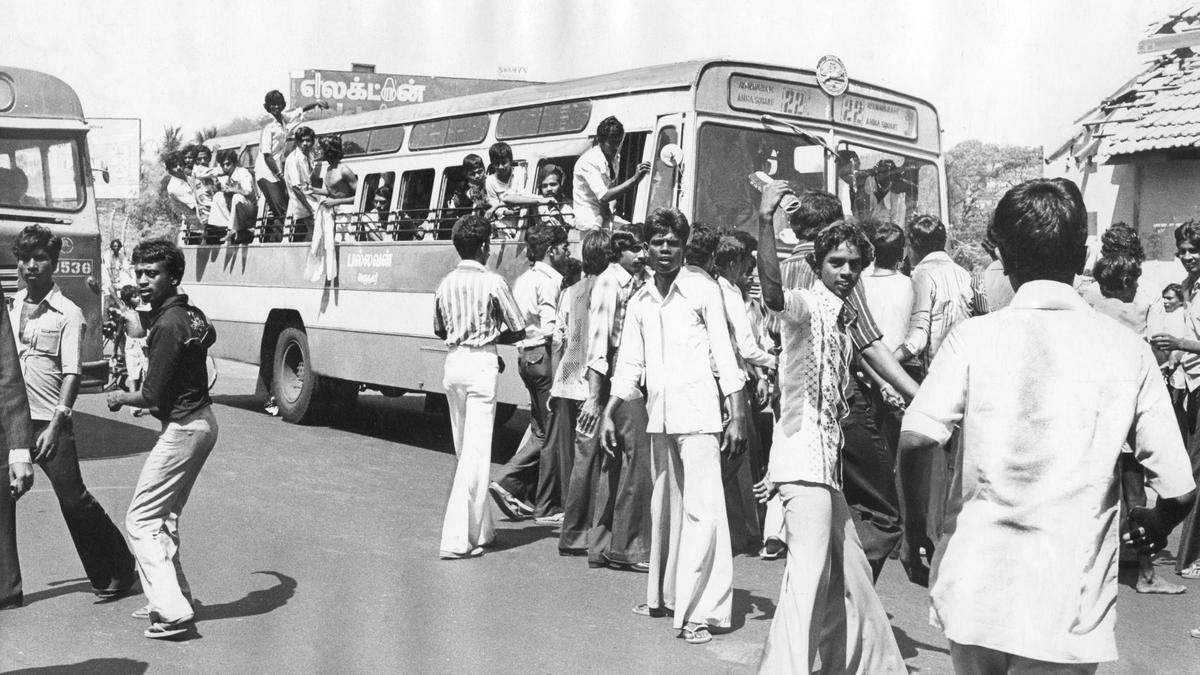
There is no accounting for what you will find in the archives of The Hindu. Is it even possible that something like Bus Day and Route Thala can have a chronological history? Well they do. It was on March 8, 1974, that the uniquely Chennai event known as Bus Day, was first noticed. The Hindu on March 9 reported that the Pallavan Transport Corporation was nonplussed and denied any knowledge of a “bus day” celebration. The event was new enough for The Hindu to publish a detailed note explaining what it was – “A group of college students decorated this morning a PTC bus flying from Parrys to Saidapet with festoons and banners. They merrily travelled in the bus up to Nandanam via Mount Road, several of them riding on the vehicle’s roof also.
Later the boisterous students virtually forced the driver to take the bus to the Marina where it was stopped by the traffic police. The boys who were asked to clear off the bus ran into a nearby canteen and caused some damage to property. They were however chased away. On a complaint from the manager of the canteen the police have registered a case.”
Bus Days are reported fairly regularly thereafter, always with the expression within quotes and it is only in the new millennium that they became commonplace enough for the quotes to vanish. But a report dating to July 10, 1997, is revealing. The paper does not mention institutions but says six colleges – “three in South Chennai, another at Chetpet and two in North Chennai” were the chief culprits. On this occasion, however, the offending students belonged to the Nandanam Arts College. The success in College Union elections had led to a demand for a victory bus procession. The PTC was reluctant to provide permission but “a police official intervened and supported students’ demand.” Therefore, students packed themselves into three buses and directed the drivers to take them to Anna Samadhi to pay homage. Many began dancing on top of the buses and the roof of one of the vehicles caved in causing minor injuries to students as well. The PTC and the police were clearly at loggerheads judging by the statements that followed. The students eventually were asked to compensate for the damages as can be seen in a sequel dating to August 22 (Madras Day!)
What could still be dismissed as juvenile expressions of energy took a serious turn in 2000. By then, Bus Day celebrations had a season – February/March – and were conducted across many colleges and as per a report in The Hindu dated April 2, there were as many as eight such events within the week across the city. Violence was beginning to manifest itself. Money was extorted from passing motorists and if they did not oblige branches from trees overhead were cut and thrown at them. The Hindu article spelt out the student-politician connect – the police were asked to soft-pedal the issue as the Assembly was in session. The MTC (by then the PTC had acquired a new name) on the other hand was clearly the victim – it pointed out the losses suffered in terms of revenue (a bus being hijacked for eight hours meant it was not available for routine services) and also the risk of injuries to students and passersby. But it consistently refused to file police complaints which indicated pressure from higher quarters.
The Hindu traces the manner in which Bus Days were slowly spiraling out of control. By 2007, the police is seen accompanying the buses. As a curtain raiser to the Bus Day season in 2007, P Oppili and L Srikrishna reported on how this was invariably a boys college problem. The women too observed Bus Day but in a very dignified manner – they invited the crew to their colleges, offered them refreshments and gifts and then discussed various issues of mutual interest. Why could men not be the same asked a police official off the record. Slowly, irate commuters joined the lists and began demanding an outright ban on Bus Days.
By 2011, the High Court of Madras was interesting itself in the matter. Even while hearings on this subject were in progress, students of Pachaiyappa’s College observed Bus Day on February 24, leading to large scale violence, including stoning of the police. On March 3 that year, the High Court ordered a ban on Bus Days. But they have continued since, though informally – a sudden boarding of a bus and dancing on its roof is a manifestation.
But a new development was the Route Thala or route leader. Rather akin to the cock of the walk, this involved the recognition of one person as the boss of a certain bus route. The position was bitterly contested and won amidst violence. It is generally a precursor to a successful career in politics. This too had a history - “It all started in the early 1980s, when some college students took to singing tweaked lyrics of film songs of that period. Irked over this, students of other colleges came up with ‘counter songs’. The cycle took an ugly turn when both sides took to facing off on bus routes,” recalled a police officer. This was as per The Hindu dated November 28, 2021.


CCB arrests three drug peddlers in Mangaluru, seizing ₹2.5 lakh worth of MDMA and other valuables.

TVK's 28 candidates in Puducherry include former BJP MLAs, a sitting Independent, and a retired police IG.

BRS submits notice on private member bill to Speaker

CPI-M accepts DMK's five-seat offer for Tamil Nadu Assembly elections, prioritizing INDIA bloc unity over seat demands.

Ricky Rai, son of former underworld operative Muthappa Rai, on Monday appeared before the Bengaluru Traffic Police for questioning in connection with a case involving a Lamborghini performing dangerous stunts at Anil Kumble Circle on March 21.

The Dispur election heats up as 'CongBJP' defections shape a high-stakes contest between veteran candidates from BJP and Congress.

Bengaluru's M. Chinnaswamy Stadium conducts readiness drill ahead of IPL 2026, ensuring upgrades and technical preparations are complete.

First-level randomisation of EVMs completed in Nagapattinam for upcoming elections, ensuring transparency and security.

A district-level committee in Krishnagiri has been formed to assess and verify seizure claims of goods and cash.

Minister Anam Ramanarayana Reddy pledges government support for local fishermen and farmers facing challenges in Andhra Pradesh.

MP M. Sribharat urges collective efforts to revive Visakhapatnam Steel Plant, highlighting key reforms for crucial recovery and growth.

141 candidates have filed nominations for Kozhikode's Assembly elections, with scrutiny on March 24 and campaigning intensifying.

BJP's Vijayendra accuses Congress of using money to influence Bagalkot bypolls, urging voters to reject their tactics.