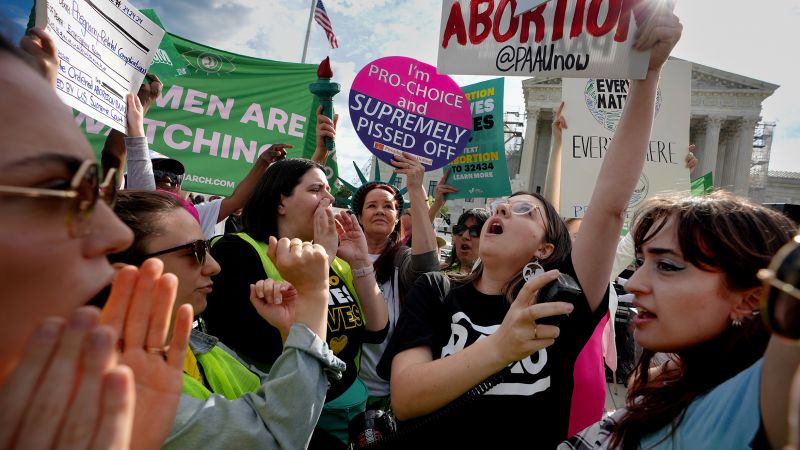
CNN Poll: Americans still broadly oppose overturning Roe; they’re less united on what abortion laws should look like
CNN
Nearly two years after the Supreme Court decision that overturned Roe v. Wade, Americans remain broadly opposed to the ruling, according to a new CNN poll conducted by SSRS. But in the midst of a presidential campaign where the major candidates offer starkly different approaches to the issue, the country is less united over how best to handle abortion laws, the survey finds.
Nearly two years after the Supreme Court decision that overturned Roe v. Wade, Americans remain broadly opposed to the ruling, according to a new CNN poll conducted by SSRS. But in the midst of a presidential campaign where the major candidates offer starkly different approaches to the issue, the country is less united over how best to handle abortion laws, the survey finds. The country’s widespread opposition to the 2022 Supreme Court decision, which held that women do not have a federal constitutional right to an abortion, does not translate into equally broad support for taking federal action to protect abortion access. Roughly half of US adults, 49%, want to see federal politicians work to enshrine abortion access nationally, while 37% say abortion laws should be left to states, and 14% call for nationwide restrictions. About two-thirds (65%) oppose the 2022 Supreme Court decision, Dobbs v. Jackson Women’s Health Organization, and 34% approve, numbers that have remained effectively unchanged in CNN’s polling across the nearly two years since the ruling. Those who strongly disapprove of the decision continue to outnumber those who strongly approve by a more than 2-to-1 margin. A 69% majority who disapprove of overturning Roe, including 82% of those who strongly disapprove, say that federal politicians should work to pass laws ensuring national abortion access. Those who support the ruling largely say federal politicians shouldn’t take action on the issue: 59% say laws on abortion should be left up to the states, with 29% in favor of further restrictions to abortion access nationwide. New national restrictions are supported by just about one-quarter of Republicans, White Evangelical Christians and those who describe themselves as conservative. The poll comes in the wake of two years of largely state-level skirmishes over abortion laws following the overturn of Roe – political fights with tangible consequences for residents’ access to abortion in those states. Last month, the Arizona Supreme Court ruled to revive a Civil War-era abortion ban in the state, which the state’s House voted last week to repeal. Overall, a 45% plurality of Americans say that the laws governing abortion in their own state are currently about right, similar to a year ago, with 37% calling them too restrictive and 17% too permissive.


President Donald Trump has said ICE agents will head to US airports tomorrow amid a partial government shutdown. Follow for live updates

Cuba is working to restore the electricity supply after another island-wide blackout left more than 10 million people without power.

President Donald Trump said Sunday border czar Tom Homan will be in charge of deploying Immigration and Customs Enforcement agents to airports on Monday, with Homan telling CNN the agents will help with security at entrances and exits to ease the Transportation Security Administration’s workload.

Donald Trump wants us to believe that a deal with Cuba is close at hand. After this past week, I am not so sure.

President Donald Trump has said ICE agents will head to US airports tomorrow amid a partial government shutdown. Follow for live updates

President Donald Trump said Sunday border czar Tom Homan will be in charge of deploying Immigration and Customs Enforcement agents to airports on Monday, with Homan telling CNN the agents will assist with security at entrances and exits to ease TSA workload amid a partial government shutdown.

Janet Mills and her allies are counting on a gender gap to narrow Platner’s wide lead ahead of the June 9 primary to decide who will face incumbent Republican Sen. Susan Collins. They are betting that the unfiltered style that has brought Platner widespread attention as someone who could help Democrats reach young men will backfire with women.

Why do people “pledge allegiance” to a “state” that is no longer a state? And what spurs someone to not just attack innocent people, but to then make a statement of loyalty while doing so?

A Supreme Court case examining state deadlines for election ballots sent in the mail is just the tip of the spear in President Donald Trump’s war on mail-in voting.

As a shrinking number of Transportation Security Administration agents work to keep hourslong security lines moving despite not being paid, President Donald Trump stepped into the fray Saturday, announcing he will send Immigration and Customs Enforcement officers to airports by Monday if Congress doesn’t agree to a plan to end the partial government shutdown.

Donald Trump wants us to believe that a deal with Cuba is close at hand. After this past week, I am not so sure.

The search for missing 84-year-old Nancy Guthrie, mother of “Today” show host Savannah Guthrie, has stretched into another anguished week, with mounting pressure on investigators and a family grappling with uncertainty.

Cuba’s Ministry of Energy announced Saturday evening that entire island has suffered another electrical blackout, leaving more than 10 million people without power.