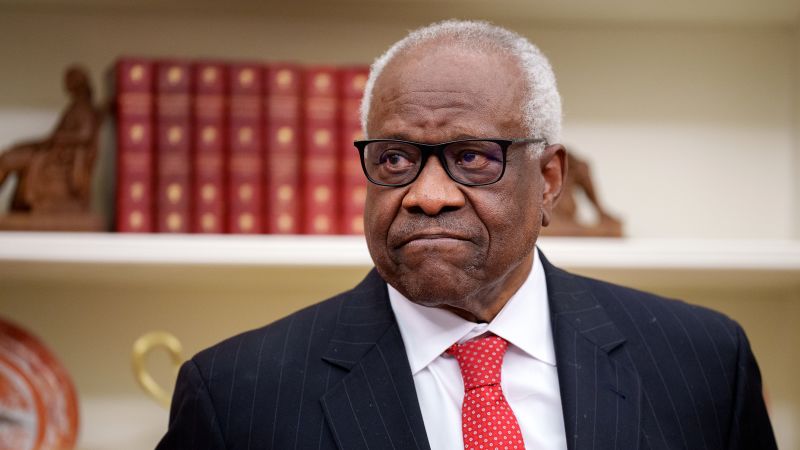
Clarence Thomas has long tried to undercut the Voting Rights Act. Now, he may finally have the numbers
CNN
Supreme Court Justice Clarence Thomas has been imploring his colleagues for decades to gut a crucial part of the iconic Voting Rights Act that prohibits practices denying Blacks, Hispanics and other racial minorities an equal right to vote.
Supreme Court Justice Clarence Thomas has been imploring his colleagues for decades to gut a crucial part of the iconic Voting Rights Act that prohibits practices denying Blacks, Hispanics and other racial minorities an equal right to vote. When Thomas first laid out his objections in 1994, insisting that the act was exacerbating rather than easing “racial tensions,” several colleagues called his position “radical,” and only Antonin Scalia endorsed it. But as more right-wing justices have joined the court, the views of Thomas, a conservative African American, have gained traction. Now, a mysterious order from the high court in a Louisiana redistricting case suggests it is seriously reconsidering the scope of VRA safeguards against congressional and state legislative district maps that dilute minority votes. The looming battle comes as some states, notably Alabama, are resisting court orders to remedy discrimination, and President Donald Trump’s Justice Department is abandoning the federal government’s usual role in protecting minority voting rights. The justices’ eventual action on this case and other simmering controversies, which would affect congressional maps used in the 2026 elections and beyond, could lead to a retrenchment of practices that consider race to ensure that minorities are not put at a disadvantage. The entire debate necessarily acquires a partisan dimension as Blacks and other minority voters tend to lean Democratic. The stakes in the Louisiana dispute pending at the high court rose when the justices on June 27, the last day of their regular session, revealed that they had not been able to resolve the case that had been argued in March. The justices announced it would be reargued in the upcoming session that begins in October and that they’d issue a subsequent order regarding additional ground to be covered.


An Air Canada plane was damaged after colliding with a vehicle on a runway at New York’s LaGuardia Airport Monday, according to video from the scene and air traffic control audio.

A statue of Christopher Columbus has been erected outside of an ornate federal office building on the White House grounds — the latest sign of the Trump administration’s efforts to reshape cultural and historical representations across the nation’s capital.

Kentucky Gov. Andy Beshear, speaking in JD Vance’s home state of Ohio on Saturday, tore into the vice president, questioning his Appalachian roots and telling voters they “deserve better.”

President Donald Trump has said ICE agents will head to US airports tomorrow amid a partial government shutdown. Follow for live updates

Cuba is working to restore the electricity supply after another island-wide blackout left more than 10 million people without power.

President Donald Trump said Sunday border czar Tom Homan will be in charge of deploying Immigration and Customs Enforcement agents to airports on Monday, with Homan telling CNN the agents will help with security at entrances and exits to ease the Transportation Security Administration’s workload.

Donald Trump wants us to believe that a deal with Cuba is close at hand. After this past week, I am not so sure.

President Donald Trump has said ICE agents will head to US airports tomorrow amid a partial government shutdown. Follow for live updates

President Donald Trump said Sunday border czar Tom Homan will be in charge of deploying Immigration and Customs Enforcement agents to airports on Monday, with Homan telling CNN the agents will assist with security at entrances and exits to ease TSA workload amid a partial government shutdown.

Janet Mills and her allies are counting on a gender gap to narrow Platner’s wide lead ahead of the June 9 primary to decide who will face incumbent Republican Sen. Susan Collins. They are betting that the unfiltered style that has brought Platner widespread attention as someone who could help Democrats reach young men will backfire with women.

Why do people “pledge allegiance” to a “state” that is no longer a state? And what spurs someone to not just attack innocent people, but to then make a statement of loyalty while doing so?

A Supreme Court case examining state deadlines for election ballots sent in the mail is just the tip of the spear in President Donald Trump’s war on mail-in voting.

As a shrinking number of Transportation Security Administration agents work to keep hourslong security lines moving despite not being paid, President Donald Trump stepped into the fray Saturday, announcing he will send Immigration and Customs Enforcement officers to airports by Monday if Congress doesn’t agree to a plan to end the partial government shutdown.