Circadian rhythms: how your body’s internal clock regulates your health Premium
The Hindu
Understanding the importance of circadian rhythms in maintaining health and wellness through sleep, diet, and exercise.
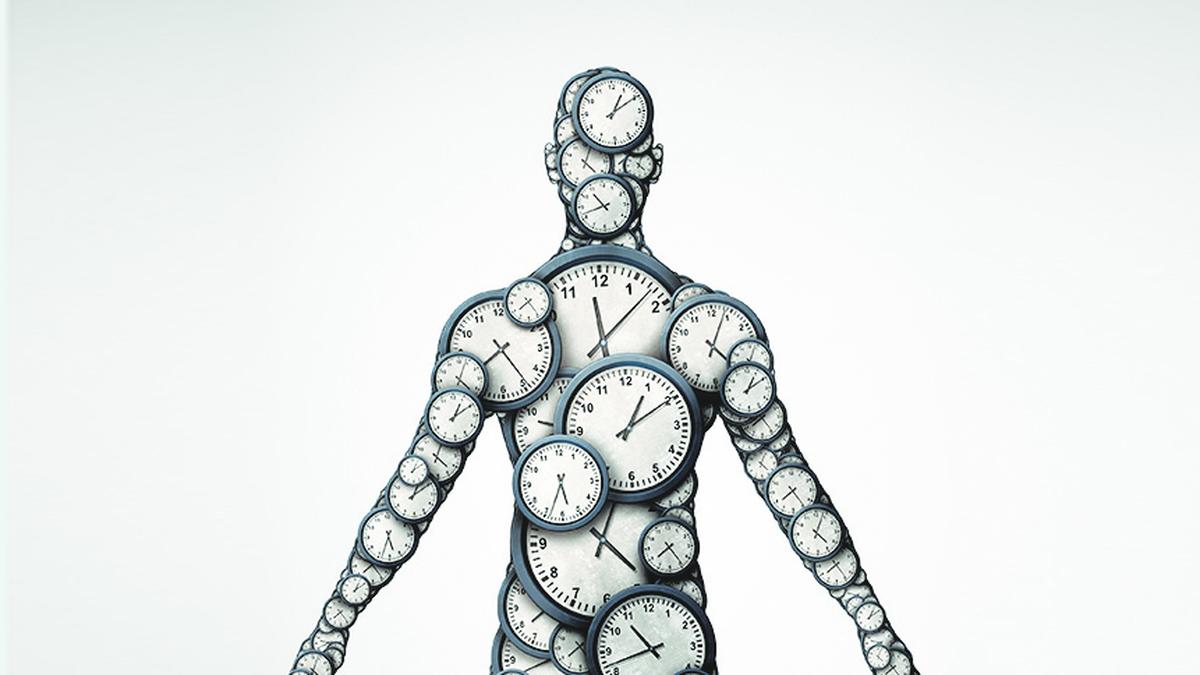
Awake all night? Taken a flight across time zones? Each of these events makes us tired, grumpy and out-of-sorts. A short nap may not be enough to catch up on either sleep or a sense of wellness, because the biological rhythm of the body has been disrupted.
There are many biological rhythms in nature, one rhythm familiar to all, is the seasonal flowering of plants. Another such rhythm is the 24-hour-cycle circadian rhythm. The word ‘circadian’ is derived from the Latin words circa which means ‘about’ and dies meaning day. The earth’s day-night cycle directly impacts the biological clock of all living organisms, including plants and microorganisms.
The French astronomer Jean Jacques d’Ortous de Mairan was the first to observe circadian rhythms in the Mimosa plant. He observed that the plant unfurled its leaves in the morning and closed them in the evening. This behaviour continued despite the plant being kept in the dark, and was the first demonstration that the behaviour of leaves could continue, independent of light input.
The molecules that control circadian rhythms were discovered in the 1960s through Ronald J. Konopka’s elegant work with Seymour Benzer. He discovered the period or per gene, whose variants either shortened, lengthened or abrogated the 24-hour circadian rhythm of the fruit fly, Drosophila. This showed that the period gene was a component of the 24-hour clock, and not its output. In the 1980s and 1990s, Jeffrey Hall, Michael Rosbash, and Michael Young built on Konopka’s work identifying: (i) the cycling expression of the period gene that was entrained by light, (ii) light-sensitive genes like timeless and cryptochromes, that act along with the period and (iii) feedback regulation that led to the cycling of the period protein. This pioneering research laid the foundations of understanding how the central 24-hour circadian clock operated in the fruit fly brain. Their work was awarded the Nobel Prize in Physiology (Medicine) in 2017.
Joseph Takahashi’s work in mice showed that central clock genes in this organism were similar to those identified in fruit flies, and these genes showed similar light-dependent feedback regulation. Such experiments revealed the existence of an evolutionarily conserved ancient mechanism to tie light input from the natural rotation of the earth to cycling molecules in the brain.
A ‘master’ clock called the suprachiasmatic nucleus (SCN) is present in the brain and consists of both neurons and supporting glial cells. This master clock drives several peripheral clocks in the heart, liver, spleen, skin, skeletal muscles, lungs, gastrointestinal tract, etc.
The SCN integrates several sensory inputs called zeitgebers which mean ‘time givers’. Zeitgebers for the circadian clock include light, food, noise, stress, social environment and temperature. Among these, light is the strongest zeitgeber. The process of synchronisation of the circadian clock in response to external cues is called ‘entrainment’. Light is sensed by the photosensitive retinal ganglion cells and transmits information to the SCN, which in turn synchronises the peripheral clocks of the body. Exposure to light at dawn advances and entrains the clock and at dusk delays the clock. This entrainment releases hormones, such as cortisol to help us wake up and stay alert (activity rhythm) and suppresses melatonin, the hormone that assists sleep and is sometimes used as a sleep aid to help with jet lag. Aside from these ‘activity rhythms’, these released molecules control feeding, blood pressure and body temperature.


Discover the Minor Planet Centre, the key hub for tracking and verifying observations of small solar system bodies.

Discover the Minor Planet Centre, the key hub for tracking and verifying observations of small solar system bodies.

In this week's Science for All newsletter, XX explains

Test your knowledge with the quiz on Science films at the Oscars through history

Set between the Siwalik hills and the plains, Butwal offers travellers a mix of regional cuisine, pilgrimage trails to Lumbini and the comfort of Hyatt’s new hospitality landmark

Explore 2026's wallpaper trends in India, highlighting botanicals and handmade designs that enhance modern homes with nature-inspired aesthetics.

Mercedes-Benz CLA 250+ with EQ Technology review: design, performance, range and features explained. Discover how the new electric CLA combines advanced AI, long range, fast charging and futuristic styling for the next generation of luxury EVs.

AI tool for sparrow conservation

BTS’s comeback with ‘Arirang’ marks a major global music event. When does the album release, and where can you watch their concert live stream? We have all the details

The 2026 U.S. cholesterol guidelines urge starting screening and treatment at 30 to prevent cardiovascular disease effectively.

Olam Festival 2026 in Thiruvananthapuram returns March 27-29 with 120+ vendors, music, art, and cultural zones.

A few storytellers in Thiruvananthapuram share their journeys, challenges, and evolving methods on World Storytelling Day, inspiring young minds.

76-year-old Kurian Jacob from Kerala triumphs with seven medals, including five golds, at the Open Masters Games in Abu Dhabi.