China will ‘significantly’ increase spending to revive economic growth
CNN
China will “significantly increase” government debt issuance to offer subsidies to people with low incomes, support the property market and replenish banks’ capital.
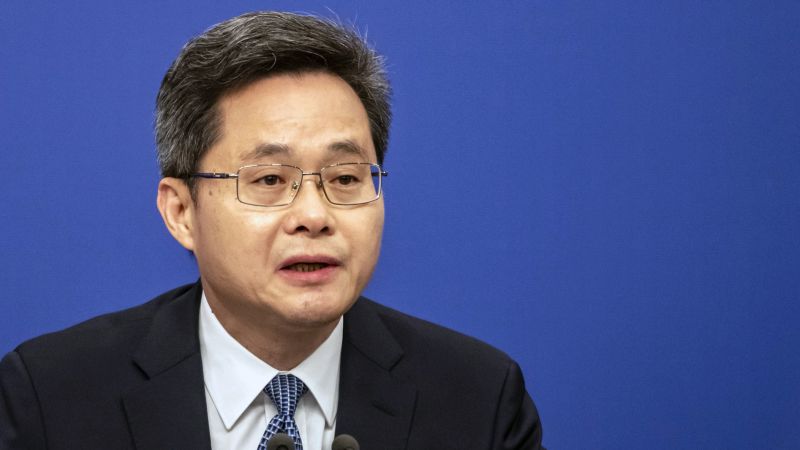
China will “significantly increase” government debt issuance to offer subsidies to people with low incomes, support the property market and replenish state banks’ capital as it pushes to revive sputtering economic growth. Without providing details on the size of the fiscal stimulus being prepared, Finance Minister Lan Foan told a news conference on Saturday there will be more “counter-cyclical measures” this year. “There is still relatively big room for China to issue debt,” he said. The world’s second-largest economy faces strong deflationary pressures due to a sharp property market downturn and frail consumer confidence, which have exposed its over-reliance on exports in an increasingly tense global trade environment. A wide range of economic data in recent months has missed forecasts, raising concerns among economists and investors that the government’s roughly 5% growth target this year was at risk and that a longer-term structural slowdown could be in play. Data for September, which will be released over the coming week, is expected to show further weakness, but Zheng Shanjie, the chairman of the National Development and Reform Commission (NDRC), China’s state planner, said he was “fully confident” that the target will be met.


Artificial intelligence could widen the problem of income inequality, said BlackRock CEO Larry Fink in his annual letter to shareholders.

Stocks soared and oil prices fell after President Donald Trump on Monday said the United States would postpone further strikes on Iran’s energy infrastructure, pending the outcome of negotiations.

The national average price for a gallon of regular unleaded gasoline is on the verge of hitting $4 for the first time since 2022.

Oil prices rose Monday after the United States and Iran threatened fresh attacks on energy facilities in the Middle East, including power plants, signaling that the conflict may yet escalate.

The war in Iran is pushing up prices for already-strained farmers, with higher costs for fertilizer and energy on top of last year’s tariffs. And the increasing pressure on American agriculture could lead to even bigger price tags at the grocery store.

If you only watched Fox News over the weekend, you didn’t hear about President Donald Trump’s widely condemned reaction to Robert Mueller’s death.

Oil prices rose Sunday after President Donald Trump threatened to “obliterate” Iran’s power plants if the Strait of Hormuz is not reopened by Monday evening.

Defense Secretary Pete Hegseth has been taking steps to thwart news coverage of the Pentagon for more than a year. Now he has finally met some resistance.

Defense Secretary Pete Hegseth has been taking steps to thwart news coverage of the Pentagon for more than a year. Now he has finally met some resistance.

Gerald Rodriguez, the general manager of an NPR affiliate in rural Colorado, expected federal funding for public media to shrink. He didn’t expect it to disappear almost overnight.

The much-touted new tax breaks for tips, overtime, seniors and car loan interest have a lot of income tax filers expecting a big bump in their refunds this year – or a big cut in their tax bill.

Looking out his shop window, across the street, just to the right, Paloma Clothing co-owner Mike Roach sees one of Portland, Oregon’s, most expensive gas stations.

Oil and liquefied natural gas tankers moving through the Strait of Hormuz carry around 20% of the world’s supply. But for countries on the Persian Gulf, the waterway is more than just an energy route – it’s a lifeline for more than 100 million people.