China’s “wolf warrior” era
The Hindu
Xi Jinping’s worldview carries with it an inherent contradiction — that of a world that is simultaneously China’s to lead and one that is apparently full of external threats. This paradox, more than any other factor, has shaped China’s diplomacy in the past decade
“Defend every inch of our land!”, reads a sign in Beijing’s Military Museum, which, to mark the Chinese military’s 95th anniversary, opened a sprawling exhibit earlier this year. Divided into four sections, the exhibition went deep into the past of the People’s Liberation Army (PLA), unique among militaries in serving not a state but a single political party. The largest sections were devoted to the contributions of Mao in building a revolutionary army, and to the current leader, Xi Jinping, for building a “strong country” (“qiang guo”).
The corner of the exhibition where the sign has been displayed showcases stones from the Karakoram mountains along the India-China border as well as images from the June 2020 Galwan Valley clash, declaring that the Chinese military will do everything “to protect sovereignty”.
As Mr. Xi completes a decade in office and begins an unprecedented third term at the Communist Party’s 20th Party Congress which begins on October 16, “qiang guo” has become the short but sharp phrase of choice that sums up his view of China’s place in the world. Past maxims of China’s “peaceful rise” and “biding time, hiding brightness” have been given a quiet burial. The thrust of Mr. Xi’s argument is that China’s time has come. At the party’s previous congress in 2017, he declared China was “moving to the centre stage of the world”. His other favourite maxim is to declare that “the West was declining and the East was rising” in what he has repeatedly called a world witnessing “changes unseen in a century”.
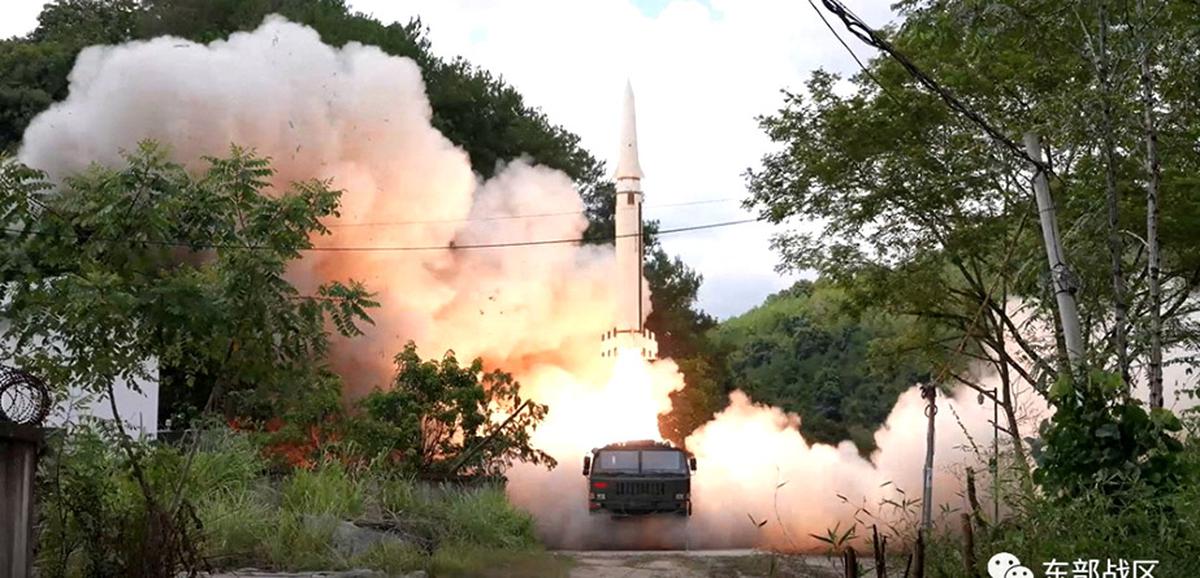
At this turning point, Mr. Xi has emphasised not only opportunities for China — taking the “centre stage” — but peril that lurks in every corner in a global order, that he has often described as being in turmoil, even chaos. Mr. Xi presents the Communist Party under his leadership as China’s defence against this “chaos” and as leading what he calls the country’s “great rejuvenation”. This inherent contradiction in Mr. Xi’s worldview — of a world that is simultaneously China’s to lead and one that is apparently full of external threats — has arguably, more than any other factor, shaped China’s diplomacy in the past decade. China’s foreign policy appears to be caught between, on the one hand, presenting itself as the saviour of the UN-centred world order and globalisation — building, as Mr. Xi has christened, “a community of shared destiny” — and on the other, pursuing China’s core interests ever more aggressively, dubbed the ‘wolf warrior’ approach after a Chinese action hero, regardless of the consequences, from the mountains of Ladakh and the South China Sea to most recently, the waters around Taiwan.
The launch of the Belt and Road Initiative (BRI) in 2013 was Mr. Xi’s signature foreign policy initiative and a platform to stake China’s claim to global leadership. According to the estimates of the Green Finance and Development Centre at Shanghai’s Fudan University, over the past decade, the total value of projects and investments through the BRI stands at over $930 billion. But more than the infrastructure projects and investments in connectivity, the biggest success of the BRI — which ten years later remains an amorphous and hard-to-define initiative, more an idea than an actual project — has been in furthering a narrative of the inevitability of China’s rise.
The BRI, much like China’s global ambitions, stands at an inflection point. Beijing today is facing criticism for rising debt levels in many partner countries and for unsustainability in some of its projects. Criticism aside, the fact that indebted partners have only returned to Beijing for more assistance underlines the reality of China’s economic muscle, as well as an apparent push to evolve the BRI away from a hard-infrastructure focus to a wider array of financial assistance. Consider Pakistan and Sri Lanka, which have received more than $26 billion from China in the past five years, and dealing with financial crises, are turning not only to the International Monetary Fund (IMF) but again, to Beijing.
Beyond the BRI, rising China-U.S. rivalry and deepening China-Russia ties have been perhaps the clearest markers of the direction of China’s foreign policy in the Xi era. As relations with Washington torpedoed during the Donald Trump administration, Beijing has increasingly sought to present itself as the defender of a world order that in its view the U.S. was seeking to wreck. Mr. Xi, in recent speeches, has repeatedly referred to a world facing two paths — one of disorder caused by “small cliques”, as China refers to the U.S. and its allies, and the other his “community of shared destiny”.


Trump claims “very good” talks with Iran, despite Tehran’s denial, as U.S. negotiators plan potential meetings in Pakistan.

Netanyahu discusses U.S.-Israeli military gains with Trump, emphasizing commitment to protect Israel's interests amid ongoing conflicts.

Pakistan reaffirms commitment to combat terrorism as Afghan ceasefire approaches end amid rising tensions and recent casualties.

Trump postpones military strikes on Iranian power plants for five days amid escalating tensions and ongoing diplomatic discussions.

Shorts News:Watch: NATO chief: 22-nation group forming to secure Strait of Hormuz

Saudi Aramco reduces crude supply to Asia for April, citing disruptions from the Iran-Israel conflict affecting trade routes.

Tencent launched a tool on Sunday to integrate its WeChat messaging platform with the OpenClaw agent

An Air Canada flight collided with a Port Authority vehicle at LaGuardia Airport, causing significant damage and police response.

Saudi Arabia and the UAE face missile attacks, with casualties reported and air defenses engaged amid escalating regional tensions.

Slovenia's parliamentary election results show a tight race between liberals and populists, signaling potential political instability ahead.

IEA chief warns of a potential energy crisis worse than the 1970s, with 11 million barrels lost daily amid regional conflicts.

Cuba begins restoring power after a nationwide grid collapse, affecting thousands amid an ongoing energy crisis and blackouts.

The Hindu LIVE updates on March 23 2026 on Iran-Israel war. Iran faces deadline of US President Donald Trump warning to open Strait of Hormuz