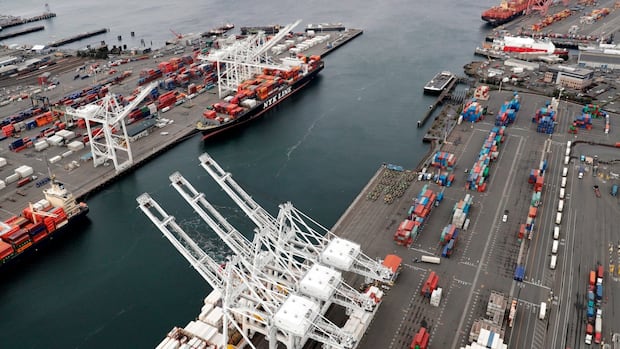
China exempts some U.S. imports from 125% tariff rate
CBC
China has exempted some U.S. imports from its 125 per cent tariffs and is asking firms to identify critical goods they need levy-free, according to businesses that have been notified.
The move, which follows de-escalatory statements from Washington, signals that the world's two largest economies might be prepared to rein in their conflict, which had frozen much of the trade between them and raised fears of a global recession.
Beijing's exemptions — which business groups hope might extend to dozens of industries — pushed the U.S. dollar up slightly and lifted equity markets in Hong Kong and Japan.
"As a quid-pro-quo move, it could provide a potential way to de-escalate tensions," said Alfredo Montufar-Helu, a senior adviser to the Conference Board's China Center, a think-tank.
But he cautioned: "It's clear that neither the U.S. nor China want to be the first in reaching out for a deal."
China has not communicated publicly on any exemptions.
U.S. President Donald Trump told Time magazine in an interview that U.S.-China talks were taking place on tariffs and that Chinese President Xi Jinping had called him.
"He's called. And I don't think that's a sign of weakness on his behalf," Trump told the magazine. He did not say when Xi called or what the two leaders discussed.
Beijing has so far disputed the U.S. characterization of talks — the Chinese embassy said again on Friday that there have been no talks between the two countries, adding in a statement that the U.S. should "stop creating confusion."
A Friday statement by the Politburo, the Communist Party's elite decision-making body, focused on efforts to maintain stability at home by supporting firms and workers most affected by tariffs.
The readout, which followed the Politburo's regular monthly meeting, showed that Beijing was also ready to hunker down and fight a trade war of attrition if needed to outlast Washington in enduring trade war pain.
A Ministry of Commerce task force is collecting lists of items that could be exempted from tariffs and is asking companies to submit their own requests, according to a person with knowledge of that outreach.
The ministry said on Thursday it had held a meeting with more than 80 foreign companies and business chambers in China to discuss the impact of U.S. tariffs on investment and the operation of foreign firms.
"The Chinese government, for example, has been asking our companies what sort of things are you importing to China from the U.S. that you cannot find anywhere else and so would shut down your supply chain," American Chamber of Commerce in China President Michael Hart said.


The former secretary general of NATO says he doesn't think allies will be pulled further into the conflict in the Middle East, but he's concerned the ongoing war with Iran will benefit Russia's economy and take the world's attention away from the invasion of Ukraine.

As American and Israeli strikes pound Iran — while it attacks shipping and energy infrastructure across the Persian Gulf — U.S. President Donald Trump made a new threat to Tehran's leaders.

The armed man who rammed his vehicle into one of the largest Reform synagogues in the U.S. Thursday has been identified as a 41-year-old naturalized citizen born in Lebanon, according to federal officials.

With jagged cliffs rising from the Arabian Sea, the Strait of Hormuz is striking in its scenery — and these days, its emptiness. This resource superhighway, which normally hosts more than a hundred of the world’s largest oil and liquid natural gas (LNG) tankers every day, has seen no more than a handful all week.

The Canadian government said Tuesday it is alarmed by the escalation of violence and attacks in Lebanon, as the war in the Middle East expands.

In a resounding victory that is guaranteed to reshape Nepal's politics, rapper-turned-politician Balendra Shah appeared headed for a landslide win in the South Asian country's first polls since youth-led protests toppled the previous government last fall.

China’s latest blueprint for driving growth in its economy was largely written before the U.S. and Israel instigated the most far-reaching war in the Middle East in decades.

U.S. President Donald Trump's firing of Homeland Security Secretary Kristi Noem on Thursday overshadowed the announcement of his plans to nominate Republican Sen. Markwayne Mullin as her successor.

The truck carrying Nepali prime ministerial candidate Balendra Shah was swarmed by cheering supporters in the capital, Kathmandu, on Saturday, unable to inch forward as the former rapper, wearing sunglasses and a sleek black suit, danced on top of the roof.

Israel sent troops into southern Lebanon on Tuesday and warned residents of more than 80 villages to evacuate as the Iran-backed militant Hezbollah group said it was ready for an "open war" with Israel in the wake of the U.S.-Israeli war with Iran.

U.S. President Donald Trump has given Americans a short list of his objectives in attacking Iran, but when it comes to the justification for launching the war and how the conflict is expected to play out, he and his team are sending mixed messages.

Omid Golabkesh dragged his suitcase down a long hallway marking the exit of the Kapikoy border crossing in eastern Turkey. He had nearly reached the end of an exhausting journey that included a 12-hour drive to the checkpoint from his home in Tehran.