Children face starvation in Gaza as Israel's blockade of food, medication reaches 2 months
CBC
WARNING: This story contains images of severely malnourished children.
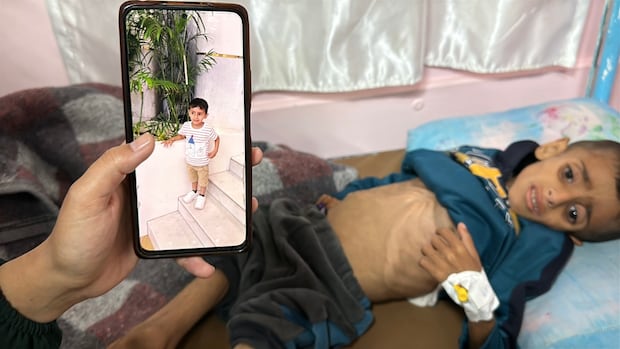
Mona Al-Raqab glances at a photo of her son, a once-healthy preschooler, from before the war in Gaza. Now five, he lies in a hospital bed emaciated, with his ribcage and bones protruding.
"The last time he ate meat was the first day of Ramadan [Feb. 28]," Mona told CBC News on April 25 from Nasser Hospital, in the southern Gaza city of Khan Younis.
"And after that, it just wasn't affordable. Now, everyday his condition is worsening."
Osama suffers from severe malnutrition and malabsorption, which causes difficulty in the digestion or absorption of nutrients from food. Gaza's Health Ministry says roughly 60,000 children are currently showing signs of malnutrition amid the renewed bombardment and Israeli-imposed blockade on goods entering the besieged Palestinian territory.
He weighs about 20 pounds, roughly 13 pounds less than what doctors say his weight should be, Mona said. The toll of the total blockade, which has been in place since March 2, has significantly worsened his condition.
Osama, lying in bed frail and weak, pleads with his mother: "I want to leave."
For two months now, Israel has blocked the entry of medical, fuel and food supplies into the war-torn territory — the longest such closure the Gaza Strip has ever faced. Aid organizations, including the Red Cross, have since sounded the alarm, saying the humanitarian response in Gaza was on the verge of "total collapse."
The United Nations Office for the Co-ordination of Humanitarian Affairs (OCHA) has also warned of acute malnutrition worsening among children in Gaza.
Because of malnutrition throughout the war in Gaza, Osama requires a high-protein diet and special medication, his mother said, adding that he has not had access to due to the blockade. Before the blockade, Mona said she would be able to feed her son small portions of eggs, avocado, nuts and chicken. But after March 2, she said prices of food became exorbitant and unaffordable, before food supplies further depleted.
"I fear for my son's life," she said, urging international groups to press for an immediate evacuation for Osama to seek medical treatment.
Hani Al-Fleet, head of the pediatric department at Al-Aqsa Martyrs Hospital, said the hospital is treating a significant amount of malnutrition cases in babies aged one year or under.
"The worst is coming, in my opinion, because long-standing malnutrition will lead to starvation and starvation treatment is much more difficult to treat," Al-Fleet told CBC News on April 26.
Mahmoud Taleb Al-Kahlout says his six-month-old daughter, Ghazal, is suffering due to the lack of treatment in the territory.


Arab Gulf states reported new missile and drone attacks on Sunday after Iran threatened to widen its campaign as the war in the Middle East entered its third week.


The former secretary general of NATO says he doesn't think allies will be pulled further into the conflict in the Middle East, but he's concerned the ongoing war with Iran will benefit Russia's economy and take the world's attention away from the invasion of Ukraine.

As American and Israeli strikes pound Iran — while it attacks shipping and energy infrastructure across the Persian Gulf — U.S. President Donald Trump made a new threat to Tehran's leaders.

The armed man who rammed his vehicle into one of the largest Reform synagogues in the U.S. Thursday has been identified as a 41-year-old naturalized citizen born in Lebanon, according to federal officials.

With jagged cliffs rising from the Arabian Sea, the Strait of Hormuz is striking in its scenery — and these days, its emptiness. This resource superhighway, which normally hosts more than a hundred of the world’s largest oil and liquid natural gas (LNG) tankers every day, has seen no more than a handful all week.

The Canadian government said Tuesday it is alarmed by the escalation of violence and attacks in Lebanon, as the war in the Middle East expands.

In a resounding victory that is guaranteed to reshape Nepal's politics, rapper-turned-politician Balendra Shah appeared headed for a landslide win in the South Asian country's first polls since youth-led protests toppled the previous government last fall.

China’s latest blueprint for driving growth in its economy was largely written before the U.S. and Israel instigated the most far-reaching war in the Middle East in decades.

U.S. President Donald Trump's firing of Homeland Security Secretary Kristi Noem on Thursday overshadowed the announcement of his plans to nominate Republican Sen. Markwayne Mullin as her successor.

The truck carrying Nepali prime ministerial candidate Balendra Shah was swarmed by cheering supporters in the capital, Kathmandu, on Saturday, unable to inch forward as the former rapper, wearing sunglasses and a sleek black suit, danced on top of the roof.

Israel sent troops into southern Lebanon on Tuesday and warned residents of more than 80 villages to evacuate as the Iran-backed militant Hezbollah group said it was ready for an "open war" with Israel in the wake of the U.S.-Israeli war with Iran.

U.S. President Donald Trump has given Americans a short list of his objectives in attacking Iran, but when it comes to the justification for launching the war and how the conflict is expected to play out, he and his team are sending mixed messages.