Chepauk and its colourful legacy of delivering classics Premium
The Hindu
Chepauk and its colourful legacy of delivering classics
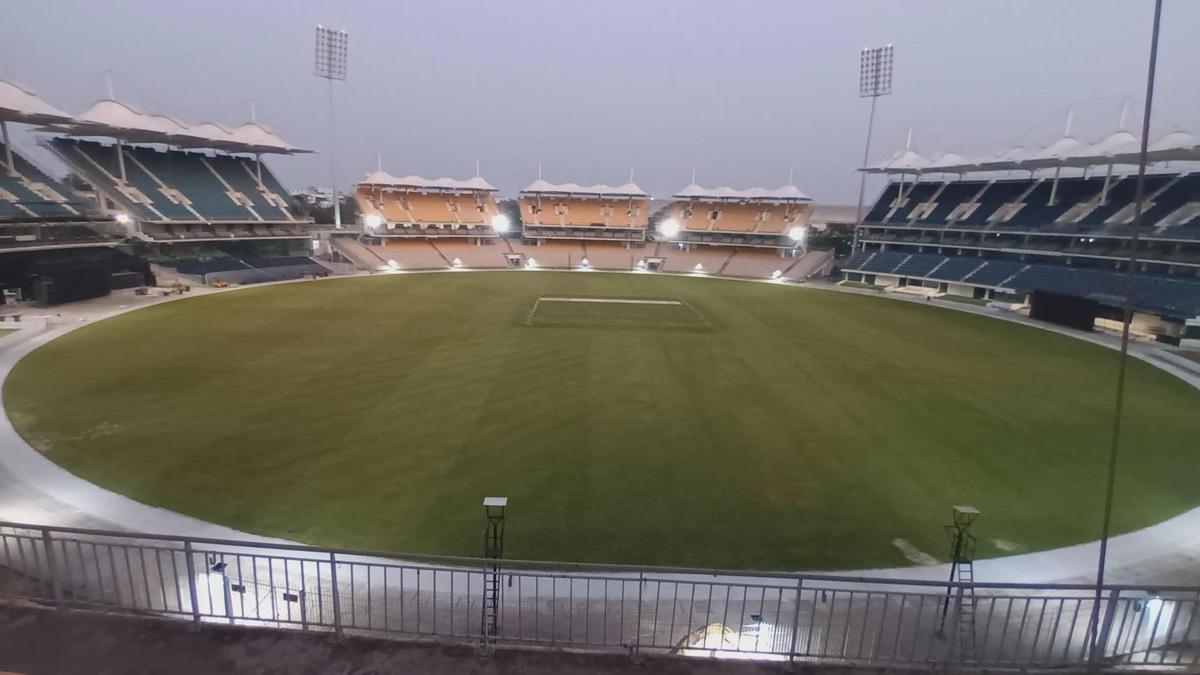
There is an aura about the M.A. Chidambaram Stadium that’s hard to express in words. Terms associated with Chepauk that one first heard on the radio – the V. Pattabhiraman Gate, the Wallajah Road End – surge to your mind as you negotiate the broad gates and cast your eyes on the lush-green, newly laid outfield which cuts a pretty picture.
The refurbished Madras Cricket Club serves as a reminder of the traditional sprucing itself up to keep in tune with the modern. The steepling new stand crammed with blue seats is another example of the necessity of having to embrace the new reality even if it is somewhat at the expense of spectator comfort. Rows of seats almost tumble over each other and negotiating the narrow passage to reach one’s perch towards the end of a row is a huge challenge.
Think Chepauk, and the first thought is of the tied Test of September 1986. Nearly 40 years ago, to have to score 348 in a single day’s play, and that too on the final day of a Test, was almost unheard of. That’s the target Allan Border set Kapil Dev’s men on September 22. India made a game fist of it with Sunil Gavaskar, who has lit up the venue with several incandescent efforts, leading the way. The little master top-scored with 90 as each of the top five made at least 39, and at 251 for three, an improbable victory appeared imminent.
Ray Bright, the left-arm spinner, then got into the act alongside Greg Matthews, the maverick off-spinner who preferred bowling with his Baggy Green on. Ravi Shastri held firm and Chetan Sharma weighed in with 23 but when Shivlal Yadav was ninth man dismissed, India needed four for victory with Maninder Singh joining Shastri. The latter was a master at playing the situation. Instead of going for the glory shot that might have brought about his downfall, he first ensured that India would not lose the game, leaving Maninder on strike to Matthews with the scores level.
As the off-spinner pinged the No. 11 on his pad, umpire Vikram Raju’s right index finger shot skywards, upholding the appeal and sending one side into paroxysms of delight. The other’s immediate reaction was disappointment; to this day, Shastri and Maninder insist there was an inside-edge, Raju is adamant there was no contact between bat and ball.
It doesn’t matter anymore, does it? With that one act which brought an end to India’s chase and a riveting Test match, Raju had formalised only the second ‘tie’ in the history of Test cricket. Australia had been involved in both games where the match had ended with the teams dead level in terms of runs scored when the dust had settled and the final wicket had fallen.


Shorts News:Watch: Iranian female footballers safe in Malaysia: Asian Football Confederation

Argentina vs. Spain's Finalissima in Qatar canceled due to escalating West Asian conflict, impacting pre-World Cup match plans.

Smriti Mandhana and Shubman Gill win BCCI's top awards for their exceptional performances in the 2024-2025 cricket season.

Rajnath Singh advocates for stronger public-private partnerships to enhance India's sports economy and global identity, especially in polo.

Kimi Antonelli's historic victory at the Chinese Grand Prix signals a thrilling future for Mercedes and intense internal competition.

Penalty-corner conversion is a real concern for Indian women’s team

Pooja wins women's high jump at Indian Open, while Baranica and Mubassina excel in pole vault and long jump.

Gopi Thonakal aims to break the 48-year-old National marathon record while pursuing glory at the Asian Games.

Punjab FC seeks improved goal-scoring as they face FC Goa in a crucial ISL clash at Jawaharlal Nehru Stadium.

Archer Rishabh Yadav overcomes recent challenges, focusing on the Asian Games and the 2028 Olympics preparation.

Inter Milan's Serie A title hopes falter after a 1-1 draw with Atalanta, allowing AC Milan to close the gap.

Formula One cancels Bahrain and Saudi Arabian races due to the ongoing Iran-Israel war, prioritizing safety.

England clinches gold at Women’s Hockey World Cup Qualifiers, defeating India 2-0 amid missed opportunities for the host team.