Chennai sees veteran artist C Douglas’ works on display after more than 10 years
The Hindu
Dismembered body parts, fragmented text and layers of mediums that dominate the work of veteran artist C Douglas are on display after more than a decade
In curator Ashvin Rajagopalan’s words: C Douglas is the “quintessential artist”.
Unpredictable, chaotic and layered, his art is but a reflection of the person he is. And so, it comes as no surprise that he refused to speak for this piece. His canvases, however, speak volumes. Displayed at Gallery Veda, with four ceramic companions at Ashvita’s Gallery, the collaborative show is a window into Douglas’ world — a world, though famed, that is rarely on display. It has been more than a decade since Chennai saw a solo show of the veteran’s work.
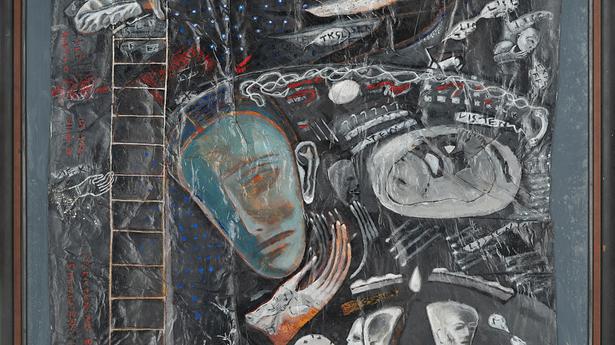
It is no news that dismembered body parts, fragmented text and layers of mediums dominate his work: the vacuum, hollowness or void, that lie inside of us all, are characters in his artistic expression. And so, though he revels in abstraction, Douglas’ work connects one to the innermost truths of self. A strange, bizarre sense of relatability is quick to wash over the viewers.
For instance, an untitled work from the ‘90s, characterized by different shades of black, gray and blue is crowded with familiar motifs (think: ladders, speech bubbles, angular faces, skeletal hands, all thrown in together). It is discomforting. Perhaps, that is the point. A circular canvas displayed at Gallery Veda takes on a soothing tone, but only in terms of colors. Titled ‘The fountain and the bird song’, the heavily textured work is fraught with mutilated parts of perhaps, a mannequin or stick-like figure.
While Gallery Veda houses 33 paintings of his, the narrative travels further to give a glimpse into his work with four of his ceramic sculptures being showcased at Ashvita’s. These works were done in an artist-in-residency programme at Oisterwijk, the Netherlands, in 1994, along with Indian contemporary artist Bhupen Khakhar.
And Douglas does not fail to reference himself in his sculptures as well. The similarities are unmissable. “Both Bhupen and Douglas are not sculptors, but they were made to use the medium so you can see that he is interpreting his works onto a three-dimensional medium. There may be only one or two more sculptures.” A geometric oil on canvas from 1981, one of Douglas’ earlier works, on display also shows a time when he was experimenting with textures.
Ashvin tries to draw a picture of Douglas’ style of working that one can only describe as ‘in the moment’. “He doesn’t use a traditionally stretched canvas. He uses the canvas, sticks paper on it and crumples the paper, to give this [textural] effect. And then of course, he brings in text. Then there is sand, tea, charcoal, and if he is smoking, cigarette ash...”


South African naturalist Steve Boyes speaks on ghost elephants, ancestral tracking, and Werner Herzog’s documentary exploring Angola’s elusive highland giants

Actor-director Amol Palekar will receive META's Lifetime Achievement award for 2026 on March 25 in New Delhi.

India's artists unite against rising censorship, advocating for creative freedom and support for marginalized voices in the arts.

Written and directed by Kunal, the film also stars Sparsh Shrivastava and Vanshika Dhir

This year, Bharatnatyam artistes will present the Tyagaraja Aradhane as a dance performance

This year, Bharatnatyam artistes will present the Tyagaraja Aradhane as a dance performance

The actor, along with director Sushant Shah, speak about their upcoming series ‘Chiraiya’, Divya’s process of working on the dialect, Sushant’s approach to telling a story about women, and more

An independent video, ‘Feel the Spark’ by Raleigh Rajan with vocals by Ciera Dumas that celebrates Tamil literary giants, garnered 1.4 million views in less than 36 hours.

In ‘Jack Ryan: Ghost War’, John Krasinski is back as the savvy CIA analyst, diving headfirst into a high-stakes mission that unravels a deadly conspiracy and pits him against a rogue black-ops unit

Shriram Bharatiya Kala Kendra’s Shankarlal festival showcased rare ragas, radiant artistry, and inclusive performances, from Pt Madhup Mudgal’s serene morning ragas to Ramana Balachandran’s Saraswati veena.

Explore "Threads that Bind: The Kantha Project," an exhibition in Delhi reimagining kantha as a medium of repair and renewal.

Sean Penn skips the Oscars to meet Ukraine's Zelenskyy, who praises him as a "true friend" amid the war.

The teaser of Tamil star Suriya’s much-awaited film with director Venky Atluri, titled Vishwanath and Sons, was unveiled by the makers on Monday