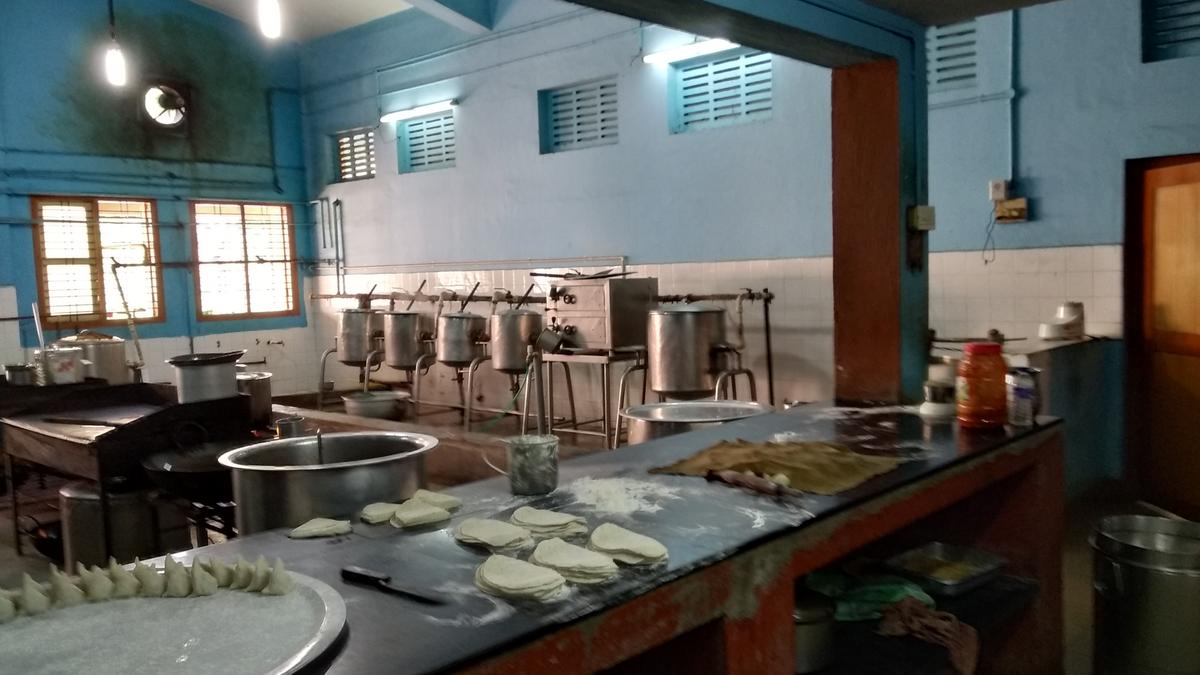
Chefs in community kitchens of Dakshina Kannada district in Karnataka exposed to inhaling high levels of particulate matter, says collaborative study
The Hindu
The observations of the study reveal that the current exhaust systems installed in the community kitchens are not optimal for air cleaning. The study has recommended that the authorities concerned take note of these findings and develop relevant guidelines to improve air quality in community kitchens.
A collaborative study on air pollution levels in 15 community kitchens in Dakshina Kannada district of Karnataka where large-scale cooking is done reveals that chefs are exposed to high levels of particulate matter (PM).
The study titled ‘Assessment of health risks due to the inhalation of respiratory particulate matter generated in the community kitchens’ was carried out by Mangalore University in collaboration with IIT-Bombay and University of Miami, U.S.
It was published online in the Journal of Environmental Monitoring and Assessment, Springer in March 2025.
The study was done by K. Sudeep Kumara, a post-doctoral fellow at Mangalore University; N. Karunakara, Coordinator of the Centre for Advanced Research in Environmental Radioactivity (CARER), Mangalore University; Y. S. Mayya, Professor, Department of Chemical Engineering, IIT, Bombay; and Pratim Biswas, Professor, Department of Chemical, Environmental and Materials Engineering, University of Miami, U.S.A.
Advanced real-time air quality monitoring devices (APT-MAXIMA by Applied Particle Technology Inc, USA) that measure particle size distribution from 0.3 µm (micrometre) to >10 µm (micrometre) were used in this study. Continuous and real-time monitoring of PM concentration was performed for 15 to 20 days. The study focused on measuring PM1, PM2.5, and PM10 airborne particles known to penetrate deep into the lungs and then into the bloodstream.
The continuous monitoring allowed the researchers to establish the essential database on air pollution levels in community kitchens, for which previous studies were non-existent.
The kitchens included in the research served large populations in schools, hostels, restaurants, and mid-day meal programmes, reflecting typical cooking environments in India.


Congress leader K.C. Venugopal alleges corruption in Kerala's bar license renewals, accusing CPI(M) and BJP of unethical collusion ahead of 2026 polls.

Bengaluru police arrest three in a money-doubling fraud, recovering ₹40 lakh and uncovering additional victims.

AIADMK faces perception challenges and electoral setbacks in Tamil Nadu, struggling to maintain its traditional stronghold and voter base.

K. Ashok appointed Executive Director of BHEL Tiruchi, succeeding S. Prabhakar after 36 years of experience in the company.

Garbage collection resumes in Bengaluru amid contractor disputes over payment delays and new waste segregation rules by BSWML.

Delhi High Court rules universities cannot restrict peaceful expression of dissent, emphasizing the importance of independent thought and discourse.

Mettur Dam's water level is at 82.83 feet, with an inflow of 384 cusecs and discharge of 800 cusecs.

Lebanon expels Iran's ambassador, declaring him persona non grata, while maintaining a Charge d'Affaires at the embassy.

Sunny Joseph accuses Pinarayi Vijayan of targeting Rahul Gandhi as part of a political deal with the BJP.

AIADMK faces perception challenges and electoral setbacks in Tamil Nadu, struggling to maintain its traditional stronghold and voter base.

Sunny Joseph accuses Pinarayi Vijayan of targeting Rahul Gandhi as part of a political deal with the BJP.

Mahesh Dattani and Jonathan Taikina Taylor collaborate play, ‘The Monk & The Warrior’, to be staged at Mumbai’s Experimental Theatre from April 2 to 5

NHAI's rooftop solar plants on three toll plazas generate 521 daily units, saving 1.87 lakh conventional power units annually.