Chandrayaan-3 | A flight to the moon Premium
The Hindu
India's third lunar mission, Chandrayaan-3, has captured the imagination of the public as it sets off to the moon. With improved designs and safeguards, ISRO hopes to succeed in the mission and become the fourth nation to land on the moon. If successful, it will be a major fillip for the space agency as it prepares for the manned Gaganyaan mission.
On moonlit nights between now and the final days of August, curious Indians will turn their gazes to the sky, surveying it in playful attempts to pick out a spacecraft — a mere man-made speck in the vast, forbidding reaches of space — as it resolutely makes its way to the Earth’s closest neighbour and lone companion.
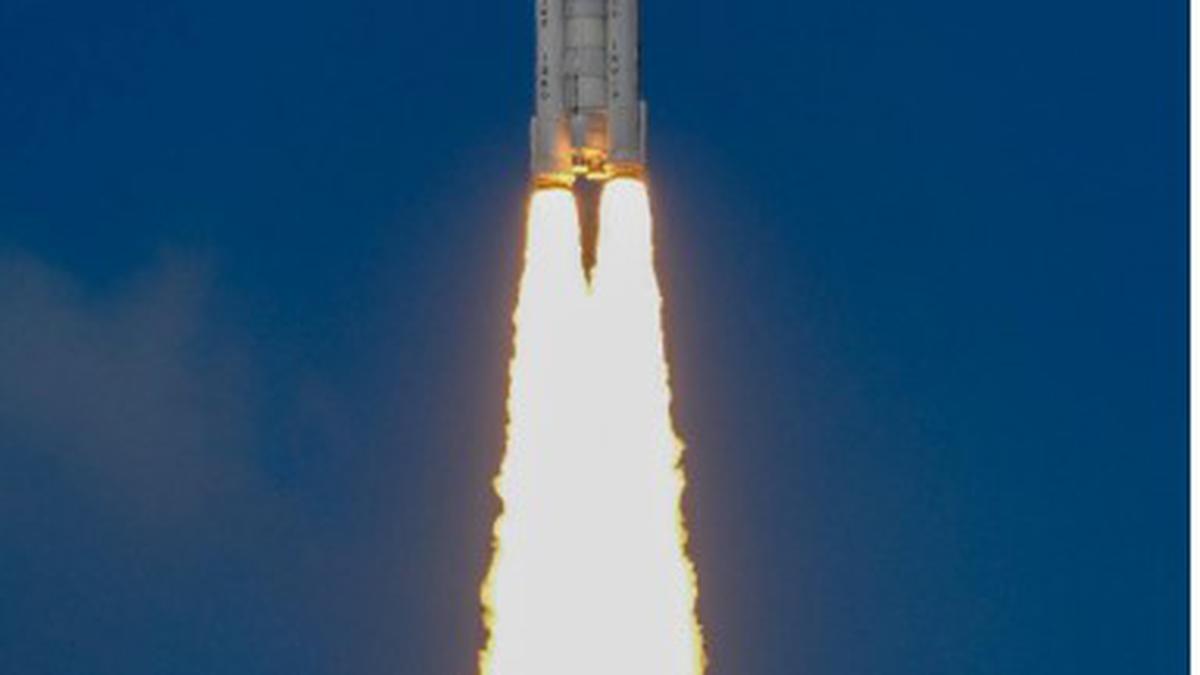
Predictably, India’s third lunar mission, which got off to a thrilling start from the Satish Dhawan Space Centre, Sriharikota, on Friday afternoon, has captured the imagination of the public as did the two earlier ones. The Chandrayaan-3 mission, launched aboard the Indian Space Research Organisation’s (ISRO) hefty Launch Vehicle Mark-3 (LVM3), is a follow-up mission to Chandrayaan-2, which it resembles in many ways. Once the spacecraft is safely in orbit around the moon in late August, ISRO will attempt to soft-land the Lander and deploy the six-wheeled, box-shaped Rover, which it failed to do with the Chandrayaan-2 mission in 2019. ‘Vikram’, the Chandrayaan-2 lander, had crashed on the lunar surface, breaking off communication much to the bitter disappointment of the space agency.
This time, the mission is better designed to withstand the challenges of a robotic moon landing near the south pole, according to S. Somanath, Chairman, ISRO. The Propulsion Module will carry the Lander-Rover configuration to a 100-km circular polar orbit around the moon. All three, the Propulsion Module, the Lander and Rover, carry scientific payloads designed to further our knowledge of the earth’s lone natural satellite, a rocky orb that has variously mystified, enchanted and inspired countless generations of humans through the slow-moving centuries.
The Lander has four payloads: ChaSTE, designed to measure the thermal properties of the lunar regolith near the polar region; the RAMBHA, a Langmuir Probe, for measuring near-surface plasma density and how it changes with time; the Instrument for Lunar Seismic Activity (ILSA) for measuring seismicity; and the LASER Retroreflector Array (LRA), a passive experiment to understand the dynamics of the moon. On board the Rover are the LASER Induced Breakdown Spectroscope (LIBS), and the Alpha Particle X-ray Spectrometer (APXS), designed respectively to study the chemical and mineralogical composition of the lunar surface and to measure the elemental composition of the lunar soil and rocks around the landing site. The Propulsion Module has one payload, the Spectro-polarimetry of HAbitable Planet Earth (SHAPE), which will study Earth from lunar orbit, an analysis designed to aid exoplanet research.
If it succeeds with the moon landing in August, India will become only the fourth nation to have done so; after the U.S., Russia and China. Moreover, a successful mission will be a major fillip for the space agency as it prepares for another tough enterprise — the manned Gaganyaan mission to space. Understandably, hopes, as well as the stakes, are high this time. Major improvements have been made to the lander to guarantee a safe touchdown, Mr. Somanath had explained during a recent visit to Thiruvananthapuram ahead of the launch. Safeguards include stronger ‘legs’ for the lander and the ability to withstand a higher descending velocity. “We have increased the quantity of the propellant, and solar panels cover a larger area. New sensors too have been added,” he said. “But more importantly, we have conducted hundreds of tests over the past two years.”
But before all this happens, the Chandrayaan-3 spacecraft has to make it safely to the moon, some 3.84 lakh km away. On Friday, after the LVM3-M4 / Chandrayaan-3 Mission lifted off from the second launchpad at the Sriharikota Range, lifted off at 2.35 p.m. (14:35:17 to be precise), the tension which gripped the Mission Control Centre began to thaw and smiles began to appear. The mood had perceptibly lightened. Once the spacecraft was safely in orbit around the earth, a visibly happy Mr. Somanath, flanked by the Mission Director S. Mohan Kumar, exclaimed, “Chandrayaan-3 has started its journey towards the moon. Our dear LVM3 has put the Chandrayaan-3 craft into a precise orbit around the earth.”
“We had a perfect launch, an on-the-dot performance. All components aboard LVM3 worked perfectly,” S. Unnikrishnan Nair, Director of the Vikram Sarabhai Space Centre, the ISRO facility in Thiruvananthapuram responsible for launch vehicles, told The Hindu after the launch. After orbit raising manoeuvres in the days ahead, ISRO is expected to perform the spacecraft’s translunar injection — when the spacecraft will be set on a trajectory for its late-August rendezvous with the moon —sometime around July 31-August 1. Many who watched on television the LVM3 (formerly the Geosynchronous Satellite Launch Vehicle Mk-III) climb to the sky on Friday may find it hard to believe that Moon and Mars missions were once the farthest things from the minds of the visionaries who shaped India’s space programme. The priorities and anxieties of a young nation were such that it could not have been otherwise. Indeed, Vikram Sarabhai famously remarked, “’There are some who question the relevance of space activities in a developing nation... To us, there is no ambiguity of purpose. We do not have the fantasy of competing with the economically advanced nations in the explorations of the moon or the planets or manned space flight. But we are convinced that if we are to play a meaningful role nationally, and in the comity of nations, we must be second to none in the application of advanced technologies to the real problems of man and society, which we find in our country.’‘


Test your knowledge with the quiz on Science films at the Oscars through history

Set between the Siwalik hills and the plains, Butwal offers travellers a mix of regional cuisine, pilgrimage trails to Lumbini and the comfort of Hyatt’s new hospitality landmark

Explore 2026's wallpaper trends in India, highlighting botanicals and handmade designs that enhance modern homes with nature-inspired aesthetics.

Mercedes-Benz CLA 250+ with EQ Technology review: design, performance, range and features explained. Discover how the new electric CLA combines advanced AI, long range, fast charging and futuristic styling for the next generation of luxury EVs.

AI tool for sparrow conservation

BTS’s comeback with ‘Arirang’ marks a major global music event. When does the album release, and where can you watch their concert live stream? We have all the details

The 2026 U.S. cholesterol guidelines urge starting screening and treatment at 30 to prevent cardiovascular disease effectively.

Olam Festival 2026 in Thiruvananthapuram returns March 27-29 with 120+ vendors, music, art, and cultural zones.

A few storytellers in Thiruvananthapuram share their journeys, challenges, and evolving methods on World Storytelling Day, inspiring young minds.

76-year-old Kurian Jacob from Kerala triumphs with seven medals, including five golds, at the Open Masters Games in Abu Dhabi.

Explore the nature of the human mind as an emergent property of brain activity and complex neural interactions.

CERN's Large Hadron Collider discovers the Xi-cc-plus particle, enhancing understanding of quantum mechanics and baryon behavior.

Vibha Batra’s latest book, Spotless (Hachette India) is a novel in verse for young adults