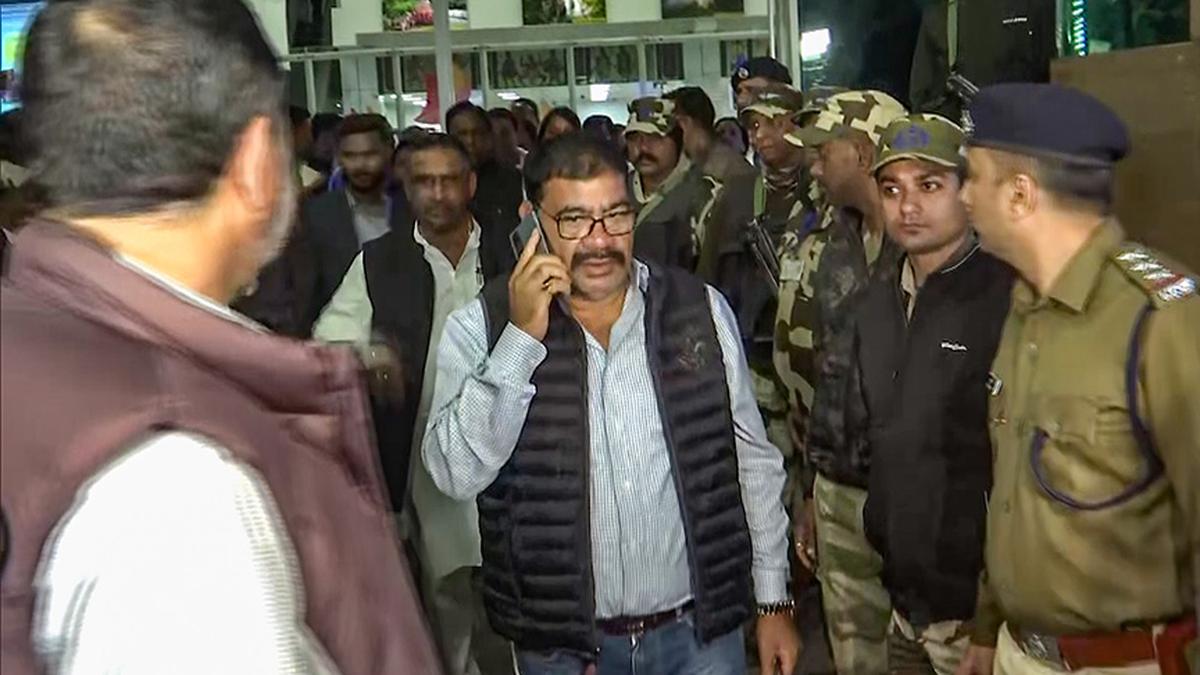
Champai Soren government to face floor test in Jharkhand on February 5
The Hindu
JMM-led ruling alliance returns to Ranchi for crucial floor test, with support from rebel MLAs.
Legislators from the Jharkhand Mukti Morcha (JMM)-led ruling alliance returned to Ranchi from Hyderabad on Sunday for new Chief Minister Champai Soren’s crucial floor test in the Jharkhand Assembly, slated to be held on Monday.
Former CM Hemant Soren has been cleared to participate in the trust vote, and at least one rebel JMM MLA has also agreed to support the government, which will require 41 votes in the 80-strong Assembly to pass the floor test.
The Congress legislative party leader Alamgir Alam, one of two Cabinet Ministers in the new government, was present to welcome the 39 returning MLAs when their chartered plane landed in Ranchi at 9 p.m. “All our MLAs are intact and no one is in touch with the Bharatiya Janata Party. We are going to win the floor test. The BJP leaders were spreading rumours that some of our MLAs are in touch with them. It’s nothing as such,” Mr. Alam said at Ranchi airport.
From the airport, the MLAs were rushed straight to the Ranchi Circuit House where they will stay overnight before participating in the vote of confidence in the Assembly. Immediately after the swearing-in ceremony on Friday, 39 MLAs had been flown to Telangana and sequestered at a resort to prevent them from being approached by the BJP.
Mr. Hemant Soren, currently in the custody of the Enforcement Directorate (ED) in connection with an alleged land scam case, will also partcipate in the trust vote, after he was permitted to do so by a special court.
With one JMM MLA having resigned recently, the Assembly’s current strength stands at 80, meaning that the ruling alliance needs the support of 41 MLAs. Mr. Champai Soren’s letter of support submitted to Governor C.P. Radhakrishnan had included 43 signatures.
On the eve of the floor test, Lobin Hembrom, a veteran JMM leader and rebel MLA from the Borio Assembly seat, announced that he would back the new government, if it met his demands. These include: the imposition of prohibition in the State; protection of forests; water conservation; and a special court to expedite trials in cases filed against tribals and local residents.


Kerala's political parties continue to marginalize women candidates, highlighting a troubling disconnect between gender demographics and representation.

The High Court of Karnataka on Tuesday ordered the issue of a notice to the State government on a PIL petition, which had complained about disturbances caused to people residing in the localities around the National Public School situated in Rajajinagar 5th block due to use of loudspeakers with high volume in the school and parking of school buses in residential areas.

China is extensively mapping ocean floors to enhance submarine warfare capabilities against the U.S. and allies across key oceans.

AIADMK's 2026 manifesto promises free rations, women's benefits, education reforms, and economic growth initiatives for Tamil Nadu.

The vehicle towing drive will soon resume in the city to ease traffic congestion. The Bengaluru Traffic Police (BTP), in coordination with the Greater Bengaluru Authority (GBA), is set to relaunch the vehicle towing drive across the city shortly to tackle traffic congestion and illegal parking.

Panic buying, not shortage, is leading to long queues at Hyderabad petrol pumps.

District Collector urges collective action against TB during World TB Day rally, highlighting screening efforts and patient support initiatives.

DMK finalises seat-sharing for the 2026 Tamil Nadu Assembly elections, contesting 175 seats with allies DMDK and VCK.

Collector V. Saravanan and Police Commissioner Kamini promote voter awareness through outreach programs and traditional events in Tiruchi.

Mysuru DC stresses precautionary measures to reduce road accidents, urging officials to identify and address high-risk areas.

Growing influence of Artificial Intelligence highlighted

Telangana MP urges quick approval and funding for Musi River and 7,444 km sewerage projects during AMRUT review meeting.

Former Udupi MLA K. Raghupathi Bhat, who had launched an indefinite dharna in front of the Udupi Urban Development Authority (UUDA) office on Monday against the Authority’s alleged illegal refusal to grant single site approval for 1.1 acres of his land at Badanidiyur, ended his dharna on Tuesday.