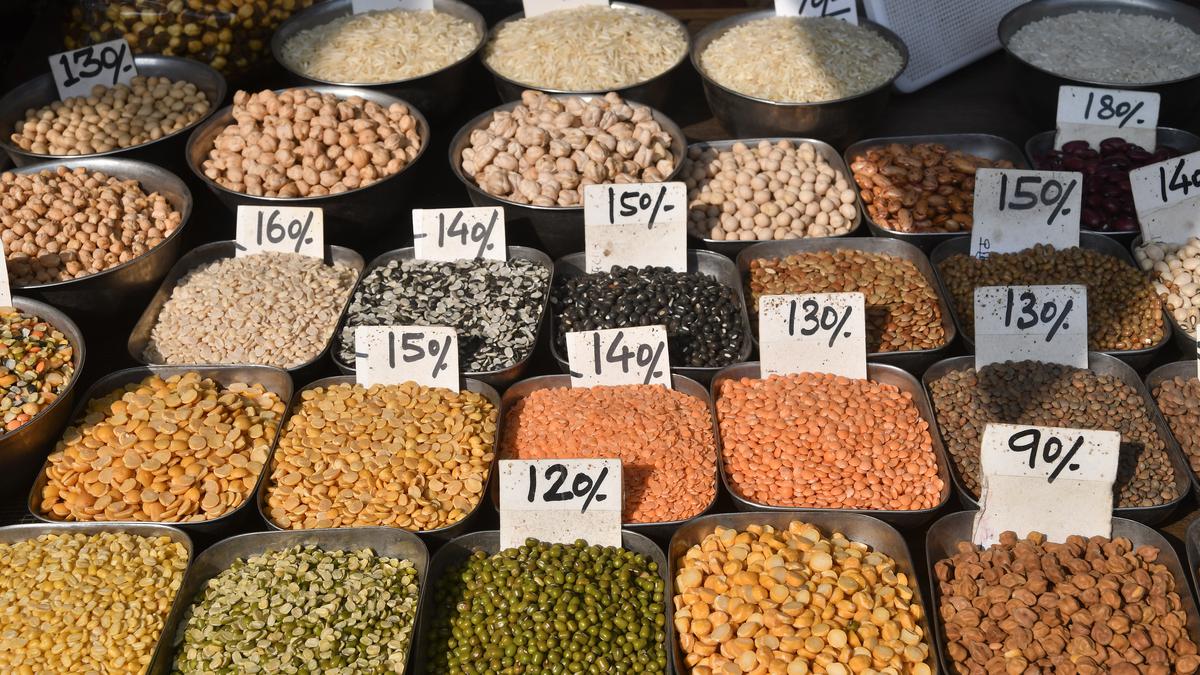
Centre caps tur and urad dal stocks to prevent hoarding, speculation
The Hindu
The Centre has imposed stock limits on tur dal and urad dal till October 31 to prevent hoarding and speculation
The Centre has imposed stock limits on tur dal and urad dal to prevent hoarding and speculation, and also to improve affordability. According to the Ministry of Consumer Affairs, Food and Public Distribution, these stock limits on the pulses are applicable to wholesalers, retailers, big chain retailers, millers and importers with immediate effect and will be applicable till October 31 this year.
“Under this order, stock limits have been prescribed for tur and urad until 31st October 2023 for all states and Union Territories,” Consumer Affairs Secretary Rohit Kumar Singh said.
According to the statement released on June 2 night, stock limits applicable to each of the pulse individually will be 200 MT for wholesalers; 5 MT for retailers; 5 MT at each retail outlet and 200 MT at the depot for big chain retailers; last three months of production or 25% of annual installed capacity, whichever is higher, for the millers. Importers are not to hold stock beyond 30 days from the date of customs clearance.
Also Read |India working to rein in inflation: Finance Minister Nirmala Sitharaman
The statement further detailed that the respective legal entities are to declare the stock position on the portal of the Department of Consumer Affairs and, in case the stocks held by them are higher than the prescribed limits then, they shall bring the same to the prescribed stock limits within 30 days of issue of the notification.
The Ministry stated that the imposition of stock limits on tur and urad is another step in the consistent efforts taken by the government to reduce the inflation of essential commodities.
The Department of Consumer Affairs had been closely monitoring the stock position of tur and urad through the stock disclosure portal which has been reviewed on a weekly basis with the state government.


The rupee hits a record low of 93.94 against the dollar amid foreign fund outflows and a crashing equity market.

The Thane police have arrested two co-founders of cryptocurrency exchange platform CoinDCX in connection with an alleged fraud of Rs 71.6 lakh, officials said

Meta Chief Executive Mark Zuckerberg is building a CEO agent to help him do his job, the Wall Street Journal reported

Insurance penetration and density are often misunderstood and do not reveal how many families are insured or whether they would be financially secure if the main earning member were to die. The real issue is not reach but adequacy, as households may have life insurance but not enough cover to replace lost income, leaving them financially vulnerable.

Five top firms lose ₹1 lakh crore in market value, with HDFC Bank experiencing the largest decline of ₹56,124.48 crore.

L&T confirms 95% of its West Asia project sites are safe, while addressing logistics challenges amid ongoing regional conflicts.

Mines Ministry to auction 19 critical mineral blocks on March 23, expanding strategic resources for clean energy and technology sectors.

Mines Ministry to auction 19 critical mineral blocks on March 23, expanding strategic resources for clean energy and technology sectors.

Five top firms lose ₹1 lakh crore in market value, with HDFC Bank experiencing the largest decline of ₹56,124.48 crore.

HDFC Bank terminates three senior officials over client onboarding issues at its DIFC branch amid ethical concerns following chairman's resignation.

Air India CEO warns of potential flight cuts and reduced travel demand due to rising fuel costs amid ongoing Gulf conflict.

Options are widely used by retail traders to speculate on the value of the stock for immediate gains and such behaviour in large scale can distort the market

India achieves 1 billion tonne coal production for the second consecutive year, ensuring stable energy supply and economic growth.