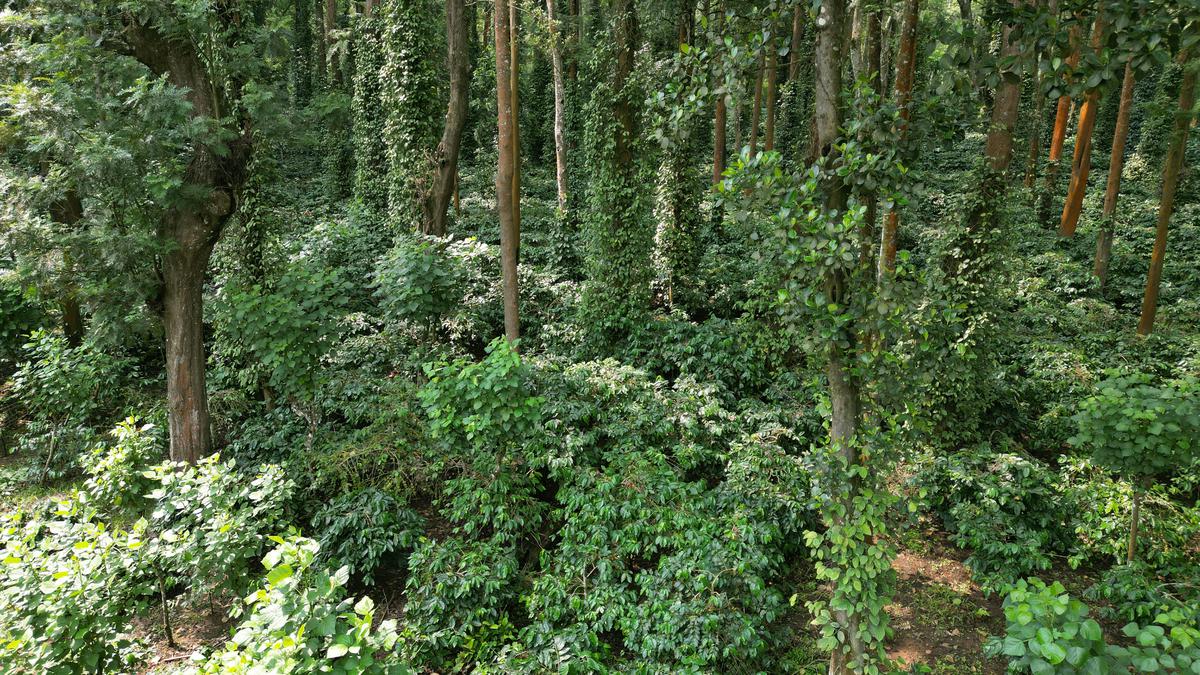
Cauvery woes: Not just deficit, erratic distribution of rainfall a major concern in Kodagu
The Hindu
Farmers blame lack of consistency in rain pattern, which was regular for centuries, but is not being seen now due to the impact of climate change. The situation has been particularly bad this year.
It is not just deficit monsoon that is worrying farmers in Kodagu, which is the main catchment area and place of origin of river Cauvery. This hilly district in Karnataka, which accounts for about 36% of India’s coffee production besides the country’s best quality pepper, is concerned over uneven distribution of rainfall. The planters here fear that uneven distribution during different months of the monsoon this year may result in loss of coffee and pepper crop to the tune of ₹850 crore.
Bose Mandanna, former vice-chairman of Coffee Board and an expert on Kodagu’s climate, says the loss of ₹850 crore is a very conservative estimate arrived at by considering 25% loss in coffee yield, accounting for ₹750 crore, and 20% in pepper yield amounting to ₹100 crore.
He observes that coffee requires 60 to 80 inches of evenly-distributed rain in a year. But of late, the rainfall has not been evenly distributed in various months in Kodagu. “It remains dry when we need rain, and it rains when it should be dry,” he says.
“We need blossom showers in February-March for Robusta variety of coffee, and in March-April for Arabica variety of coffee. If it rains during this time, then there is nearly 80% of assurance of good crop yield. After 20 days to a month later, we need backing showers. Later, when the fruits develop, we need further rains,” he explains.
Such consistency in rain pattern, which was regular for centuries, is not being seen now due to the impact of climate change. The situation has been particularly bad this year, he notes.
Referring to the cumulative deficit of 42% rainfall in South West Monsoon in Kodagu this year, he says, “It has created multiple problems of high temperature and lack of moisture. Coffee requires temperatures below 35 degree Celsius. While generally the temperatures are going up as an impact of climate change, the increase in temperature can be clearly felt this year due to deficit monsoon that has reduced moisture.”


Union Minister Kiren Rijiju meets Tamil Nadu Bishops and pastors to discuss minority welfare and counter anti-BJP narratives.

Japan may consider minesweeping in the Strait of Hormuz post-ceasefire, says Foreign Minister Motegi, amid ongoing regional tensions.

Delhi University job fair guidelines excluding School of Open Learning students spark protests over equity and access to opportunities.

Rwanda's Fanny Utagushimaninde, at 15, becomes the youngest player to score a T20 international century.

Assembly polls 2026: Follow updates from The Hindu on the upcoming elections in five States, on March 22, 2026

Currently, only the services in the 32 series stop at the section of the road adjacent to the Broadway terminus, temporarily closed on account of reconstruction work. Small traders association tells R. Ragu that ensuring the services now accommodated at the temporary terminus at Island Grounds stop at NSC Bose road would benefit visitors to the markets in Parrys

The Hindu photo feature on Aragam which is now known as book village. Photos and text by Imran Nissar

The silent reading movement in the Mylapore-Mandaveli-RA Puram area showed up first at Nageswara Rao Park around two years ago, with modest ambitions, when Balaji launched it along with other reading enthusiasts from the region. This initiative has now moved parks, and seems to set to get entrenched in one. Due to renovation work at Nageswara Park, the reading session became irregular. With the Nageswara Rao park work gaining more surface area, it had to be shifted elsewhere. And it seems set to continue with a newly discovered green patch in RK Nagar in the Sundays to follow.

Explore Tamil Nadu's upcoming four-cornered election contest, featuring key players DMK, AIADMK, TVK, and Naam Tamizhar Katchi.

Trump plans to deploy ICE officers for airport security unless Democrats fund the Department of Homeland Security amid ongoing shutdown.

Cuba experiences its second nationwide blackout in a week, exacerbated by an ongoing U.S. oil blockade and energy crisis.

Kamal Haasan urges Tamil media to avoid the term "censorship" in films, advocating for artistic freedom and recognition of certification.

Pottalurani residents boycott elections again, demanding closure of fish waste processing units impacting health and environment.