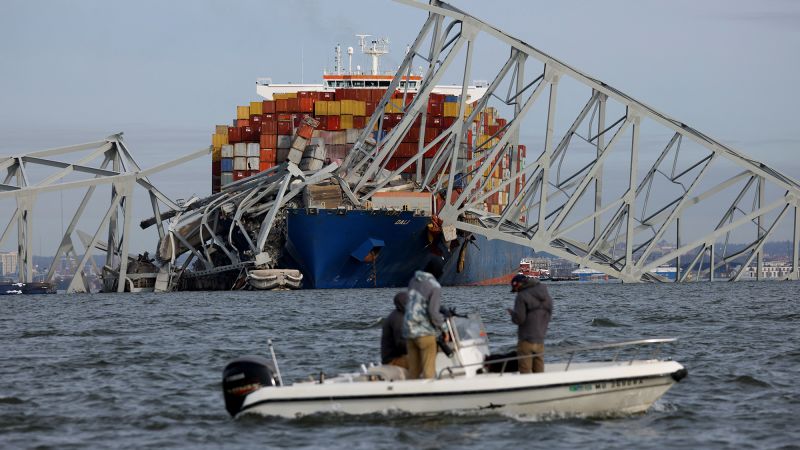
Cars, sugar and cruises: How the Port of Baltimore closure could hurt the economy
CNN
The bridge collapse that has indefinitely halted the flow of ships in and out of the Port of Baltimore could hurt the local economy, strain supply chains and scramble deliveries along the US East Coast.
The bridge collapse that has indefinitely halted the flow of ships in and out of the Port of Baltimore could hurt the local economy, strain supply chains and scramble deliveries along the US East Coast. The Key Bridge collapsed after a container vessel called Dali collided with one of its supports. Dali is operated by Singapore-based Synergy Group but had been chartered to carry cargo by Danish shipping giant Maersk. The Port of Baltimore said in a post on X that vessel traffic was suspended until further notice, but trucks were still being processed at its terminals. Seven container vessels were scheduled to arrive in Baltimore through Saturday, according to Judah Levine, head of research at logistics firm Freightos. “We are omitting Baltimore on all our services for the foreseeable future, until it is deemed safe for passage through this area,” Maersk said in a statement. It said it would discharge cargo destined for Baltimore in other ports nearby, but Maesrk warned customers that could mean delays. Closer to the Midwest than any other port on the East Coast, Baltimore is a major hub for vehicles, containers and commodities. Baltimore ranks first among US ports for autos and light trucks, handling a record 850,000 vehicles last year.


A federal judge says the Trump administration must let more than 1,000 sidelined Voice of America employees return to work by next week.

Former judges side with Anthropic and raise concerns about Pentagon’s use of supply chain risk label
Nearly 150 retired federal and state judges have filed an amicus brief on Tuesday supporting AI company Anthropic in its lawsuit against the Trump administration for designating it a “supply chain risk,” CNN has learned.

Attacks on commercial ships in the Middle East this month have all but closed the vital Strait of Hormuz to oil tankers. One of the few alternative routes for oil exports from the region goes through the Red Sea. But now even that lifeline is in danger.

When Mona Panjwani opened One40 Rooftop, a swanky restaurant in lower Manhattan last year, one of the biggest dilemmas besides the menu was choosing the reservation platform.

What could get more expensive because of the war in Iran?

Gas prices have skyrocketed due to the US-Israel war on Iran, putting even more financial strain on many Americans’ wallets.

United Food and Commercial Union Local 7, the union representing the 3,800 striking workers, said that JBS failed to meet its demands during contract negotiations over higher wages, life-saving safety equipment and improved healthcare.

Every day brings a new complaint — or three — from the Trump administration about the American news media’s coverage of the Iran war.

Traffic through the strait, normally the conduit for a fifth of global oil output, has been severely curtailed since the start of the Iran conflict. But Iran itself is shipping oil through the waterway in almost the same volumes as before the war, earning the cash needed to sustain its economy and war effort.

How Anthropic may benefit from its fight with Trump

The price of oil rose to its highest level since July 2022 Sunday evening as the Trump administration suggested the war with Iran could last several more weeks and President Donald Trump called on the international community for help reopening the Strait of Hormuz to oil tankers.

When Melanie Galeaz posted a fan edit of “Heated Rivalry,” she didn’t know it would lead to her dream job.

The worst global oil crisis in decades could become a major problem for the Federal Reserve, whose policymakers meet this week to determine the next moves for the US economy.