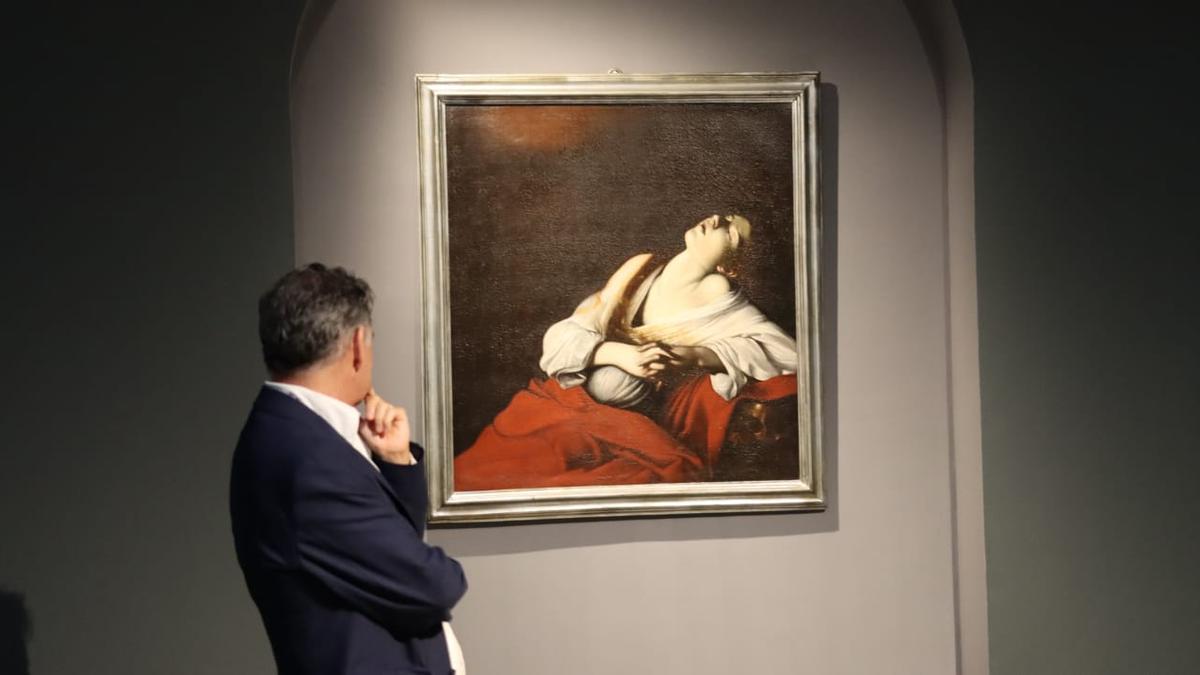
Caravaggio’s Magdalene in Ecstasy travels to Bengaluru
The Hindu
Caravaggio’s Magdalene in Ecstasy, which is believed to have been painted in 1606, while Caravaggio was in hiding, will be displayed at the National Gallery of Modern Art till July 6
“This is the first time an original Caravaggio has travelled to India,” says Alfonso Tagliaferri, Consul General of Italy in Bengaluru, at a press conference preceding the unveiling of Magdalene in Ecstasy by Renaissance artist Michelangelo Merisi da Caravaggio in Bengaluru at the National Gallery of Modern Art (NGMA). “It defines a very good moment of the bilateral relations that we are living in now,” he adds.
The painting depicts Mary of Magdala in a state of almost-erotic spiritual rapture, semi-reclining, draped in scarlet robes with bared shoulders and flowing auburn hair, against a dark background: an especially pronounced use of the classic chiaroscuro technique of Renaissance art called tenebrism, which he is often credited as having introduced. “Art historians, when they talk of Caravaggio, quite often use the term realist, but the correct definition would be theatricality — the way he composed paintings was very theatrical,” explains Andrea Anastasio, Director of the Italian Cultural Centre, who was also present at the press conference. “Of course, there is a lot of reality because he painted with real models, which sometimes generated trouble,” says Anastasio. For instance, in his famous painting of a dying Madonna, The Death of the Virgin, he is believed to have used a prostitute, “and that caused a lot of noise in the public… the church refused to take the painting.”
Caravaggio, he continues, radically changed art, particularly because of the way he used light. “We have to keep in mind that there is a pre-Caravaggio and post-Caravaggio, when it comes to painting in Europe,” he says, pointing out that many artists, including Rembrandt and Velázquez, drew inspiration from his use of light. “Caravaggism is a fashion where artists used his way of painting pictures and his way of using light.”
Magdalene in Ecstasy is believed to have been painted in 1606, while Caravaggio was in hiding, after he had killed a man, Ranuccio Tommason, in a brawl. “Caravaggio has a troubled, really tragic life,” says Anastasio, adding that the artist was a temperamental man with a difficult childhood. “You have to keep in mind that, at the age of six, in one day, he lost his father, his aunt, uncle and another very close relative due to plague,” he says.
The remaining family left Milan to escape the epidemic, moving to the town of Caravaggio in Bergamo, Lombardy, where he was raised by his mother and, during this period, they appeared to have faced financial strife. His talent, however, by most accounts, was undeniable. According to the Caravaggio foundation’s website, in 1584, he started as an apprentice to the Lombard painter Simone Peterzano, a pupil of Titian. By 1592, he had moved to Rome, where he began “performing hack-work for the highly successful Giuseppe Cesari, Pope Clement VIII’s favourite painter,” it states.
Within two years, he quit Cesari and decided to make his own way in the world and, over time, became an established name in Italy. But his tempestuous nature meant that he was “notorious for brawling, even in a time and place when such behaviour was commonplace, and the transcripts of his police records and trial proceedings fill several pages.”
By 39, he was dead, passing away under mysterious circumstances in 1610; however, his legacy lives on, and how. “There are a bunch of artists who are the most important for us (Italians),” says Consul General Tagliaferri, naming some of them. “Leonardo (da Vinci), Michelangelo, Raphael…after this, I would say, is Caravaggio…very important for us and the history of the world.”


A round-up of events and programmes held at colleges in Tiruchi and other Cauvery delta districts

CPI(M) and Congress clash over accusations of aiding BJP, threatening the LDF-UDF duopoly ahead of Kerala Assembly polls 2026.

Shivamogga veterinarians demand accountability for the death of trainee vet Dr. Sameeksha Reddy, citing systemic failures in zoo administration.

BJP launches 'Mana Ooru–Mana Jenda' campaign on April 6 to strengthen grassroots connections and promote development in Andhra Pradesh.

Anuradha Jonnalagadda took over as in-charge Vice-Chancellor of the University of Hyderabad, focusing on continuity during the transition.

Telangana government awaits committee report on TGSRTC staff absorption, with decisions to be made at an appropriate time.

Telangana's revised pay scale implementation for employees will take timer. The tenure of Pay Revision Commission extended. Govt likely to take decision on reccomendation based on its report.

Vizianagaram's SP A.R. Damodar highlights 20 accident-prone areas and urges drivers to prioritize safety with helmets and seat belts.

Kerala HC stays disqualification of SNDP Yogam leaders, reversing a single judge's order regarding financial and regulatory compliance issues.

Karnataka announces daily supply of 10,000 LPG cylinders to hotels, easing the commercial shortage for the hospitality industry.

Malayalam superstar Mohanlal will be reuniting with filmmaker Priyadarshan, it was announced recently. It will mark the 100th film of Priyadarshan and is backed by Mohanlal’s longtime collaborator, Antony Perumbavoor

Gautham Vasudev Menon loses Madras High Court appeal, ordered to pay ₹4.25 crore to R.S. Infotainment with interest.

AIADMK faces its toughest challenge in 53 years as it prepares for the crucial 2026 T.N. Assembly elections.