Canada won't let this Afghan refugee in from the U.S. His family worries the Taliban might kill him back home
CBC
It's difficult for Shafiqa Jalali to talk about her son Mohammad Younesi without crying.
Jalali, her husband, their four adult children and daughter-in-law all found asylum in Canada after fleeing the Taliban's rule in Afghanistan in 2024.
The family secured humanitarian visas from Brazil and paid human smugglers thousands of dollars to guide them by land through 10 countries, including Peru, Ecuador, Colombia, as well as the Darién Gap, a 100-kilometre stretch of jungle connecting North and South America that's considered one of the most treacherous migration pathways in the world.
"We knew that we might lose our lives," 57-year-old Jalali told CBC News through a Farsi translator. "But we were still hopeful to make it."
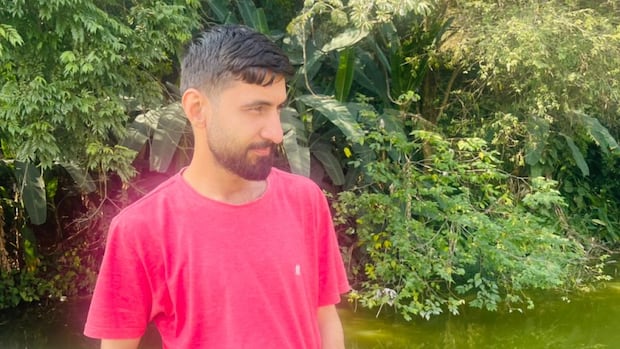
Although they didn't travel as a family unit, everyone made it to Canada safely and was granted refugee protection — except Jalali's youngest son, Mohammad. The 27-year-old was arrested by ICE agents in Arizona and has been in an immigration detention facility in Livingston, Texas, just north of Houston, for nearly a year. Jalali says she fears U.S. officials will send Younesi back to Afghanistan, where he was previously tortured by the Taliban for his human rights work. "I want the Canadian government to help my son, so that he can come here and be united with us, so that we can have a normal life," said Jalali.
"He is not doing well."
Under the Canada-U.S. Safe Third Country Agreement, people must claim asylum in whichever country they get to first, which means they can't leave the U.S. to seek refugee status in Canada — although there are some exceptions, including for family members of Canadian citizens or permanent residents, like Younesi.
A U.S. judge has granted Younesi permission to travel to the Canadian border to claim asylum. But his lawyer's petition to Immigration, Refugees and Citizenship Canada for a temporary resident permit to allow that was rejected in June.
"He is currently facing removal to Afghanistan," said Erin Simpson with the firm Landings LLP.
In an email statement to CBC News, the Ministry of Immigration, Refugees and Citizenship Canada wrote that due to privacy legislation, it could not comment on Younesi's case.
"It is absolutely not an overstatement to say that it is a matter of life and death," said Simpson. "And that has been our consistent message to the [immigration] minister and our plea for this permit to be issued."
According to a signed affidavit submitted to U.S. officials, Younesi fled Afghanistan after being kidnapped, beaten and forced to perform field labour in December 2023 because of his work with an NGO assisting vulnerable women and girls. "My life is in danger in Afghanistan, and returning would mean facing violence and persecution by the Taliban once again," reads the sworn declaration.
The Taliban retook control of the country in 2021 after the withdrawal of U.S. forces and other allies. The United Nations reports that women's rights have deteriorated drastically as a result, with "oppressive directives that target the rights, autonomy, and very existence of Afghan women and girls."
"He says that he doesn't know what will happen to him and to his life."


The former secretary general of NATO says he doesn't think allies will be pulled further into the conflict in the Middle East, but he's concerned the ongoing war with Iran will benefit Russia's economy and take the world's attention away from the invasion of Ukraine.

As American and Israeli strikes pound Iran — while it attacks shipping and energy infrastructure across the Persian Gulf — U.S. President Donald Trump made a new threat to Tehran's leaders.

The armed man who rammed his vehicle into one of the largest Reform synagogues in the U.S. Thursday has been identified as a 41-year-old naturalized citizen born in Lebanon, according to federal officials.

With jagged cliffs rising from the Arabian Sea, the Strait of Hormuz is striking in its scenery — and these days, its emptiness. This resource superhighway, which normally hosts more than a hundred of the world’s largest oil and liquid natural gas (LNG) tankers every day, has seen no more than a handful all week.

The Canadian government said Tuesday it is alarmed by the escalation of violence and attacks in Lebanon, as the war in the Middle East expands.

In a resounding victory that is guaranteed to reshape Nepal's politics, rapper-turned-politician Balendra Shah appeared headed for a landslide win in the South Asian country's first polls since youth-led protests toppled the previous government last fall.

China’s latest blueprint for driving growth in its economy was largely written before the U.S. and Israel instigated the most far-reaching war in the Middle East in decades.

U.S. President Donald Trump's firing of Homeland Security Secretary Kristi Noem on Thursday overshadowed the announcement of his plans to nominate Republican Sen. Markwayne Mullin as her successor.

The truck carrying Nepali prime ministerial candidate Balendra Shah was swarmed by cheering supporters in the capital, Kathmandu, on Saturday, unable to inch forward as the former rapper, wearing sunglasses and a sleek black suit, danced on top of the roof.

Israel sent troops into southern Lebanon on Tuesday and warned residents of more than 80 villages to evacuate as the Iran-backed militant Hezbollah group said it was ready for an "open war" with Israel in the wake of the U.S.-Israeli war with Iran.

U.S. President Donald Trump has given Americans a short list of his objectives in attacking Iran, but when it comes to the justification for launching the war and how the conflict is expected to play out, he and his team are sending mixed messages.

Omid Golabkesh dragged his suitcase down a long hallway marking the exit of the Kapikoy border crossing in eastern Turkey. He had nearly reached the end of an exhausting journey that included a 12-hour drive to the checkpoint from his home in Tehran.