Canada votes in federal elections under shadow of Trump threats. Here’s what you need to know
CNN
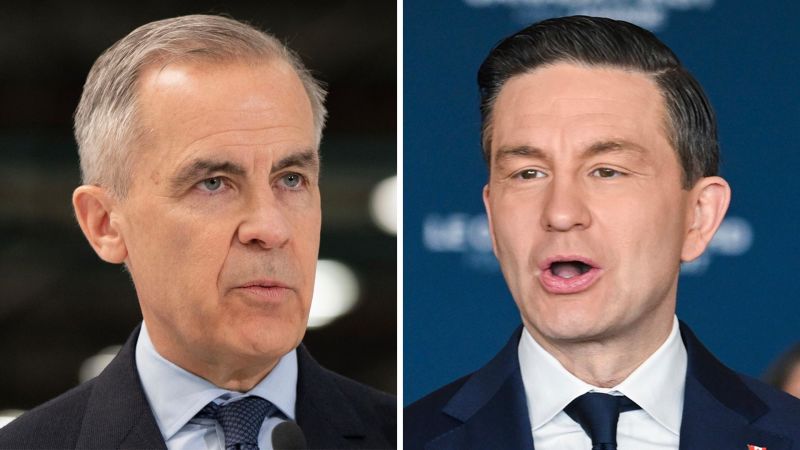
Canada is heading into federal elections, where Prime Minister Mark Carney is vying for a chance to continue leading the country, as tensions grow with the Trump administration.
Canada is heading into federal elections, where Prime Minister Mark Carney is vying for a chance to continue leading the country, as tensions grow with its closest neighbor. The former central banker’s main competition is Pierre Poilievre, Canada’s Conservative party leader whose political capital has declined as US-Canada relations nosedive amid threats from US President Donald Trump. Canadians do not vote directly for prime minister – they vote for lawmakers representing political parties in their district or riding. The party with the largest number of lawmakers elected to parliament will form the government, and its leader will become prime minister. While Carney’s Liberal Party and Poilievre’s Conservative Party are the frontrunners, other major political parties will also be on the ballot, including left-leaning New Democratic Party (NDP) led by Jagmeet Singh, the Green Party and the exclusively-Quebec-based Bloc Québécois. Poilievre was the favorite to win when former prime minister Justin Trudeau stepped down last month. But Trump’s steep tariffs on Canada, and threats to its sovereignty, dramatically transformed the race. Trump’s decision to levy a 25% duty on Canadian steel and aluminum, cars and car parts, and threats to tariff pharmaceuticals and lumber have shaken Canadian businesses. It’s a reality Carney has not sugarcoated, warning of “tough days ahead” with pressure on Canadian employment.


President Donald Trump said Sunday border czar Tom Homan will be in charge of deploying Immigration and Customs Enforcement agents to airports on Monday, with Homan telling CNN the agents will help with security at entrances and exits to ease the Transportation Security Administration’s workload.

Donald Trump wants us to believe that a deal with Cuba is close at hand. After this past week, I am not so sure.

President Donald Trump has said ICE agents will head to US airports tomorrow amid a partial government shutdown. Follow for live updates

President Donald Trump said Sunday border czar Tom Homan will be in charge of deploying Immigration and Customs Enforcement agents to airports on Monday, with Homan telling CNN the agents will assist with security at entrances and exits to ease TSA workload amid a partial government shutdown.

Janet Mills and her allies are counting on a gender gap to narrow Platner’s wide lead ahead of the June 9 primary to decide who will face incumbent Republican Sen. Susan Collins. They are betting that the unfiltered style that has brought Platner widespread attention as someone who could help Democrats reach young men will backfire with women.

Why do people “pledge allegiance” to a “state” that is no longer a state? And what spurs someone to not just attack innocent people, but to then make a statement of loyalty while doing so?

A Supreme Court case examining state deadlines for election ballots sent in the mail is just the tip of the spear in President Donald Trump’s war on mail-in voting.

As a shrinking number of Transportation Security Administration agents work to keep hourslong security lines moving despite not being paid, President Donald Trump stepped into the fray Saturday, announcing he will send Immigration and Customs Enforcement officers to airports by Monday if Congress doesn’t agree to a plan to end the partial government shutdown.

Donald Trump wants us to believe that a deal with Cuba is close at hand. After this past week, I am not so sure.

The search for missing 84-year-old Nancy Guthrie, mother of “Today” show host Savannah Guthrie, has stretched into another anguished week, with mounting pressure on investigators and a family grappling with uncertainty.

Cuba’s Ministry of Energy announced Saturday evening that entire island has suffered another electrical blackout, leaving more than 10 million people without power.

Iran’s attempt to strike a US-UK base over 2,000 miles (over 3,000 kilometers) off its coast has renewed questions about Tehran’s military capabilities and how far its missiles can reach.

For years, President Donald Trump has offered crass and insensitive comments about people who died – especially his foes. That reached a new level on Saturday.