Can you mount an art exhibition about race in the age of Trump?
CNN
What Trump’s order for the Smithsonian to review its exhibits says about the limits and power of art.
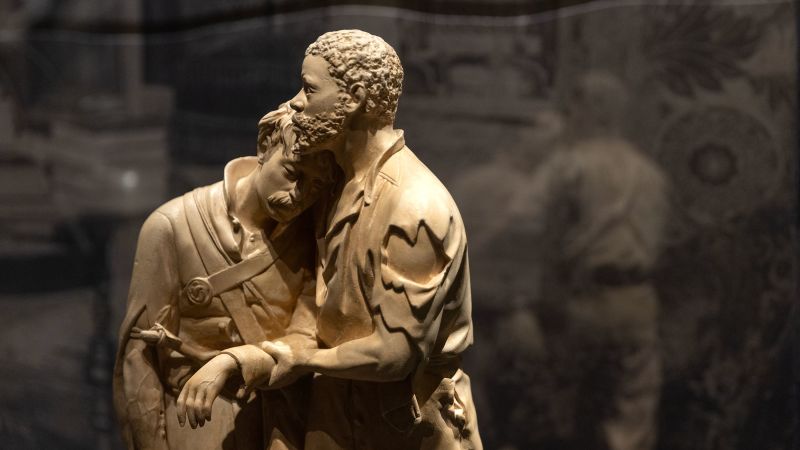
It is one of the most evocative works from the American Civil War: a sculpture of a Black man who had escaped from slavery helping an injured White Union soldier lost in hostile territory. When it was unveiled in 1864, John Rogers’ “The Wounded Scout, a Friend in the Swamp,” was celebrated for its anti-slavery message and patriotic tone. But in 2025, a Smithsonian exhibition, “The Shape of Power: Stories of Race and American Sculpture,” asked visitors to reconsider the message behind the piece. On display, the sculpture is paired with a description that prompts viewers to consider how the work, and others by Rogers “reinforced the long-standing racist social order,” despite its pro-Union and emancipation sentiment. The exhibition’s efforts to challenge enduring ideas about race and American sculpture became a subject of President Donald Trump’s ire earlier this year. In an executive order, he condemned the exhibition for stating that “sculpture has been a powerful tool in promoting scientific racism,” that “race is a human invention” and that the United States has used race “to establish and maintain systems of power, privilege, and disenfranchisement.” “Museums in our Nation’s capital should be places where individuals go to learn — not to be subjected to divisive narratives,” the executive order said. Trump has championed a cultural agenda built around celebrating, as the executive order put it, “shared American values” and “unmatched record of advancing liberty, prosperity, and human flourishing,” and he has put Vice President JD Vance, who serves on the Smithsonian’s Board of Regents, in charge of stopping government spending on exhibits that don’t align with that agenda.


Top Trump administration officials testified publicly Wednesday for the first time since the launch of the Iran war three weeks ago.

The White House is temporarily lifting key limits on the shipping of oil, gas and other commodities throughout the US, in its latest effort to counter rising energy prices sparked by its war with Iran.

Any attempt by the United States to take control of Cuba would be met with “impregnable resistance,” Cuban President Miguel Díaz-Canel said Tuesday, as power returned to some parts of the island following a nationwide grid collapse.

Deputy Attorney General Todd Blanche defended the Justice Department’s handling of the Jeffrey Epstein files and asserted it does not have new evidence to prosecute anyone for crimes related to the convicted sex offender, in an interview released Tuesday.

TSA workers face reality of working without pay as passengers unaware of the shutdown see long lines
More than a third of the security screeners at Hartsfield-Jackson Atlanta International Airport didn’t show up to work Tuesday, the airport’s general manager said, causing passengers to have to wait in line for up to two hours.

Any attempt by the United States to take control of Cuba would be met with “impregnable resistance,” Cuban President Miguel Díaz-Canel said Tuesday, as power returned to some parts of the island following a nationwide grid collapse.

Many assume JB Pritzker’s run for president is just a year away. His effort to engineer a victory for his lieutenant governor, Juliana Stratton, in Illinois’ Senate primary was also a victory for him and a political operation with national ambitions.

Lt. Gov. Juliana Stratton’s win in the Senate Democratic primary was also a win for Gov. JB Pritzker, while big-spending groups like AIPAC got mixed results in Tuesday’s contests.

United Farm Workers is not participating in annual celebratory events this month of its co-founder Cesar Chavez over what it calls serious allegations the union did not specify

Illinois Lt. Gov. Juliana Stratton will win the Democratic primary for an open Senate seat, CNN projects, a stunning rise for a little-known state officer now on a glide path to Washington.

President Donald Trump promised his endorsement was forthcoming in the GOP Texas Senate runoff and said he wanted whoever he didn’t pick to drop out. But now — preoccupied with the Iran war and a doomed voting bill — he’s missed a critical deadline.

The Senate has kicked off extended debate on the “SAVE America Act” — one of President Donald Trump’s top legislative priorities.

Organized crime in Latin America is proving difficult to defeat with the kind of decapitation strategy apparently favored by US President Donald Trump.