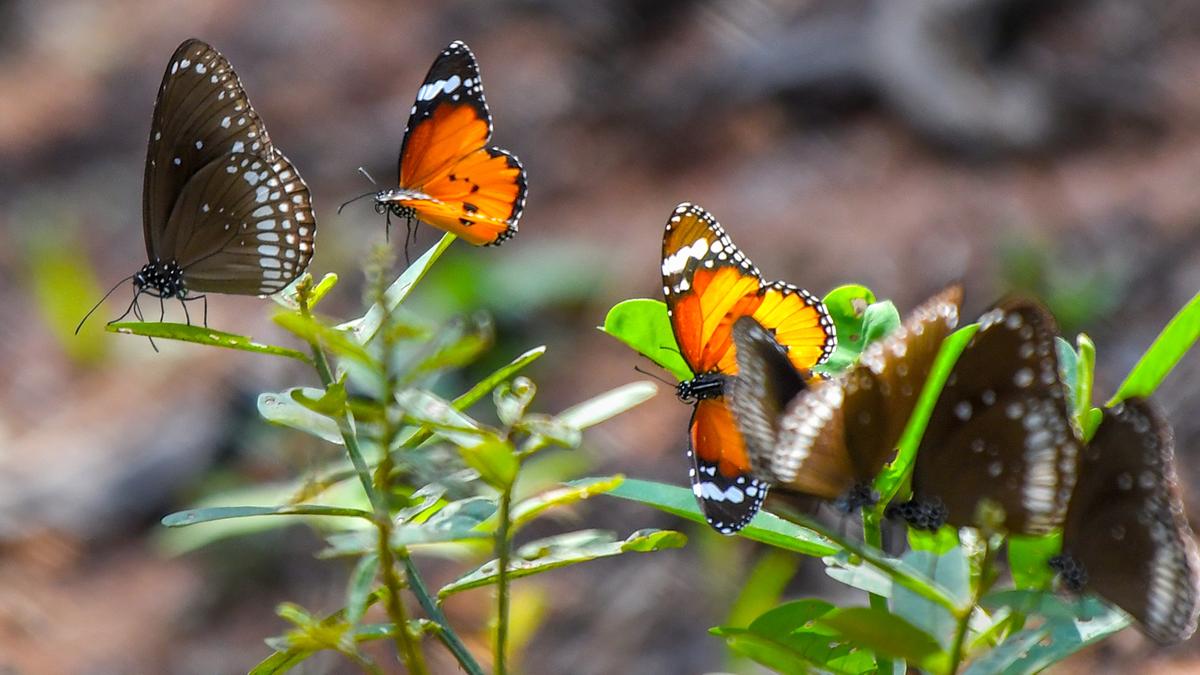
Butterfly population shrinks in some areas of Vizag, indicating grave air quality
The Hindu
A study conducted by two environmental science students of GITAM University on the butterfly population in Visakhapatnam has indicated poor air quality in some areas of Visakhapatnam
A study conducted by two environmental science students of GITAM University on the butterfly population in Visakhapatnam has indicated poor air quality in some areas of the city.
Bachelor of Environmental Management students K. Pratyusha and R. Sanjana, under the guidance of M. Kiranmai Reddy of the Department of Environmental Science, undertook the study.
Speaking to The Hindu, Ms. Kiranmai Reddy said that Central Park at Dwarakanagar in the city has 12% butterfly population as compared to the butterfly population found in thick forests. The butterfly population at Kailasagiri is 65%, whereas Indira Gandhi National Zoological Park has 85%. GITAM College at Rushikonda has a butterfly population of 45% as compared to dense forests.
“Animals or any living organisms are disturbed by noise or pollutants like carbon monoxide (CO), sulfur oxide (SOx) and nitric oxides (NOx). In the case of butterflies, pollutants are a major irritant. As the breed has no ears at birth, the noise of heavy vehicles does not affect their living conditions. However, the lean percentage of the butterfly population in Central Park indicates the presence of high pollutants in the air,” said Ms. Kiranmai Reddy.
In the lush green areas, 62 species of the order Lepidoptera were identified. Most species are from Nymphalidae, Pieridae, Lycanidae and Papilionidae. Not a single species was found in the family of Riodinidae, said Sanjana, a student.
“Tourist spots like Kailasagiri and Indira Gandhi Zoological Park, and GITAM University are thronged by people daily. Despite the high population density at these sites, the density of butterflies has not decreased. But in Central Park, which is also a tourist spot, only about 12 per cent of the population was recorded,” Ms. Kiranmai Reddy said.
Therefore, it is the utmost responsibility of every stakeholder in the city to conserve butterflies as these are the natural indicators of the city’s environment, and pollution levels can be quickly reflected by their presence rather than relying on pollution measurements, the environmentalist concluded.


Congress nominates Umesh Meti and Samarth Mallikarjun for Karnataka bypolls, keeping candidacies within influential families.

South Africa wins the toss and opts to bat in the fourth T20 match against New Zealand in Wellington.

High in the Nilgiris, a quiet ecological revival is underway. Once lost to plantations and invasive species, native grasslands and shola forests are slowly returning—bringing back wildlife, improving water security, and strengthening climate resilience. Driven by civil society groups, conservationists, and indigenous communities, this restoration story offers hope at a time when fragile ecosystems across India face growing threats.

Blasts and sirens sounded in Jerusalem as Israel warned of incoming Iranian missile threats amid escalating tensions.

275 former judges and officials criticize USCIRF's report on religious freedom, calling it biased and lacking credible evidence.

Jharkhand Police request Indian Army's help to safely defuse an active WWII-era bomb found near Subarnarekha river.

Tamil Nadu Assembly election: VCK under compulsion to consider local candidates, says Thirumavalavan
VCK leader Thirumavalavan emphasizes the need for local candidates amid concerns over past electoral losses due to outsiders.

Explore Tamil Nadu's upcoming four-cornered election contest, featuring key players DMK, AIADMK, TVK, and Naam Tamizhar Katchi.

I and EPS were appointed CMs, Stalin elected by people, says O. Panneerselvam

The ₹88.41 crore AMRUT scheme aims to eliminate Kavali's water scarcity, transforming the town’s infrastructure and services.

A 4.1 magnitude earthquake struck Sikkim's Mangan district; no casualties or property damage reported.

Telangana government updates building rules, increasing TDR usage, allowing more floors, and easing setback regulations for developers.

The escalating Israel-Iran conflict over the South Pars gas field threatens global energy security and impacts India's energy imports.