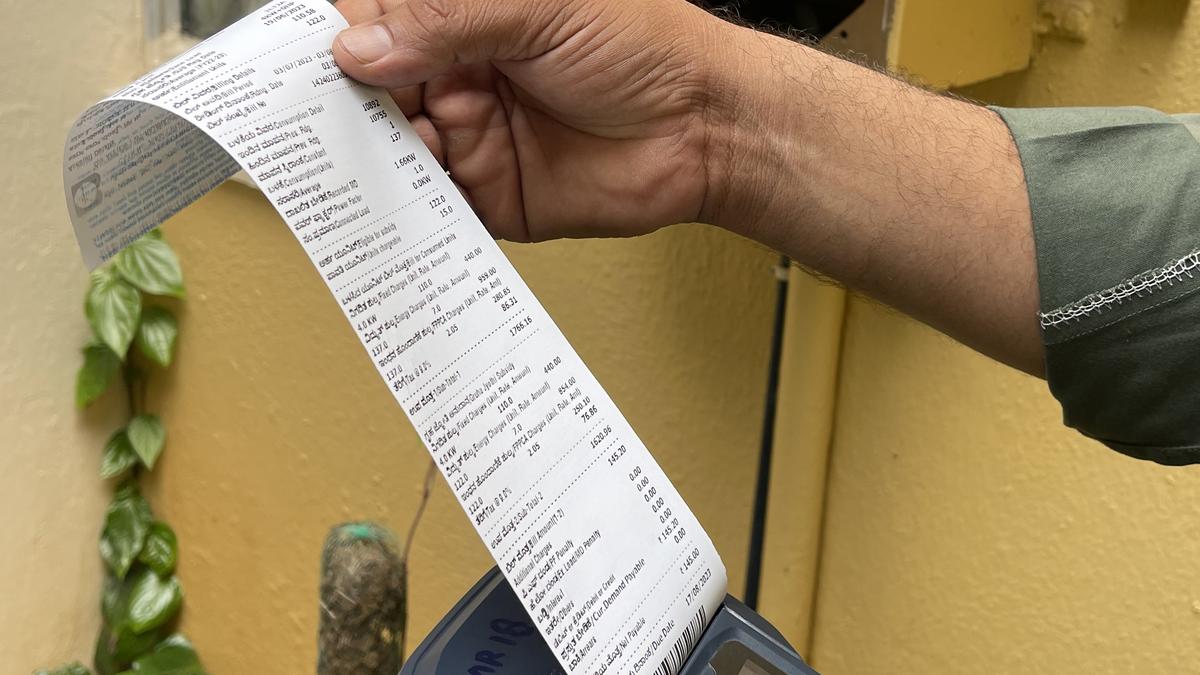
Bulk metering in residential complexes keeps residents away from Gruha Jyothi scheme
The Hindu
For years now, multiple builders in Bengaluru have provided the occupants of their residential complexes private metering from a single High Tension (HT) connection from the Bangalore Electricity Supply Company (Bescom) instead of individual Low Tension (LT) meters. While some residents had opposed it from time to time, of late, the number of residents approaching Bescom asking for ways to convert to LT has increased, thanks to Gruha Jyothi scheme.
For years now, multiple builders in Bengaluru have provided the occupants of their residential complexes private metering from a single High Tension (HT) connection from the Bangalore Electricity Supply Company (Bescom) instead of individual Low Tension (LT) meters. While some residents had opposed it from time to time, of late, the number of residents approaching Bescom asking for ways to convert to LT has increased, thanks to Gruha Jyothi scheme.
Many builders opt for a single HT connection to cut costs. According to a Bescom official, there are 850 such domestic residential complexes in the power utility’s limits. Most of them are in Bengaluru. “In the last year, residents of four or five residential complexes have come enquiring about conversion to LT as they want to avail of benefits of the Gruha Jyothi scheme. Earlier, some residents used to come asking for conversion as they did not want to miss out on benefits like solar rooftop installations, now it is Gruha Jyothi,” the official said.
Karthik (name changed on request), a resident of an apartment complex on Sarjapur Road, said Gruha Jyothi was one among the many concerns residents have due to the HT arrangement. “Even upon our insistence, the builder is adamant that he will not let us convert to individual LT meters. We are worried that once the RWA is formed and the building is handed over, then any pending dues of the builder (to Bescom) will have to be borne by all the residents of the building. They also use separate software to generate bills for our private meters and if there is a bug in the software, then it might result in some residents getting wrongfully charged more,” he said.
According to the tariff structure of Bescom, LT consumers are charged less than HT consumers. But in such arrangements, consumers are forced to pay HT price for electricity. “The LT and HT categories exist for specific purposes. Technically, each house should come under LT, and it is not right on the builders’ part to have them in HT category. The residents will miss out on the prices and benefits of LT due to this,” said Vikram Rai, general secretary, Bangalore Apartment Federation.
While many residents expressed doubts about the legality of providing electricity like this, Bescom officials said that bulk metering under HT was allowed for residential complexes. “If the residents want to change it, then they can convince the builder and get into an agreement with Bescom for their LT connection,” the official said.
The residents argued that Bescom should not let builders have this kind of arrangement as many would not be aware of the technicalities. “Unfortunately for buyers, at the time of purchasing a house, they only know that they are getting electricity. But most of them are not aware if it is LT or HT and end up in such situations,” Mr. Rai said.


The ‘Swastha Mysuru’ initiative aims to promote healthy living and preventive healthcare in Mysuru through community engagement and awareness.

Farmers in Ongole protest against BJP's policies, citing dangers to their livelihoods and demanding support for local agriculture.

From March 24, paneer queserotta, prawn tostadas, beef birria and more feature on MadCo's special Mexican pop up menu by Chef Mathangi Kumar alongside experimental cocktails, including a marigold highball

Revenue Minister Krishna Byre Gowda defends subsidies as crucial for economic growth, emphasising their role in boosting consumer demand during recessions.

Three doctors were arrested by the Mico Layout traffic police on Monday (March 23) after a video allegedly showing them triple-riding without helmets with one of the pillion riders seen drinking from a bottle went viral on social media.

Assembly protest ends in arrests as BJP targets Government over guarantees

Andhra Pradesh accelerates city gas distribution with streamlined approvals, enhancing access to cleaner energy and supporting sustainable urban development.

Sattankulam father-son custodial deaths case: Trial court convicts all nine accused police personnel
Nine police personnel convicted in Sattankulam custodial deaths; sentencing to be announced on March 30.

Minister Laxmi Hebbalkar supports local protests against a solid waste management plant in Turmuri, addressing residents' concerns.

Sattankulam father-son custodial deaths case: Trial court convicts all nine accused police personnel
Nine police personnel convicted in Sattankulam custodial deaths; sentencing to be announced on March 30.

Erode district conducts first EVM randomisation for April 23 Assembly elections, ensuring transparency and fairness in allocation.

TNCC conducts public consultation in Erode to gather community input for its upcoming election manifesto.

CID to investigate sexual assault allegations against suspended Moodbidri Police Inspector P.G. Sandesh, reveals Home Minister Parameshwara.