Building bridges to Kashmir Premium
The Hindu
Nowgam railway station in Srinagar at 1,730 metres above sea level connects Kashmir to India, offering hope and growth.
The summer sun shines pleasantly down on the Nowgam railway station in Srinagar, located at an altitude of 1,730 metres above sea level, and just nine kilometres from Lal Chowk, the city centre. It’s around 7 a.m. on June 10.
India’s railway stations usually smell of a heavy mix of diesel and fried food. Nowgam doesn’t; it smells of timber instead. The red-brick, double-storey station with a sloped green tin roof has elements of Kashmiri architecture: woodcarving on the windows and khatamband, parquet on the ceiling. The two-platform station has the cleanliness of a well-kept hospital and the security of an airport. Outside, the central kerb of the two-lane road is lined with cypresses, and on the roadside are a few signatory chinars, unique to Kashmir.
Outside the station is a larger-than-life hoarding with three faces: Prime Minister Narendra Modi, Jammu and Kashmir Lieutenant-Governor Manoj Sinha, and Chief Minister Omar Abdullah. It announces the inauguration of the Vande Bharat Express between Srinagar and Katra, opened by the PM on June 6, integrating the line with the rest of India’s. The hoarding has three bold terms to call people’s attention to it: “Strengthening national integration”, “Boosting trade and tourism”, “Empowering economic growth”.
For Abid Dar, 48, and Khursheed Dar, his father in his late 60s, apple orchardists from Pulwama district’s Newa village, the train is a journey to hope and recovery. Abid has stomach cancer, and the duo will travel to Jammu, from where they will catch another train to Delhi.
“We plan to go to the All India Institute of Medical Sciences there. The train has been a great comfort for patients like my son,” says Khursheed. Previously, the journey from Srinagar to Katra in Jammu, would have taken 24 hours; now it will take 13 hours, covering 191 km.
The operation to connect Kashmir to the rest of India was started in 1994, and declared a national project in 2008, funded by the Central government. Now, the 272-km Udhampur-Srinagar-Baramulla rail link, of which the Srinagar-Katra stretch has been developed so far, is the first train to link the Kashmir Valley to Jammu, in the plains. While trains on the broad-gauge tracks plied within Kashmir, the connection to the rest of India was only through air and road.
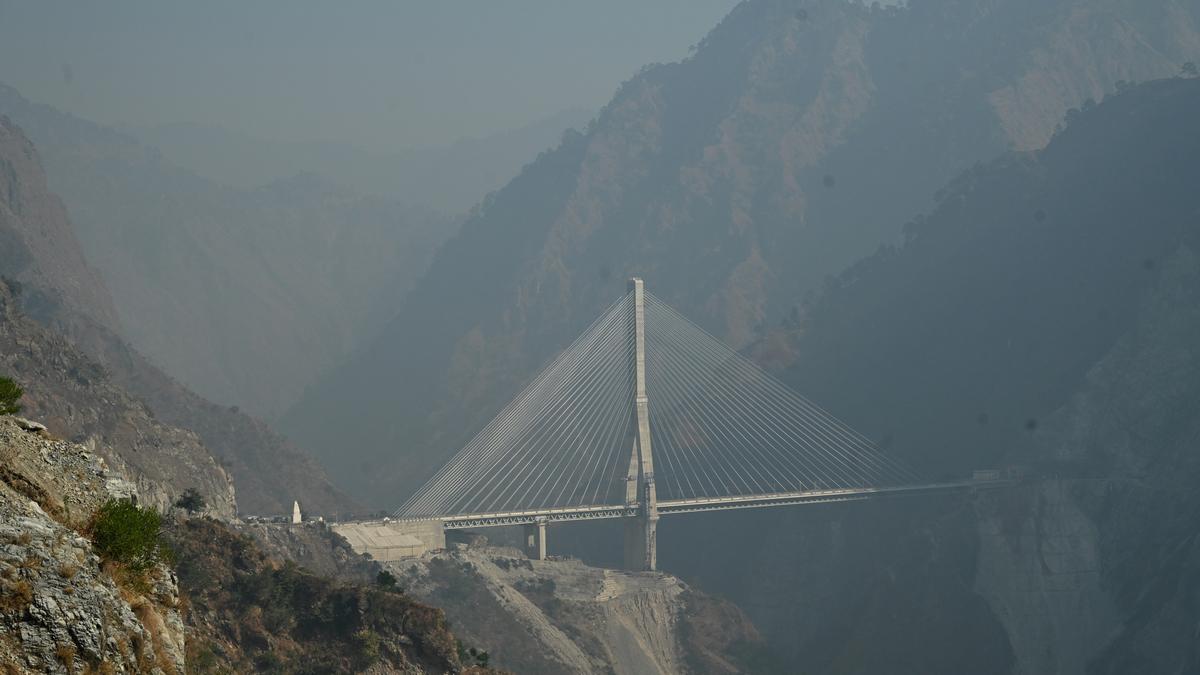
This stretch of the track that cost ₹43,780 crore runs through mountains and over deep gorges. It offers a glimpse of India’s engineering strength and the extreme Himalayan terrain, with many firsts to the project.


Perundurai's industrial growth faces challenges of pollution, water scarcity, and healthcare, impacting residents ahead of the 2026 elections.

The Travancore Devaswom Board asserts that courts should respect community beliefs in its Supreme Court submission on Sabarimala's entry issue.

Karnataka cancels Deendayal Upadhyay event at KSOU due to protocol violations, citing inconsistency with university objectives.

Illegal pickle unit busted in Hyderabad, one arrested; unhygienic stock worth ₹3 lakh seized

Karnataka has entered a state of demographic transition where a large working-age population will no longer be enough to drive economic growth, and future gains will depend on how productively people are employed, the ‘State of Working India 2026’ report said.

Key demands in Sulur Assembly constituency include reviving the powerloom sector, addressing farmers' needs, and protecting River Noyyal.

Kodihalli urges Karnataka CM to allocate ₹10,000 crore revolving fund for seamless procurement of farm products under MSP scheme.

Kerala's political parties continue to marginalize women candidates, highlighting a troubling disconnect between gender demographics and representation.

The High Court of Karnataka on Tuesday ordered the issue of a notice to the State government on a PIL petition, which had complained about disturbances caused to people residing in the localities around the National Public School situated in Rajajinagar 5th block due to use of loudspeakers with high volume in the school and parking of school buses in residential areas.

China is extensively mapping ocean floors to enhance submarine warfare capabilities against the U.S. and allies across key oceans.

AIADMK's 2026 manifesto promises free rations, women's benefits, education reforms, and economic growth initiatives for Tamil Nadu.

The vehicle towing drive will soon resume in the city to ease traffic congestion. The Bengaluru Traffic Police (BTP), in coordination with the Greater Bengaluru Authority (GBA), is set to relaunch the vehicle towing drive across the city shortly to tackle traffic congestion and illegal parking.

Panic buying, not shortage, is leading to long queues at Hyderabad petrol pumps.