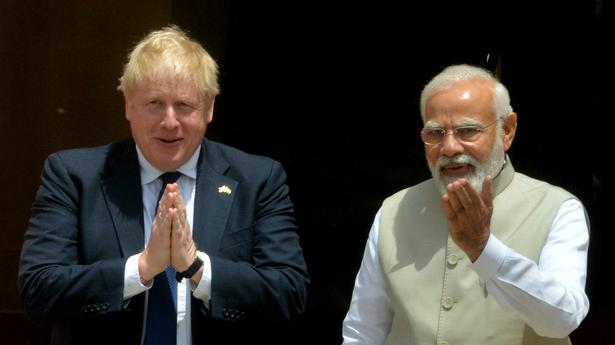
Boris Johnson hails India-U.K. FTA as ‘biggest of them all’
The Hindu
U.K. PM reiterates Diwali deadline for draft free trade agreement with India
British Prime Minister Boris Johnson on Monday reiterated the Diwali timeline for a draft India-United Kingdom free trade agreement (FTA), declaring that the proposed trade deal with New Delhi would be the biggest yet in the post-Brexit context.
In a statement to mark the start of the Commonwealth Heads of Government Meeting (CHOGM) in the Rwandan capital of Kigali on Monday, Mr. Johnson plugged for the “Commonwealth advantage” which added immense value to all 54-member countries of the organisation.
Explained | The FTA talks between India and the United Kingdom
He pointed out how India, as the largest member of the grouping, will be at the same table as the smallest for CHOGM, indicating the diverse strengths of the Commonwealth.
“The Pacific archipelago of Tuvalu (population of 11,000) will be at the same table as India (population 1.3 billion). Yet for all the differences between us, we are joined by an invisible thread of shared values, history and institutions and of course the English language,” Mr. Johnson writes in The Daily Telegraph newspaper.
“All of this creates a unique opportunity for Britain whereby the Commonwealth – and only the Commonwealth – combines vast and rapidly growing markets with a real and quantified trading advantage. That is why we are mobilising the U.K.’s regained sovereignty to sign free trade or economic partnership agreements with as many Commonwealth countries as possible. So far we’ve done 33, including Australia and New Zealand, and we’re aiming for India, the biggest of them all, by Diwali in October,” he said.
It was during his visit to India in April that Mr. Johnson and Prime Minister Narendra Modi had announced that the negotiating teams on both sides must work towards a Diwali timeline for the completion of a draft free trade agreement.


FM Nirmala Sitharaman defends Centre's cess collections, emphasizing constitutional rights and states' benefits exceeding collected amounts.

Rupee hits record low of 94.05 against the dollar, despite strong gains in Sensex and Nifty amid market volatility.

Oil companies reassure the public of no fuel shortage, urging against panic buying and reliance on verified information.

GameStop reported a 14% drop in fourth-quarter revenue on Tuesday, a sign that its struggling brick-and-mortar business continues to face immense pressure

Epic Games said Tuesday it is laying off 1,000 employees to save money as it grapples with industry-wide and company-specific challenges.

Indian stock markets rise 2% as investor optimism returns amid easing crude prices and improved geopolitical clarity.

Gold and silver prices rebounded on March 25, but remain under pressure amid high volatility and global uncertainties.

Gaining the approval of local communities has become paramount to building data centres in the U.S., Microsoft President Brad Smith said

OpenAI on Tuesday announced key leadership appointments for its nonprofit arm and committed to investing at least $1 billion through the division

EU antitrust chief Teresa Ribera, who has voiced concerns about Big Tech extending its dominance into artificial intelligence, will meet the CEOs of Alphabet, Meta Platforms and OpenAI

OpenAI is close to securing about $10 billion in fresh funding from investors, boosting its valuation to $850 billion, including the money raised, a person familiar with the matter said, confirming an earlier report in Bloomberg News

Discover the key changes in the New Income Tax Rules 2026, simplifying compliance and enhancing deductions for taxpayers.

Palantir, which won a contract to supply AI systems to Britain’s Financial Conduct Authority, will not have access to regulatory intelligence, an FCA official said