BMC elections: The two Shiv Senas and the battle for Asia’s richest civic body Premium
The Hindu
BMC's political battleground between Mahayuti and Maha Vikas Aghadi, with Shiv Sena facing existential crisis.
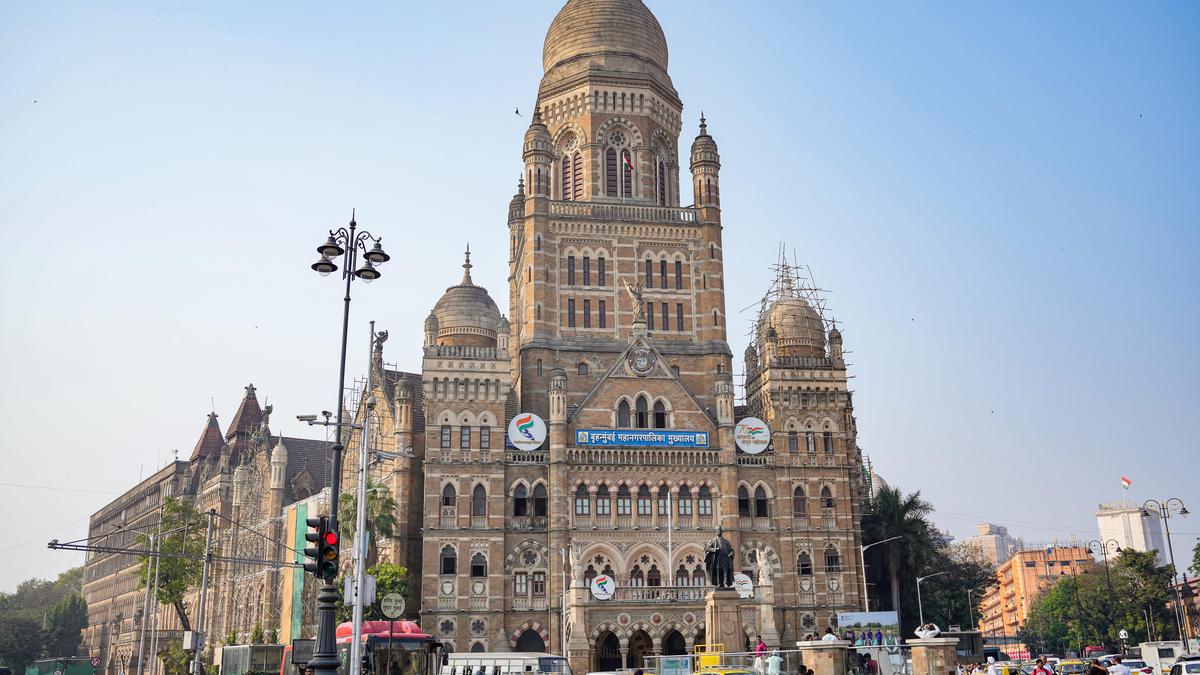
Story so far: Mumbai’s civic body, the Brihanmumbai Municipal Corporation (BMC), is the next battleground for the two political alliances — Mahayuti and Maha Vikas Aghadi — after the recently concluded State polls. Dubbed Asia’s richest corporation, the civic body’s legislature lapsed in 2022 and has since then been run by a government-appointed administrator. Dates for the polls are yet to be announced by the Maharashtra State Election Commission (SEC).
Shiv Sena, which has ruled the civic body since 1985 (barring 1992-1996), faces an existential crisis in these polls. Similar to the Lok Sabha and these State polls, the two Shiv Sena factions led by Eknath Shinde and Uddhav Thackeray are set to clash head-on for the Sena’s Marathi votebase in Mumbai. Apart from these two factions, the BJP, which has been gaining ground in Mumbai, would like to expand its domain into the BMC, Mr. Thackeray’s power centre.
With the State’s mandate favouring the BJP-led Mahayuti, it is this coalition which holds the edge, says Dr. Mridul Nile, Associate Professor in Political Science, Mumbai University. “Demography of Mumbai is changing. Lot of non-Maharashtrian population is shifting to Mumbai while the Marathi-speaking and the Konkan migrants population is shifting to other municipal corporations like Kalyan-Dombivli, Thane, Virar, Vasai and Navi Mumbai. They (Shiv Sena) will win in those corporations, however Mumbai has become more cosmopolitan and it is the BJP which has a client base of both Maharashtrians and non-Maharashtrians,” Dr. Nile says.
The Congress, on the other hand, faces a battle for survival as it seeks to hold on to its dying vestiges in the city. “Congress, which had quite a robust organisational structure in Mumbai, has lost it, just like it has nationally, to the BJP. It is now reduced to some minority slum pockets in Mumbai. I don’t believe that Congress has much of a chance of revival in this. In fact, it is not just a matter of revival, it is survival,” says Dr. Ajinkya Gaikwad, Assistant Professor of Politics, SIES College of Arts, Science and Commerce. He adds, “The idea of postponing elections, bringing up ward issues, OBC quota was a ploy to extinguish the matter for sometime; get a mandate in the State and come back strongly in the city. For BJP, losing 5-10 assembly seats is OK but stakes in Mumbai are very high.”
Here’s a look at the fierce battle for the BMC and how it became a Sena fiefdom.
Since its formation in 1966, Shiv Sena has been active in the city’s civic body polls. In 1968, when elections were held for the first time in 140 single-member constituencies across Bombay (as it was named then), Shiv Sena made its electoral debut, winning 42 seats. The Congress won 64 seats, falling two seats short of a majority. Its candidate Dr. R.N. Kulkarni became the city’s first elected mayor, defeating Dr. H.S. Gupte, who had the Shiv Sena’s backing.
Since then, Shiv Sena has steadily gained clout in the BMC. The split of Congress into two – Congress (O) and Congress (R), favoured the Shiv Sena, whoch got its candidate Dr. Hemachandra Gupte elected as mayor in 1971. In the 1973 polls, no party gained a clear majority, with Congress (R) finishing first with 45 seats, and Shiv Sena a close second with 39 seats. Sena’s Sudhir Joshi was elected as the mayor, winning 76 votes.


Hyderabad faces traffic challenges due to rising vehicle numbers; government appoints international consultant for effective infrastructure solutions.

Discover the Delhi Capitals' IPL 2026 player roster, schedule, and support staff as they pursue their first championship.

Sanya Malhotra and Aditya Rawal have started shooting for their upcoming romantic-thriller, Sundar Poonam.

Telangana Government plans a ₹940 crore double-decker elevated corridor from Panama Godowns to Hayatnagar on the Vijayawada highway.

PM Modi emphasizes India's pursuit of diverse gas and crude oil sources amid the global energy crisis due to West Asia conflict.

Kerala BJP chief Rajeev Chandrasekhar challenges Congress to prove undisclosed assets allegations in court, dismissing them as distractions.

As per information by Minister of State for Civil Aviation Murlidhar Mohol to a question in the Rajya Sabha, ₹146.89 crore has been utilised under the UDAN scheme till October 31, 2025.

Supreme Court rules women officers in Armed Forces deserve equal opportunities, upholding their right to permanent commission and pension benefits.

Telangana government assures no fuel shortage; Hyderabad police commissioner urges citizens to avoid panic buying

Telangana government employees will receive 10-20% discounts on electric vehicles to promote eco-friendly transportation, announces Transport Minister.

Discover the engaging teaser of 'Pallichattambi,' a period drama starring Tovino Thomas, releasing on April 10.

SP P. Jagadeesh reviews night patrols in Anantapur to enhance security and public safety during Operation Night Safety.

DMK announces candidates for 13 seats in Puducherry elections, reserving one seat for ally VCK amid strategic alliances.