Blue Origin launches New Glenn rocket, with 2 Mars-bound satellites aboard
CBC
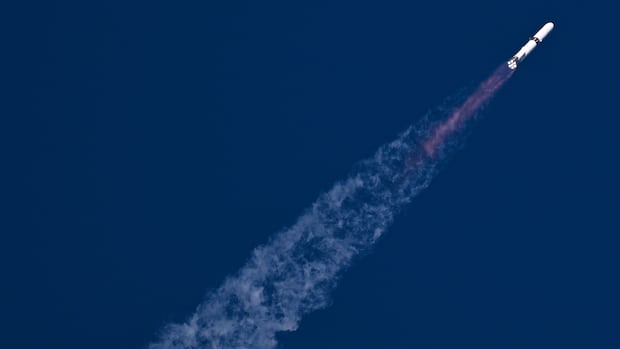
The giant New Glenn rocket from Jeff Bezos' space company Blue Origin launched from Florida on its debut mission for paying customers on Thursday, sending two NASA satellites toward Mars while also nailing the landing of its reusable booster for the first time.
The powerful two-stage rocket blasted off from Cape Canaveral Space Force Station, marking the first mission of any kind flown by Blue Origin since the inaugural launch of a New Glenn vehicle, NG-1, in January 2025.
With Thursday's launch, Blue Origin has delivered into space its first science payload for NASA or any customer, a milestone for the company in its quest to compete on a more equal footing with Elon Musk's SpaceX, the world's leading rocket launch service.
A live Blue Origin webcast showed the rocket ascending from its launch tower through clear afternoon skies in a thunder of flames and billowing clouds of vapor moments after its seven BE-4 liquid-fuelled engines roared to life. The launch followed several days of delays due to cloudy skies and a geomagnetic storm.
Some 10 minutes after liftoff, the 17-storey-tall New Glenn first-stage booster made a return landing on the deck of a barge floating in the Atlantic, achieving for Blue Origin a key objective of reusability that was pioneered by Elon Musk's SpaceX. The first attempt at such a landing in January failed.
Cheers erupted in Blue Origin's Rocket Park mission control centre at Cape Canaveral as video showed the landing of the booster, dubbed "Never Tell Me the Odds" in a reference to a line spoken by Star Wars hero Han Solo in the film The Empire Strikes Back.
About 20 minutes later, mission control confirmed that New Glenn's upper stage had achieved its primary mission — deployment of NASA's twin EscaPADE spacecraft into outer space to embark on a 22-month voyage to Mars.
Arianne Cornell, a Blue Origin vice president, hailed the launch as heralding "the next era of spaceflight for Blue Origin."
The two NASA spacecraft, dubbed Blue and Gold, are due to reach Mars in 2027 and enter synchronized elliptical orbits for an 11-month study of the planet's space weather environment.
Instruments aboard the satellites will analyze how solar winds — the fluctuating stream of high-energy charged particles from the sun — interact with the relatively weak Martian magnetic field and how that interaction may contribute to depletion of the thin Martian atmosphere.
EscaPADE, short for Escape and Plasma Acceleration and Dynamics Explorers, was originally slated for launch in October 2024, but was delayed by setbacks in development of the New Glenn rocket.
The Blue and Gold satellites were built for NASA by California-based aerospace company Rocket Lab, with instruments supplied by the University of California, Berkeley.
The rocket also carried a secondary payload from the satellite company Viasat that remained attached to its upper stage for a technical demonstration of an in-space communications relay above Earth.
When the rocket made its debut flight in January, it carried Blue Origin's own payload to space, a prototype for its maneuverable Blue Ring spacecraft it is developing for the Pentagon and commercial customers.


Toronto resident Winhan Wong's lung cancer journey began in 2016, with a nagging cough that just wouldn't go away.

Last month, Assembly of First Nations National Chief Cindy Woodhouse Nepinak pointed out on social media that history was made this year because there are a record 164 female chiefs serving across the country.

Most of humanity has a great propensity to think in the short-term, but generally, long-term considerations — air pollution, deforestation and emissions, for example — just aren't our thing.

As the COVID-19 pandemic began to unfold in early April 2020, Kolter Bouchard was just weeks into fatherhood when he noticed a lump on his neck.

Advocates and health care providers say they remain concerned about First Nations kids seeking services under Jordan's Principle even after the Canadian government’s recent promise of $1.55 billion in funding.

Contrary to science fiction, black holes are not portals to other dimensions or cosmic vacuum cleaners that swallow up everything around them.

An attempt to preserve files documenting some of the worst harms caused by Indian Residential Schools could soon head to Parliament.

A new survey suggests about three million Canadian adults are currently taking GLP-1 drugs such as Ozempic or Mounjaro and that many more would like to, but cost is a barrier.

For years, people living in Canada’s north have reported an increasing numbers of polar bears on shore, venturing into communities and encountering humans.

When Maureen Hayes first tested her Ottawa home for radon a little over a year ago, the initial reading was far below Canada's current threshold to take action.

Debate over legislation to update animal testing rules will resume next month, with one lawyer fearing it will end important research into cardio-vascular disease without proper debate.

Sam Pratt was around 13 when he first saw people talking about "looksmaxxing" on YouTube.

A group advocating on behalf of Indigenous people who cross the Canada-U.S. border says it’s disappointed by new travel advice from the federal government.