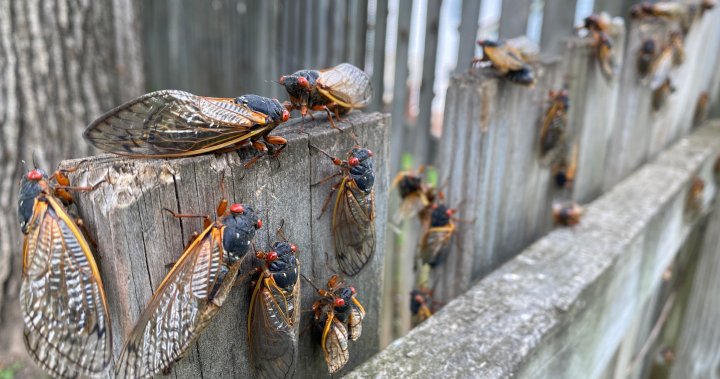
Billions of cicadas emerging amid rare double brood. Will Canadians get to see?
Global News
The two broods - one in U.S. Midwestern states and the other in the South and Midwest, with a small area of overlap in Illinois - emerge together only once every 221 years.
In a rare natural phenomenon that has not been witnessed since the 1800s, illions of cicadas are poised to emerge from their decades-long slumber across the eastern half of the United States this spring and early summer.
This double brood event will happen just south of Canada, with both 13-year and 17-year cicadas emerging simultaneously, which has not happened since 1803, when Thomas Jefferson was president. And the next time this will happen will be in 2,245.
“This is a big, big event,” said David Beresford, an entomology professor at Trent University in Oshawa, Ont. “Just like the solar eclipse, the cicada emergence is probably once or twice in a lifetime event that will be able to take advantage of, and I am quite excited.”
He stressed that these insects are harmless to humans and are “actually quite cute. They look like little tree frogs, probably one of the most endearing insects out there.”
The spectacle is set to unfold across the eastern U.S., with its northernmost boundaries extending into Illinois. Although this may be as far north as the event happens, Beresford still hopes it may appear in southern Ontario too, but admitted to speculating and remaining hopeful as an insect enthusiast.
“I hope that we catch the very edge of those and get to see it,” he said. “But it will be worthwhile going to the States to be part of this.”
Cicadas are known for their loud buzzing chorus that fills the air during mating season on warm summer days. There are more than 3,200 species of cicada worldwide, according to the Smithsonian Museum of Natural History. In Canada, Beresford said there are several species but they are “annual cicadas” meaning they may emerge from the ground every season.
In contrast, the rare double-brood event in the U.S. involves periodical cicadas that synchronize their emergence during 13 or 17-year cycles, Beresford said. Periodical cicadas occur in different regional “broods,” each consisting of one or more species with the same cycle length.


Prime Minister Mark Carney endorsed a statement after it was released by allies Thursday, expressing willingness to contribute to efforts to reopen the Strait of Hormuz..

James 'Jimmy' Gracey was reported missing after he didn't return to the short-term rental where he was staying with friends during spring break.

The Mina Al-Ahmadi refinery in Kuwait, which can process some 730,000 barrels of oil per day, is one of the largest in the Middle East.

U.S. intelligence, military and law enforcement officials unanimously agreed that an intelligence assessment doubting a foreign role in the 'Havana syndrome' should be withdrawn.

The federal Conservatives accuse the government of being too secretive about the war and point out that Canada's allies are sharing such information openly at daily briefings.

Canada is amongst several nations who 'condemn in the strongest terms recent attacks by Iran on unarmed commercial vessels in the Gulf.'

Gas prices in Canada have been climbing sharply since the Iran war began, but how much higher they could go is unclear as consumers struggle with the higher cost of living.

The Oscar-winning actor has denied all allegations against him and maintains that the incidents raised in the lawsuits either did not happen or were consensual.

European leaders have deflected entreaties from U.S. President Donald Trump to send military assets to secure the Strait of Hormuz.

All six crew members of a KC-135 Air Force refueling aircraft were killed last week in a plane crash over friendly territory in western Iraq, supporting operations against Iran.

U.S. Director of National Intelligence Tulsi Gabbard testified that the regime remains intact and Tehran and its proxies remain capable of attacking U.S. and allies' interests.

James 'Jimmy' Gracey was reported missing after he didn't return to the short-term rental where he was staying with friends during spring break.

The U.K. Health Security Agency described the event as 'rapidly evolving' and warned of the potential for further cases.