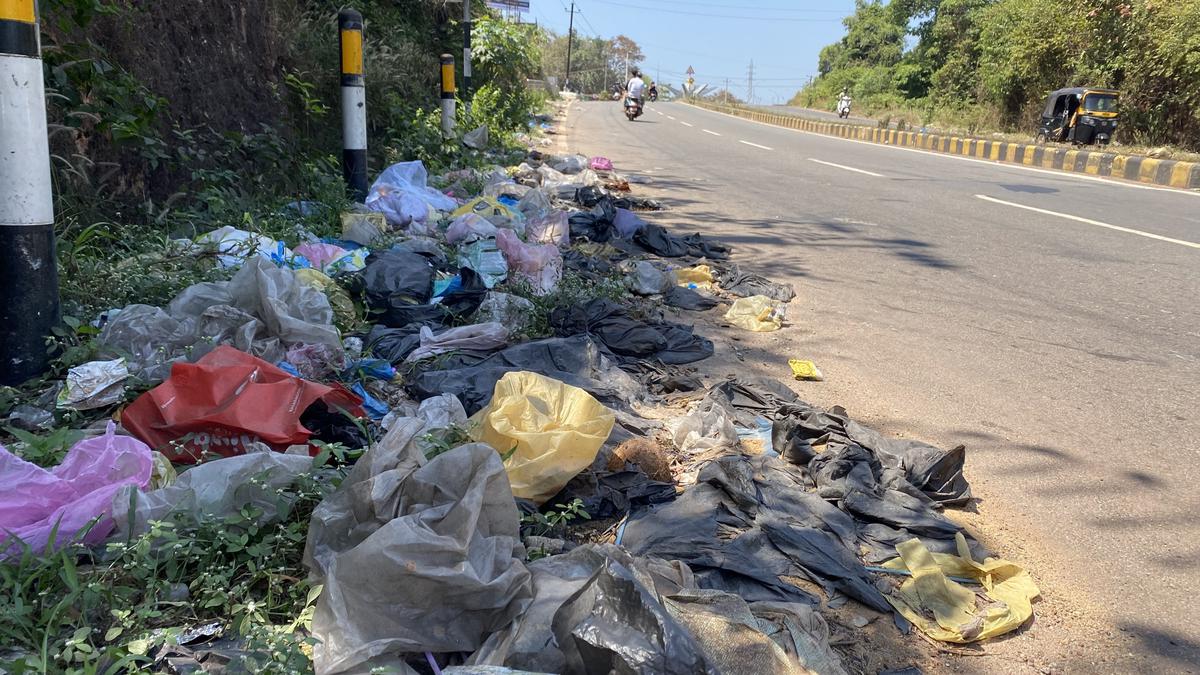
Big footfalls bring big mounds of plastic and other waste
The Hindu
Dakshina Kannada and Udupi districts, which have many pilgrim and tourist destinations that attract thousands, struggle to dispose of mounds of waste. While locals are more easily convinced to keep their environs clean, the floating population poses a problem often. The local bodies here are trying to evolve solutions.
MANGALURU
Minister for Forest, Environment and Ecology Eshwar Khandre on February 5 officially declared temple town Dharmasthala as “plastic free.” Much effort had gone into it behind the scenes by the Dharmasthala Gram Panchayat as well as Sri Kshetra Dharmasthala. The fight against plastic is no small battle in the rural areas of Karnataka, which are fast losing their “rural” character.
Plastic menace is no longer confined to urban areas and has traversed to the nooks and corners of the country. The undivided Dakshina Kannada district, that hosts several prominent pilgrim and tourist attractions, struggles with this problem. With rural local bodies lacking funds as well as expertise to handle waste, they are often piled up on the flanks of roads, highways and abandoned places.
Dharmasthala Gram Panchayat decided to fight this by taking steady steps months before the declaration. The menace was largely caused by tourists visiting Dharmasthala in thousands rather than the resident villagers. The Panchayat, therefore, organised sensitisation programmes, workshops etc., for the shopkeepers to dissuade them from selling single-use plastic, said P. Srinivas Rao, the Vice President of the Panchayat.
Panchayat President Vimala, Mr. Rao, members, the panchayat development officer and other officials visited every shop in the town to urge shopkeepers not to pack items in single-use plastic and use cloth bags instead. Similarly, shopkeepers at the Netravathi Bathing Ghat were urged not to sell shampoo sachets to prevent the plastic joining the River, which is the lifeline of Dakshina Kannada.
The declaration of “plastic free” village by Mr. Khandre was a small beginning and much more needs to be done to prevent the menace. For once, Mr. Rao says he is unable to understand the logic behind banning single-use plastic while the government continues to allow its production. Until they are available in the market, single-use plastic would continue to thrive, he said. Besides dissuading shopkeepers from packing items in plastic, the Panchayat was also preventing entry of wholesale plastic sellers into the town he said. It has also erected display boards at vantage points announcing the ban on single-use plastic and also cautioning people that they were under CCTV surveillance, Mr. Rao said.
At the Netravathi Bathing Ghat, discarded clothes too contribute to the environment pollution. Devotees who take a dip in the river discard old clothes to flow some belief thereby polluting the water body. Also, hundreds taking bath using bath soaps and shampoo too contributes to the pollution affecting the life in water. Unless people become sensitive to environmental pollution, the practice could not be stopped, though the Panchayat makes frequent appeals to them, Mr. Rao said.


BJP's B.Y. Vijayendra calls for Excise Minister Thimmapur's resignation over bribery allegations, criticizing Chief Minister Siddaramaiah's accountability.

Revanth Reddy urges media to avoid involving Cabinet colleagues in personal disputes and emphasizes government unity and accountability.

NDRF 10th Battalion celebrates Raising Day on January 19, highlighting its heroic rescue efforts and community training initiatives.

Udupi city was soaked in festive fervour from Saturday evening and Sunday for the 253rd Paryaya of Sri Krishna Mutt.

CPI(M) leader M.A. Baby discusses election strategies, targeting BJP's influence and highlighting LDF's achievements amid economic challenges.

Many commuters using the partially completed Bengaluru–Chennai Expressway have raised concerns over frequent malfunctions at the toll plazas, saying that technical glitches in the fully automated system are causing traffic congestion and eroding the time-saving benefits promised by the project.

The Royal College of Physicians and Surgeons of Glasgow (UK) has selected B. V. Manjunath, Professor and Head of Cardiology and Chief Interventional Cardiologist, A. J. Hospital and Research Centre, Mangaluru for the Honorary Fellowship of the Royal College of Physicians (FRCP) in recognition of his outstanding academic and clinical contributions to the field of cardiology

TIMS Sanathnagar's construction nears completion, with inauguration expected by Ugadi in March.

Residents of Railway Colony in Tiruchi face severe commuting challenges due to years of neglected road conditions, impacting daily travel.

Tributes were paid to N.T. Rama Rao on his 30th death anniversary, honoring his legacy and contributions to society.

Intense cold wave hits Alluri Sitharama Raju district, with temperatures dropping to 3°C and dense fog affecting visibility.

Traffic congestion on GST Road intensifies as vehicles return from Pongal celebrations, impacting nearby routes and toll plazas.

CM Stalin prioritizes Tamil Nadu's development despite Centre's funding denial, asserts Finance Minister Thangam Thennarasu.