Biden takes a political risk with his invitation to Israeli officials
CNN
When President Joe Biden asked Prime Minister Benjamin Netanyahu on Monday to dispatch a team of top Israeli officials to Washington, his hope was to preempt a large-scale ground invasion of Rafah, which the Biden administration believes would amount to a humanitarian catastrophe.
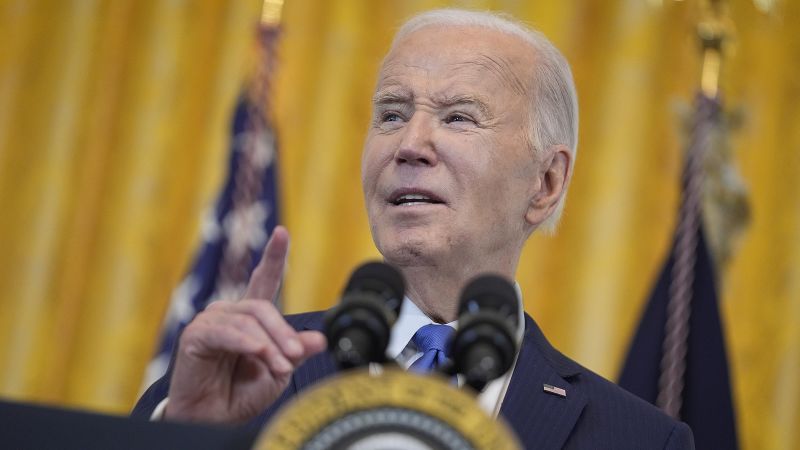
When President Joe Biden asked Prime Minister Benjamin Netanyahu on Monday to dispatch a team of top Israeli officials to Washington, his hope was to preempt a large-scale ground invasion of Rafah, which the Biden administration believes would amount to a humanitarian catastrophe. Whether the meeting, now likely to occur early next week, can accomplish that objective remains an open question. There were indications on Tuesday that – despite dire warnings Biden delivered to Netanyahu in a 45-minute telephone call a day earlier – the Israeli leader remained intent on entering the southern Gaza city, American urging notwithstanding. That leaves Biden in a now-familiar, if uncomfortable, position: Having staked out a clear position on the invasion, it appears Netanyahu is poised to reject it out of hand. “Out of respect for the president, we agreed on a way in which they can present us with their ideas, especially on the humanitarian side,” Netanyahu said Tuesday during a speech to the Foreign Affairs and Defense Committee in the Knesset. “However, I made it as clear as possible to the president that we are determined to complete the elimination of these battalions in Rafah, and there is no way to do this without a ground incursion,” he went on. The invitation to Israeli officials for talks in Washington comes with certain risks for Biden, depending how Israel decides to proceed. On one hand, he could appear ineffective in the heat of a reelection run if Netanyahu decides to move ahead with a major ground invasion despite the White House’s warnings. On the other, providing Israel with clear alternatives — even if they are rejected — could distance the president from an eventual decision to launch a major offensive.


Any attempt by the United States to take control of Cuba would be met with “impregnable resistance,” Cuban President Miguel Díaz-Canel said Tuesday, as power returned to some parts of the island following a nationwide grid collapse.

Deputy Attorney General Todd Blanche defended the Justice Department’s handling of the Jeffrey Epstein files and asserted it does not have new evidence to prosecute anyone for crimes related to the convicted sex offender, in an interview released Tuesday.

TSA workers face reality of working without pay as passengers unaware of the shutdown see long lines
More than a third of the security screeners at Hartsfield-Jackson Atlanta International Airport didn’t show up to work Tuesday, the airport’s general manager said, causing passengers to have to wait in line for up to two hours.

Any attempt by the United States to take control of Cuba would be met with “impregnable resistance,” Cuban President Miguel Díaz-Canel said Tuesday, as power returned to some parts of the island following a nationwide grid collapse.

Many assume JB Pritzker’s run for president is just a year away. His effort to engineer a victory for his lieutenant governor, Juliana Stratton, in Illinois’ Senate primary was also a victory for him and a political operation with national ambitions.

Lt. Gov. Juliana Stratton’s win in the Senate Democratic primary was also a win for Gov. JB Pritzker, while big-spending groups like AIPAC got mixed results in Tuesday’s contests.

United Farm Workers is not participating in annual celebratory events this month of its co-founder Cesar Chavez over what it calls serious allegations the union did not specify

Illinois Lt. Gov. Juliana Stratton will win the Democratic primary for an open Senate seat, CNN projects, a stunning rise for a little-known state officer now on a glide path to Washington.

President Donald Trump promised his endorsement was forthcoming in the GOP Texas Senate runoff and said he wanted whoever he didn’t pick to drop out. But now — preoccupied with the Iran war and a doomed voting bill — he’s missed a critical deadline.

The Senate has kicked off extended debate on the “SAVE America Act” — one of President Donald Trump’s top legislative priorities.

Organized crime in Latin America is proving difficult to defeat with the kind of decapitation strategy apparently favored by US President Donald Trump.

The conservative movement’s internal debate over the Iran war entered a new phase on Tuesday, with the first resignation of a prominent Trump appointee who criticized the war.

Arizona’s attorney general has filed the first-ever criminal charges in the US against a major prediction market company, accusing Kalshi of running an illegal gambling operation in violation of state law.