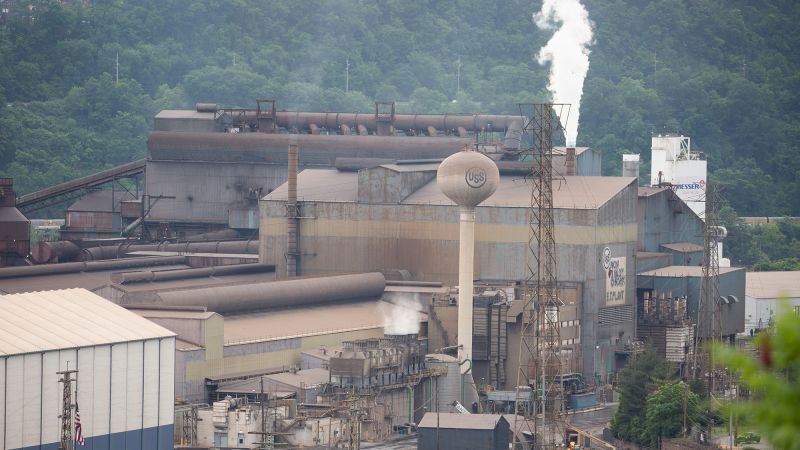
Biden, Harris and Trump all oppose the US Steel sale. But that doesn’t mean it’s dead
CNN
President Joe Biden, Vice President Kamala Harris, former President Donald Trump and his running mate JD Vance disagree on a lot. But there’s at least one thing they’re all united on: opposition to the proposed merger between Japan’s Nippon Steel and the iconic American steelmaker US Steel.
President Joe Biden, Vice President Kamala Harris, former President Donald Trump and his running mate JD Vance disagree on a lot. But there’s at least one thing they’re all united on: opposition to the proposed merger between Japan’s Nippon Steel and the iconic American steelmaker US Steel. But that might not be enough to kill the deal. Harris joined the bipartisan crowd’s opposition in a Labor Day speech to a group that included members of the United Steelworkers union, which strongly opposes the merger. “US Steel is a historic American company, and it is vital for our nation to maintain strong American steel companies,” Harris said in Pittsburgh Monday. Last month, Trump said at a Pennsylvania rally that “I will stop Japan from buying United States Steel. They shouldn’t be allowed to buy it.” Normally, that bipartisan political opposition would end a deal’s chance of survival. Such a purchase needs the approval of the Justice Department’s antitrust division and the Committee on Foreign Investment in the United States (CFIUS). And CFIUS is hardly an independent body – it is made up of members of the president’s Cabinet. In addition, the Biden administration’s Justice Department has been far more reluctant to give antitrust approval to proposed mergers, blocking some high-profile deals, such as the proposed purchase of Spirt Airlines by JetBlue. But there’s reason to think that the deal could yet win approval not only from regulators but also from the union now firmly opposed to the deal – although experts who believe that could happen say it wouldn’t occur until after the election.


The war with Iran is disrupting global oil flows, damaging energy infrastructure and raising fears of prolonged conflict. But gold, usually considered a safe haven during periods of economic uncertainty, has slumped.

US stocks and bonds fell, oil prices rose and gold had its worst week in four decades as the Iran war continues to ripple through financial markets.

The White House on Friday released its long-awaited national artificial intelligence legislative framework, a move to prevent states from enacting their own laws and enforce the Trump administration’s light-touch approach to AI regulation.

“Today is a difficult day,” CBS executives wrote to staff, explaining the cuts as a tough but necessary reallocation of newsroom resources.

President Donald Trump has repeatedly promised that Americans will get larger tax refunds this year thanks to his “big, beautiful bill.”

President Donald Trump has repeatedly promised that Americans will get larger tax refunds this year thanks to his “big, beautiful bill.”

Oil prices edged lower on Friday after a tumultuous day that saw the international benchmark surge above $119 a barrel as the Middle East conflict deepened energy supply fears.

The war in Iran has delivered what economists call a “black swan” event — an unforeseen shock so destructive, no one is immune to it.

The war in Iran is driving up the cost of buying a home in America.

Eight state attorneys general have filed an antitrust lawsuit to block Nexstar’s pending acquisition of Tegna, which would strengthen the right-leaning Nexstar and shrink the number of station owners in the US.

The Iran war has driven oil prices to their highest levels in years. Now, a wave of attacks in the past 24 hours on energy production sites across the Middle East have turned the spotlight on another crucial fossil fuel: liquefied natural gas, or LNG.

Oil and natural gas prices spiked Thursday, as Iran ramped up strikes on energy infrastructure across the Middle East and attacked one of the world’s most important liquefied natural gas (LNG) facilities in Qatar.

In normal times, the Federal Reserve would more or less ignore an oil price shock like the one we’re in now.