‘Bengaluru is more accepting of varied food cultures’ Premium
The Hindu
Prithiraj Borah remembers experiencing food-based discrimination firsthand in the summer of 2018 while working on his Ph.D. Borah, who was studying at the Indian Institute of Technology (IIT) Bombay back then, had travelled to Delhi for research and was invited to the home of some friends who lived in Munirka, South Delhi, near the Jawaharlal Nehru University campus.
Prithiraj Borah remembers experiencing food-based discrimination firsthand in the summer of 2018 while working on his Ph.D. Borah, who was studying at the Indian Institute of Technology (IIT) Bombay back then, had travelled to Delhi for research and was invited to the home of some friends who lived in Munirka, South Delhi, near the Jawaharlal Nehru University campus.
“We were making something with akhuni (a fermented soybean product commonly used in Naga cuisine) when a neighbour knocked at the door and said that you cannot cook this here,” says the Vellore-based researcher and scholar.
It got him thinking about how people of “mainstream” India often had prejudices against food consumption, particularly from the Northeast, leading him to start reading and reflecting on the issue. But then the pressing demands of his Ph.D. took over, and he could not take the idea further, he says. Then, in February 2023, he moved to Vellore, Tamil Nadu, to teach at the Department of Social Sciences and Languages at the Vellore Institute of Technology. Since he had a friend in Bengaluru, 200-odd-km away, he decided to visit the city two months after shifting to Vellore.
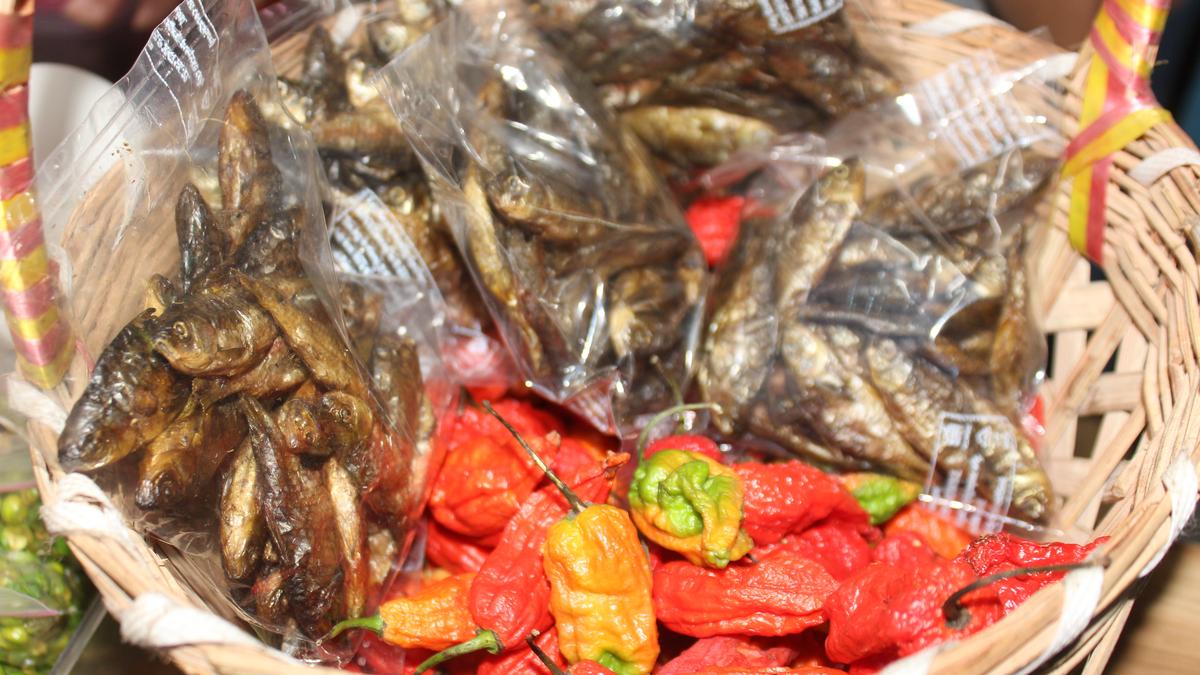
That was when he first encountered Kalyan Nagar, where his friend was staying, and discovered the many shops and restaurants selling food catering specifically to the Northeastern community. “Kalyan Nagar is a relatively new neighbourhood, and many migrants stay here,” says Borah, pointing out that the area is home to not only people from the Northeast but also Nepal, Nigeria and Bhutan. “Some of them are working as chowkidars or delivering food for Zomato, Swiggy or Dunzo. There are also people working in corporations, teaching at the university, even students,” he says.
The neighbourhood’s incredible diversity, which, in turn, had led to the mushrooming of businesses catering to this massive influx of people from the Seven Sisters, got him thinking again about food and identity. “I wanted to look at this aspect of food and belonging in Kalyan Nagar,” he says.
In August last year, Borah applied to the India Foundation for the Arts (IFA) Project 560, an initiative that supports projects that engage with Bengaluru in different ways. He submitted his proposal to “examine notions of ‘belongingness’ and ‘neighbourhood’ through an understanding of food habits of the ‘indigenous’ and ‘tribal’ communities from the northeast in Kalyan Nagar,” as the IFA website puts it, and was eventually selected.
According to the IFA website, the project fits the mandate of the Project 560 programme since it interrogates ideas around migration, labour, identity and belongingness in the microcosm of a neighbourhood, thereby enabling a layered understanding of the city. “Food becomes an important reason for people from various communities across the northeast to come together and feel a sense of camaraderie and belonging while they stay in Bangalore, far away from their homes,” it states.


CCB arrests three drug peddlers in Mangaluru, seizing ₹2.5 lakh worth of MDMA and other valuables.

TVK's 28 candidates in Puducherry include former BJP MLAs, a sitting Independent, and a retired police IG.

BRS submits notice on private member bill to Speaker

CPI-M accepts DMK's five-seat offer for Tamil Nadu Assembly elections, prioritizing INDIA bloc unity over seat demands.

Ricky Rai, son of former underworld operative Muthappa Rai, on Monday appeared before the Bengaluru Traffic Police for questioning in connection with a case involving a Lamborghini performing dangerous stunts at Anil Kumble Circle on March 21.

The Dispur election heats up as 'CongBJP' defections shape a high-stakes contest between veteran candidates from BJP and Congress.

Bengaluru's M. Chinnaswamy Stadium conducts readiness drill ahead of IPL 2026, ensuring upgrades and technical preparations are complete.

First-level randomisation of EVMs completed in Nagapattinam for upcoming elections, ensuring transparency and security.

A district-level committee in Krishnagiri has been formed to assess and verify seizure claims of goods and cash.

Minister Anam Ramanarayana Reddy pledges government support for local fishermen and farmers facing challenges in Andhra Pradesh.

MP M. Sribharat urges collective efforts to revive Visakhapatnam Steel Plant, highlighting key reforms for crucial recovery and growth.

141 candidates have filed nominations for Kozhikode's Assembly elections, with scrutiny on March 24 and campaigning intensifying.

BJP's Vijayendra accuses Congress of using money to influence Bagalkot bypolls, urging voters to reject their tactics.