Barnier voted out in no-confidence motion: Three charts to explain France’s political uncertainty
The Hindu
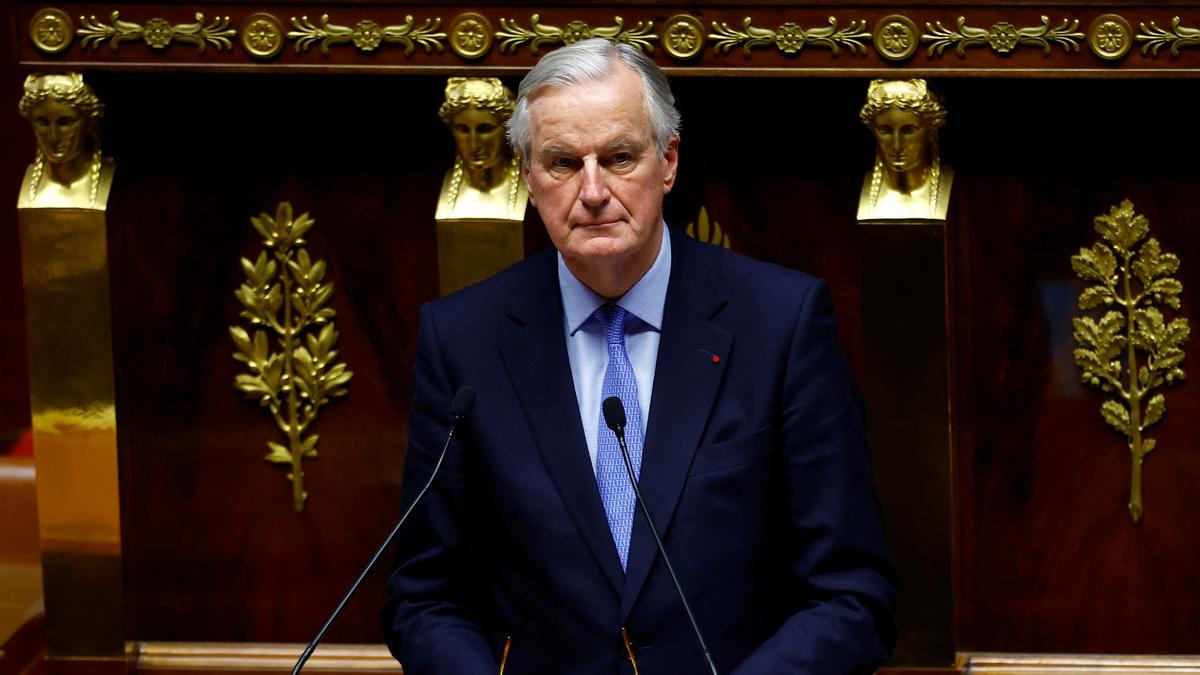
France political crisis: After France Prime Minister Michel Barnier lost a no-confidence motion in the country’s Assembly, political uncertainty has risen again after Macron’s July snap elections. Here are three charts to explain the situation.
France’s current crisis is the second in only six months when French president Emmanuel Macron called a snap election in July to reiterate his government’s strength. However, the move backfired. Ensemble, the alliance that his party headed, won fewer seats than the previous election. The two other main alliances - left alliance New Popular Front and right alliance National Rally - increased their seat tally, with the NPF winning the most seats.
This resulted in a hung parliament, where no party wins a majority of 289 or more seats in the 577-seat Assembly.
The results cast uncertainty about the country’s political future. Credit rating agency S&P said in a post-election note that it anticipated a “struggle to implement meaningful policy measures” and “a persistent risk of a vote of no-confidence”, according to Reuters. A hung parliament makes it harder to pass legislation, since decisions have to pass through a broader consensus.
Mr. Macron’s immediate concern after the election was the selection of a Prime Ministerial candidate. In the case of no majority party, this process becomes more complicated.
Since no party won a majority, Mr. Macron had to find a candidate who can withstand no-confidence motions in the future by garnering enough support. After negotiations across the board with both left and right parties, Mr. Macron appointed Michel Barnier, a moderate right-wing politician, as Prime Minister with tentative support from National Rally amidst protest from the NFP alliance. It accused Mr. Macron of “stealing” the elections by ignoring the “will of the people.” ‘
However, even within the left alliance, it was difficult to arrive at a consensus candidate. The transition took more than a month, the longest in several decades.
The process begins again, with Macron having to build support a second time from different parties.


Russia claims control of Potapivka village in Ukraine's Sumy region amid ongoing military efforts to establish a buffer zone.

Iranian missile strikes on Israeli towns cause widespread damage and injuries, marking a significant escalation in the ongoing conflict.

As Gor makes first trip as U.S. Special envoy to South Asia, Delhi watches strategic signals closely
Sergio Gor's inaugural trip as U.S. Special Envoy to South Asia signals strategic U.S. engagement amid regional tensions.

Slovenians vote in a tight election between liberal and populist candidates, impacting the country's future domestic and foreign policies.

Netanyahu asserts U.S.-Israel alliance fights Iranian threats, emphasizing global security after missile strikes on Israeli and European targets.

Israeli settlers attack Palestinian villages in the West Bank, causing injuries and destruction amid ongoing settlement expansion.

Britain asserts no evidence of Iran planning missile strikes on Europe, despite Israeli claims of missile capabilities.

UNESCO reports over half of countries have banned phones in schools due to concerns about attention, cyberbullying, and social media impact.

Analysis reveals a U.S.-operated Patriot missile likely caused a pre-dawn explosion in Bahrain, injuring numerous civilians.

Sri Lanka raises fuel prices by 25% amid ongoing West Asia conflict, impacting petrol and diesel costs significantly.

Iran strikes near Israeli nuclear research center as Trump threatens attacks on Iranian power plants
Iran's missile strikes near Israel's nuclear site escalate tensions as Trump threatens retaliation against Iranian power plants.

Saudi Arabia intercepts one of three ballistic missiles targeting Riyadh amid ongoing regional tensions and threats from Iran.

Iran's death toll exceeds 1,500 amid escalating war, with heavy airstrikes and shifting U.S. and Israel strategies reported.