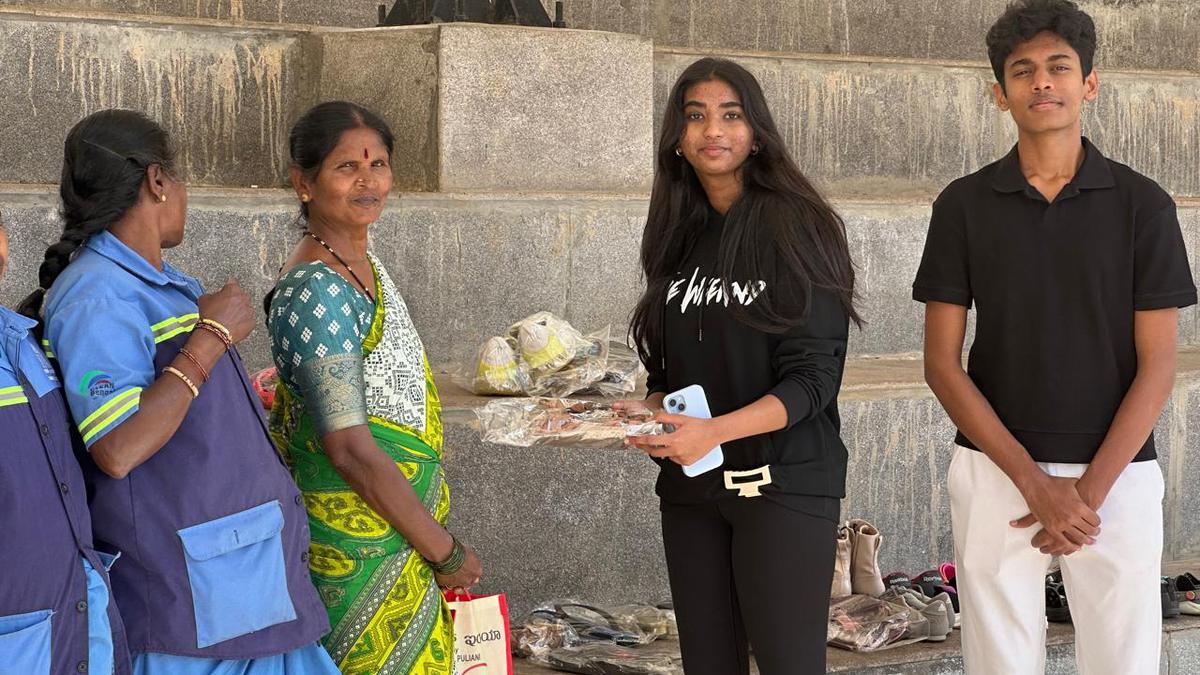
Barefoot no more: Club Hasiru Sole, an upcycling movement led by two school students of Bengaluru
The Hindu
Through their Club Hasiru Sole, Class 11 students Vedika Balachander and Ameya Uchil collect, restore, and distribute old shoes to those in need, promoting sustainability and community engagement.
Two students from a private school in Bengaluru have formed Club Hasiru Sole, through which they collect old footwear from the houses in their neighbouhood, restore them and distribute them to the children in orphanages, slum communities, pourakarmikas, sanitation workers and others.
Vedika Balachandar of Mallya Aditi International School, Yelahanka New Town, and Ameya Uchil, from The International School Bangalore (TISB), Sarjapura-Varthur Road, both from Grade 11, noticed many children and adults walking barefoot through streets littered with waste, exposed to sharp objects, and dirt.
This led to the inception of Club Hasiru Sole in February 2023, an initiative centered around upcycling discarded shoes.
Vedika and Ameya began by collecting old shoes from local households, schools, and community centers. Club Hasiru Sole has been running with 14 members, and as of now, they have distributed more than 6,000 pairs of shoes to various rural communities, domestic workers in various apartment complexes, children in orphanages, pourakarmikas of Bruhat Bengaluru Mahanagara Palike (BBMP) and others.
“While many of us throw away used footwear even if they are in a reasonable shape, we see children walking with no footwear. Same thing with BBMP pourakarmikas, whose footwear faces severe wear and tear. I met Ameya at a rural community education event, and that’s when we decided to do something which will make a difference on the ground. We did the research, created an ecosystem of donors and volunteers, engaged labour to upscale used footwear and distributed them,” says Vedika.
“Last year, we went to an event in Mumbai. During this time, the idea of distributing shoes to the children and people of Dharavi slum came to mind. Dharavi in Mumbai is the largest slum in the country, and we took more than a thousand pairs of shoes from here and distributed them. We are doing all these activities with our pocket money and the cooperation of our parents,” says Vedika.
Ameya says that restoring the shoes is hard since finding cobblers is difficult in Bengaluru nowadays. “Sometimes, we go to the city outskirts to find them. This way, we are helping them earn a livelihood too,” she observes.


Abhishek Banerjee challenges BJP's Suvendu Adhikari in Nandigram, pledging community health initiatives if Trinamool Congress wins.

Rising LPG shortages in Karnataka boost firewood demand, reviving an informal market as households and hotels seek alternatives.

Against the backdrop of intense poll activity, a 400-metre stretch of an arterial road in the outskirts of Chennai (technically in Madurapakkam panchayat under Tambaram assembly constituency) presents a salute to the idea of res publica, which underpins India’s system of governance, where citizens have a say, at least before a government is securely ensconced in the seat of power. A Republic Day initiative shines bright every night

Fadnavis claims zero FIR in Ajit Pawar crash is a defamation attempt by Karnataka against Maharashtra's investigation efforts.

Set to unfold as a one-day pop-up on April 5, the Easter Sadya brings together both vegetarian and non-vegetarian menus, offering a peek into the food traditions of the Syrian Christian (Nasrani) community. While the traditional Sadya is often associated with dishes such as sambar, avial, and rice, this version expands to include community-specific festive dishes.

BJP nominates mother of R.G. Kar victim Abhaya to contest from Panihati in West Bengal Assembly elections.

Veteran Malayalam actor-director E.A. Rajendran passes away at 71, leaving behind a rich legacy in the film industry.

Dakshina Kannada Zilla Panchayat has rolled out digital mode of water bill generation and collection in 23 gram panchayats on a pilot basis for the first time in Karnataka. This is set to be extended to the remaining 200 panchayats shortly, according to the Zilla Panchayat Chief Executive Officer Narwade Vinayak Karbhari.

Bengaluru police questioned a man carrying ₹6 lakh for medical expenses at Vidhana Soudha, later releasing him after verification.

BJP accuses Bengaluru's Congress government of corruption in e-Khata issuance, halting infrastructure projects due to financial mismanagement.

Misinformation in Hyderabad sparks panic buying, causing disruptions as residents react to unfounded rumors of an impending lockdown.

Bengaluru Metro extends services until 2 a.m. on March 28 for IPL match, ensuring convenient travel for spectators.

A bus truck-collision in Andhra Pradesh's Markapuram district, killing several. Catch LIVE updates here!