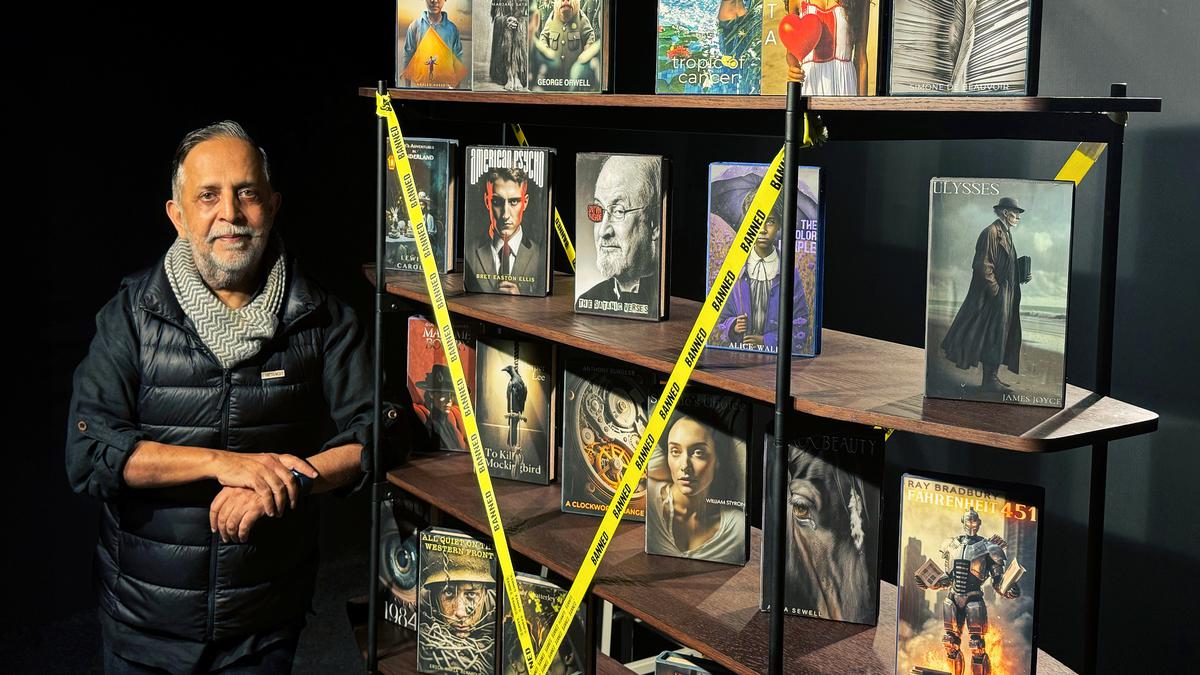
Banned | Rohit Chawla’s installation on books that were silenced
The Hindu
Rohit Chawla questions censorship and authority in Banned, a thought-provoking exhibition in Delhi
On February 7, 1497, friar Giralamo Savanarola raised a blaze in Florence, Italy. His supporters, called the Weepers, collected and burned thousands of objects deemed immoral, including books, cosmetics, playing cards, musical instruments, and artworks. Ironically, three months later, the people asked him to prove his piety by walking on fire; he refused. He was charged with heresy and sedition by the very Pope that he had called corrupt. Savanarola was hung and his body burnt in the same square where the bonfire of vanities had been held.
“Ever since the written word has existed, so has censorship. Some of the most recognisable classics, including the Bible and works by Shakespeare, were once considered controversial and were banned,” says Alka Pande, curator of The Art of India exhibition, where Rohit Chawla debuted Banned. The Goa-based photographer’s installation reimagines the covers of 30 books that have been or are currently banned in various countries around the world, including the Satanic Verses, To Kill a Mockingbird, and Alice in Wonderland.
“We live in a time of self-censorship where most creative people are mindful of what they say in a public forum,” says Chawla. “So, I’ve taken some of the greatest literary works and highlighted how they were censored and forbidden. It’s an oblique way of focusing attention on the prevailing ban and cancel culture.”
Holding the world accountable
Chawla has always been fascinated by covers. “I’ve done about 400 — of mostly mainline news magazines and glossies. So, the idea of reimagining some of these book covers seemed like an interesting thing,” says the visual artist whose campaign, Untangling the Politics of Hair — about Mahsa Amini’s custodial death in Iran — won the first Industry Craft Gold Lion for India (and integrated marketing communications company FCB) at last year’s Cannes Lions.
It’s interesting to see what books were prohibited in which countries. Persepolis, with its description of the Iranian Revolution, is banned in Iran. But it was briefly disallowed in Chicago as well, in 2013. When its proposed proscription became a high-profile story, the authorities claimed that the word “censorship” was inappropriate, as teachers could still assign the book as long as they were willing to sit through a class on how to teach such ‘sensitive material’. “They think kids are stupid,” Marjane Satrapi, the French-Iranian author, noted in an interview on the ban. “Children are not dumb.”
Some books on Chawla’s list offer curiosity value, like D.H. Lawrence’s Lady Chatterley’s Lover. “But the idea that children will not read To Kill A Mockingbird [Harper Lee] and Catcher In The Rye [J.D. Salinger] feels personal because they are books that have given me the courage to stand up for my ideals — something I would wish for every child,” he says.


Alandur faces unresolved civic infrastructure issues, including lack of water and drainage, despite recent development efforts ahead of TN Election 2026.

Delhi's fiscal deficit surged by 62% in 2025-26, reflecting revenue declines and raising concerns about the city's economic health.

Kerala Assembly Elections 2026: Anvar and Firos face multiple namesake rivals in their constituencies amid a crowded candidate field.

Kamal Haasan announces support for DMK in 2026 elections, emphasizing the need for 'Dravidian Model 2.0' for Tamil Nadu's welfare.

DMK finalises seat-sharing for the 2026 Tamil Nadu Assembly elections, contesting 175 seats with allies DMDK and VCK.

Parliament may adjourn early for Assembly elections, allowing MPs to campaign in key election-bound states.

Indian vessels can freely sail through the Strait of Hormuz without needing permission, confirms a senior government official.

The Hindu Morning Digest gives a select list of stories to start the day. Read the top news today on March 25, 2026

An IndiGo flight at Vijayawada airport was grounded due to a tyre burst, but all 79 occupants are safe.

Tamil Nadu Assembly election 2026: TMC(M) gets five seats in NDA, to contest on BJP's 'Lotus' symbol
TMC(M) secures five NDA seats, to contest Assembly elections using BJP's 'Lotus' symbol in Tamil Nadu.

The Karnataka government will discuss with officials the possibility of creating a portal for unemployed youth to share their details and access job opportunities in micro, small and medium enterprises (MSMEs), Minister for Small Industries and Public Enterprises Sharanabasappa Darshanapur said in the Legislative Council on Tuesday.

AIADMK's 2026 manifesto promises free rations, women's benefits, education reforms, and economic growth initiatives for Tamil Nadu.

U.S.-Israel war on Iran LIVE: Follow The Hindu for updates on the West Asia conflict on March 24, 2026