Bangladesh and Myanmar brace for Cyclone Mocha as powerful storm nears
Global News
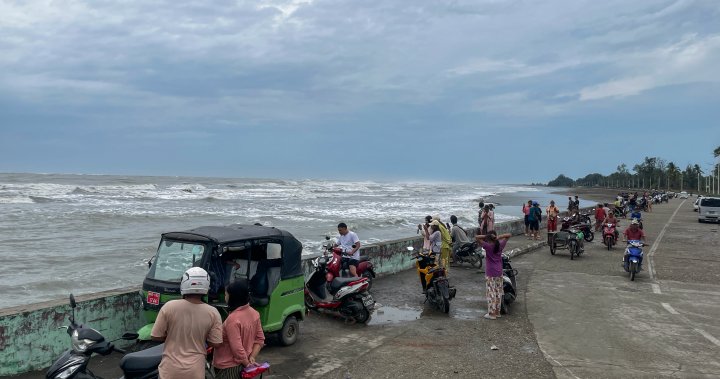
In Myanmar, rains and winds were picking up since Friday and prompted more than 10,000 people in villages around Sittwe in Rakhine state to seek shelter in sturdy buildings.
Volunteers in Bangladesh’s coastal districts were using loudspeakers to urge people to seek shelter on Saturday as the delta nation braced for an extremely severe cyclone, which is expected to slam ashore in Bangladesh and Myanmar in the next 24 hours.
U.N. agencies and aid workers prepositioned tons of dry food and dozens of ambulances with mobile medical teams in sprawling refugee camps with more than 1 million Rohingya who fled persecution in Myanmar.
The camps at Cox’s Bazar are in the path of Cyclone Mocha, which was closing in on the coast of southeastern Bangladesh and Myanmar with wind speeds of up to 200 kilometers (125 miles) per hour and gusts up to 220 kph (136 mph), the Indian Meteorological Department said. It’s projected to make landfall on Sunday between Cox’s Bazar in Bangladesh and Kyaukpyu in Myanmar.
Bangladesh, with more than 160 million people, has prepared more than 1,500 cyclone shelters. The navy said it’s keeping ready 21 ships, maritime patrol aircraft and helicopters for rescue and relief operations.
In Myanmar, rains and winds were picking up since Friday and prompted more than 10,000 people in villages around Sittwe in Rakhine state to seek shelter in sturdy buildings including monasteries, temples and schools, said Lin Lin, the chairman of the Myittar Yaung Chi charity foundation.
“Currently, about 20 places have been arranged for people to stay in Sittwe. But because there were more people than we expected, there was not enough food for the next day. We are still trying to get it,” he said.
Speaking from Cox’s Bazar across the border in Bangladesh, the International Organization of Migration’s deputy chief of mission, Nihan Erdogan, said Bangladesh put in place a massive preparedness plan.
He said his agency had trained 100 volunteers in each of the 17 refugee camps on how to alert rescuers using flag warning signals when heavy rains, floods and strong winds lash the region. “Emergency shelter materials and hygiene kits are readily available, and personal protective gear has been provided to all volunteers.”


Canada finished eighth in the gold-medal standings with just three. As for total medals, Canada placed sixth, with four silver and eight bronze.

Canada produced on average 5.3 million barrels per day of crude oil in 2025, according to the Canada Energy Regulator, making the upcoming production jump a 2.6 per cent increase.

Iran's foreign minister said the U.S. attacked Kharg and Abu Musa islands from locations in the United Arab Emirates, a claim the UAE rejected.

Citing "a more contested environment", British Prime Minister Keir Starmer and his Irish counterpart Micheal Martin said the exercises would begin in September.

Only one in four (23 per cent) Canadians approve while, 16 per cent are unsure either way. Forty-two per cent were found to strongly disapprove.

Countries around the world are grappling with skyrocketing costs for key commodities like oil and fertilizer as the war with Iran continues to upend global trade.

The U.S. Central Command said the crash followed an unspecified incident involving two aircraft in “friendly airspace,” and that the other plane landed safely.

Water treatment centres in the Persian Gulf region are under threat amid the Iran war, with desalination plants in areas like Bahrain taking damage from strikes.

John Gradek said that the price of jet fuel is up about 30 per cent and the cost of fuel represents about 30 per cent of an airline's operating costs.

Iran's unrelenting attacks on shipping traffic and energy infrastructure in the Persian Gulf pushed oil back above $100 a barrel on Thursday.

Concerns were raised in a document sent to British Prime Minster Keir Starmer in December 2024 when he was considering appointing Peter Mandelson.

Canada and a group of dozens of other countries have agreed to release 400 million barrels of oil from their strategic reserves as the Iran war threatens the global supply.

Iran's military command said on Wednesday the world should be prepared for oil to hit US$200 a barrel, as three more ships came under attack in the blockaded Gulf.