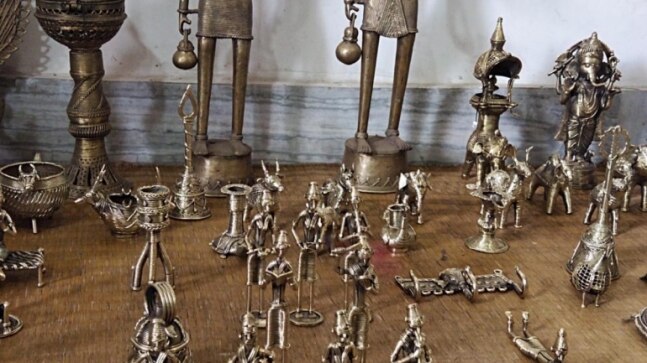
Attempt to revive Covid-hit Dhokra tribal craft in Odisha
India Today
Dokra or Dhokra is a non-ferrous metal casting that has been used in India for over 4,000 years. Alluringly, the handicraft is still prepared by hand by village artisans of Odisha, without the involvement of any machines. Anwesha tribal arts and crafts have scaled up their production with the village artisans to knit up the lost period due to the pandemic.
Dokra or Dhokra is a non-ferrous metal casting that has been used in India for over 4,000 years and is still continuing. One of the earliest known lost wax artefacts is the dancing girl of Mohenjo-daro.
Covid-19 pandemic has disrupted the tribal craft in a big way, especially those in rural tribal interiors. The artisans have been reeling under the Covid-19 crisis since its outbreak in 2020. To add to their woes, the second and the third waves of the Covid pandemic gave a devastating blow to thousands of artisans, workers and weavers across odisha, thus putting the livelihood of over 3000 odd workers depending on it at stake.
There was complete severance of the production to sales cycle, since most of their products belonged to the non-essential category and they were unable to sell them during the Covid induced lockdown.
‘Dokra’ or Dhokra is a typical tribal craft in bronze with its mesh-like features giving it a distinctive beauty. The socio-religious links to the Dhokra craft are strong in Hindu society, which dates back to the prehistoric times of the Harappa and Mohenjo-daro periods of the Indus Valley Civilization.
Notably, during different festivals like manobasa and laxmi puja, the Dokra materials are purchased and worshipped in the house.
Alluringly, the handicraft is still prepared by hand by village artisans of Odisha, without the involvement of any machines.
The products of Dhokra artisans are religious images, elephants, horses, peacocks, owls, lamps, bowls, which are very popular and in great demand in local markets as well as foreign markets.


US President Donald Trump dialled Prime Minister Narendra Modi on Tuesday, four weeks after the Iran war started. The timing is crucial, coming on the back of Pakistan's emergence as Trump's choice as a mediator. Was Trump's call a damage-control exercise?

The armoured regiments of the Army have inducted around six Shaurya Squadrons that add the power of drone-warfare to the tanks.

The Iranian embassy in New Delhi thanked India and Kashmir for sending humanitarian aid, then quietly deleted the posts. Could pressure and online vitriol from Pakistan-based users be to blame?

The incident is believed to have taken place between 2 am and 3 am on Sunday. The viral footage of the incident showed the luxury car executing high-speed turns and repeated drifts at the Anil Kumble Circle in Bengaluru.

Lalu Prasad Yadav's elder son, Tej Pratap, is speaking of wisdom and devotion again. He's no longer the Krishna bhakt that he was. He is now sporting saffron attire in Reels, and is propagating Shiva bhakti. His new Instagram handle is SantTejPratapYadav. After political and personal isolation, Teju bhaiya seems to have found solace in Rudraksha, Shiva bhajans and the Shiva Puran.

"At that time, we did not know that one of them was an Indian billionaire," a Maldives official said after rushing to aid victims of a speedboat crash involving industrialist Gautam Singhania.


Authorities said the metro tunnel lies approximately 80 to 100 feet below ground level. The breach was discovered near Mandai Metro Station, raising safety concerns.


Randhawa had accused the former minister of pressurising him to allocate a tender for a Godown to his father, Sukhdev Singh Bhullar. Before his death, the officer had also written to his seniors, accusing Bhullar of forcing him to falsely confess to taking bribes for tenders.

According to exclusive information from top defence sources, the operation is being conducted with the highest degree of caution and minimal publicity to ensure the safe evacuation and transit of Indian-flagged cargo ships.

According to the Delhi Fire Service, the bus lost control and overturned near the Jhandewalan Temple in Delhi's Karol Bagh area. The department added that the bus, carrying at least 25 passengers, came from neighbouring Rajasthan.

Rohit Pawar, nephew of late Maharashtra Deputy CM Ajit Pawar, has filed a zero FIR in Bengaluru over the January 28 plane crash in Baramati that killed his uncle and four others. Rohit Pawar has alleged a "larger criminal conspiracy" behind the crash.