At the cutting edge of medical science for more than a century
The Hindu
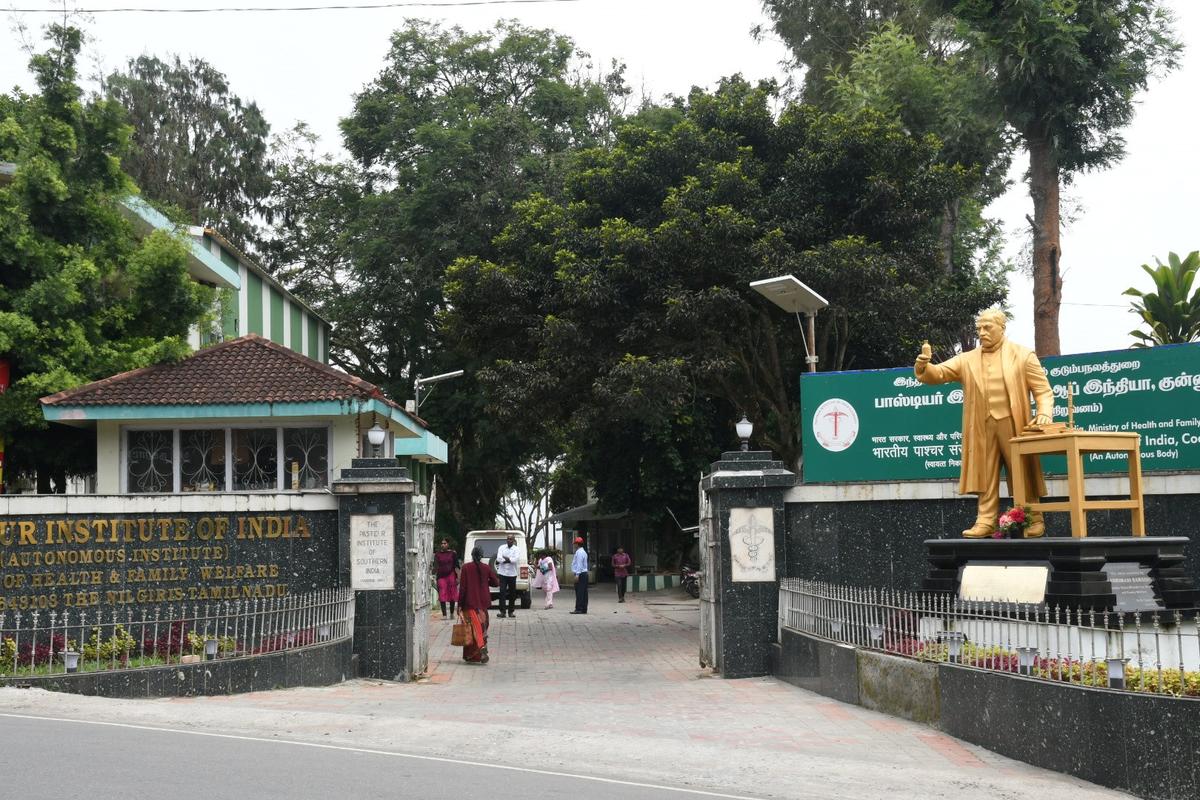
Pasteur Institute, an autonomous body under the Ministry of Health and Family Welfare, was set up to produce anti-rabies vaccines at a cost of ₹1 lakh in 1907, with part of the charitable contribution made by American philanthropist Henry Phipps
For over a century, the Pasteur Institute of India in Coonoor has been at the cutting edge of vaccine development and manufacturing in India.
Located opposite the famed Sims Park in Coonoor, it forms part of the town’s iconic landscape. It is known for its gold-coloured minarets that form the corners of the main-block, where the director’s office is located, and for its British racing-green roof tiles. A statue of Louis Pasteur, the famous French scientist, is located at the entrance.
An autonomous institute under the Union Ministry of Health and Family Welfare, the Pasteur Institute was set up initially at a cost of ₹1 lakh in 1907, with a part of the charitable contribution made by American philanthropist Henry Phipps. He contributed ₹50 lakh for the establishment of medical institutions across India after a young English woman, Lily Pakenham Walsh, died of hydrophobia in 1902 as she couldn’t get the anti-rabies treatment in time, says Dr. S. Sivakumar, Director of the Pasteur Institute of India. Initially called the Pasteur Institute of Southern India, it became the Pasteur Institute of India in 1977.
Quoting from his father’s 1952 article, Venugopal Dharmalingam, honorary director of the Nilgiri Documentation Center (NDC), says, “During the Second World War, the organisation of an extensive blood bank service in the province made it necessary to have plasma processing laboratories, and the Pasteur Institute, Coonoor, opened in 1942 a section for this purpose. Besides its pioneering and leading role in research in rabies, the institute has played a noteworthy part in public health work by serving as a depot for the distribution of prophylactic vaccines for cholera, assisting in the prompt diagnosis of such contagious epidemics as cholera, plague and enteric fever, and, at times, helping directly in prophylactic mass inoculation when such epidemics were threatening to get out of control.”
The institute was set up to produce anti-rabies vaccines, says Dr. Sivakumar. In 1957, the Asian flu virus was first isolated at the Pasteur Institute. “In 1970, the first three batches of the oral polio vaccine were also manufactured here, though production was taken up later at other facilities across India.”
Currently, anti-rabies vaccines are not being produced at the Pasteur Institute. However, the facility does treat patients who have suffered dog-bites. After 2019, when GMP state-of-the-art facilities on a par with international laboratories were set up at a cost of ₹137.02 crore, work began on the manufacture of the diphtheria, tetanus and pertussis (DTP) and tetanus and diphtheria (TD) vaccines. The production is scheduled for 2023.
“At present, 303 staff members are working at this institute, which is equipped with bulk manufacturing production units, quality control, animal breeding and testing facilities, utility, warehouses and also a small research and development centre,” says Dr. Sivakumar.


The government plans to amend the FCRA, introducing new regulations for NGO asset management and accountability for key functionaries.

The draft policy for “Responsible Digital Use Among Students”, released on Monday by the Department of Health and Family Welfare, has recommended that parents set structured routines with clear screen-time rules and prioritise privacy, safety, and open conversation with children on digital well-being.

Police Observer Sushant Kumar Saxena conducts surprise inspection at Shencottai police station, reviewing warrants and security arrangements ahead of elections.

Andhra Pradesh government to launch key projects in April, focusing on industrial growth and infrastructure development, says Nara Lokesh.

Lok Sabha refers the Corporate Laws (Amendment) Bill to a JPC amid opposition concerns over CSR provisions dilution.

SHG members in Kanniyakumari use snakes and ladders to raise election awareness and boost voter turnout.

Government accelerates consultations for early implementation of the Women’s Reservation Act to ensure women’s representation in 2029 elections.

CM A. Revanth Reddy distributes ₹1 crore insurance cheques to families of deceased Electricity department employees, enhancing financial security for workers.

The Bengaluru Traffic Police (BTP) registered 634 cases of drunk driving during a week-long special enforcement drive conducted across the city between March 16 and March 22.

GHMC intensifies action against property tax defaulters, seizing properties and offering a One Time Settlement scheme for payments.

CCB arrests three drug peddlers in Mangaluru, seizing ₹2.5 lakh worth of MDMA and other valuables.

TVK's 28 candidates in Puducherry include former BJP MLAs, a sitting Independent, and a retired police IG.

BRS submits notice on private member bill to Speaker