Astronomers find new clue about mysterious radio flashes in space Premium
The Hindu
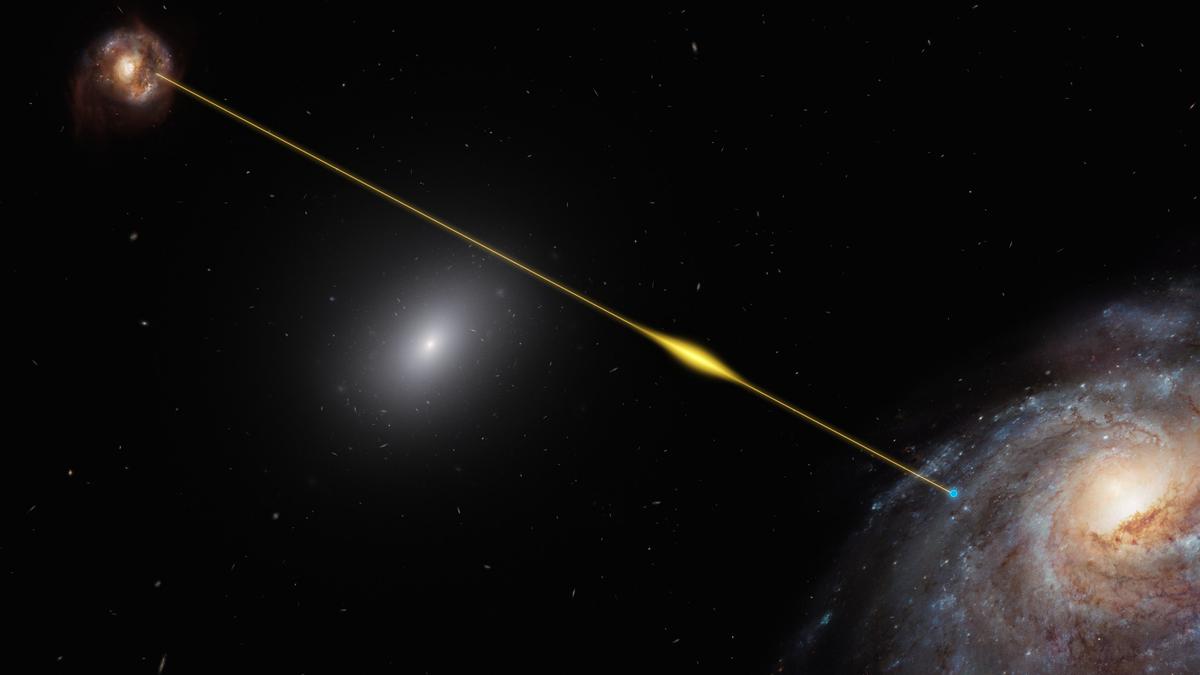
An international team of astronomers has published the results of its exhaustive study on a repeating fast radio burst from a distant galaxy that offers new clues about the origins of these mysterious radio flashes.
Mysterious emissions of radio light from the far reaches of the universe are the next big thing in modern radio astronomy. Fleeting flurries of radio waves, called fast radio bursts (FRBs) reach earth from faraway galaxies, emitting as much energy in a millisecond as the sun does over weeks.
In spite of being the brightest radio bursts found in nature, however, these will o’ the wisps of the cosmos are so transient that astrophysicists have only been able to ‘see’ them momentarily using large radio telescopes. Ever since the first FRB was picked up by radio astronomers more than 15 years ago, they have identified hundreds, and the list is getting longer by the day.
We know almost nothing about the precise origins of FRBs and why they appear in such short, sharp bursts – other than that these celestial electromagnetic impulses probably come from the embers of dying stars. Some FRBs are ‘one-off’ phenomena: spotted just once and never detected again; others are repeaters, flashing earth intermittently like some ghostly lighthouse in the depths of space.
An international team of astronomers has now published the results of its exhaustive study on a repeating FRB from a distant galaxy that offers new clues about the origins of these mysterious radio flashes. The report was published in the journal Science on May 12.
The astronomers tried to figure out what produces an FRB by studying its local environment to determine the sources that could exist in, or create, such environments. They targeted a repeating FRB, called FRB 20190520B (they are christened by the date of their discovery, in this case: May 20, 2019), using the Green Bank Telescope in the U.S. and the Parkes Observatory in Australia, and recorded hundreds of bursts from it.
They discovered that the FRB’s Faraday rotation measure – an indicator of its magnetic field strength – was highly variable and that it reversed direction twice. This magnetic reversal, they believe, has to do with the FRB source orbiting a binary star system where the companion star is probably a massive star or a black hole.
“We have used magnetic fields as probes to study the FRB’s local environment,” Reshma Anna-Thomas, lead author of the study, said in an email to The Hindu. “We saw that the magnetic field in our sightline flipped in a few months, which is tiny on astronomical timescales. The value of the magnetic field and electron density was also found to vary around this source, which indicates a very turbulent magnetised plasma environment.”


AI tool for sparrow conservation

BTS’s comeback with ‘Arirang’ marks a major global music event. When does the album release, and where can you watch their concert live stream? We have all the details

The 2026 U.S. cholesterol guidelines urge starting screening and treatment at 30 to prevent cardiovascular disease effectively.

Olam Festival 2026 in Thiruvananthapuram returns March 27-29 with 120+ vendors, music, art, and cultural zones.

A few storytellers in Thiruvananthapuram share their journeys, challenges, and evolving methods on World Storytelling Day, inspiring young minds.

76-year-old Kurian Jacob from Kerala triumphs with seven medals, including five golds, at the Open Masters Games in Abu Dhabi.

Explore the nature of the human mind as an emergent property of brain activity and complex neural interactions.

CERN's Large Hadron Collider discovers the Xi-cc-plus particle, enhancing understanding of quantum mechanics and baryon behavior.

Vibha Batra’s latest book, Spotless (Hachette India) is a novel in verse for young adults

In its first edition, the Madras Art Salon spotlights the works of journalist and artist Narayan Lakshman at The Botanical Club, a social space in the British Deputy High Commission, Chennai

Cholesterol enhances melanoma cell invasion by making nuclei squishier, revealing a potential treatment target in cancer progression.

The designers reinterpret the Swedish artist’s symbolic forms and colour energy through contemporary resortwear silhouettes

Discover the inspiring legacy of Bibha Chowdhuri, a pioneering woman in physics and a trailblazer in STEM history.