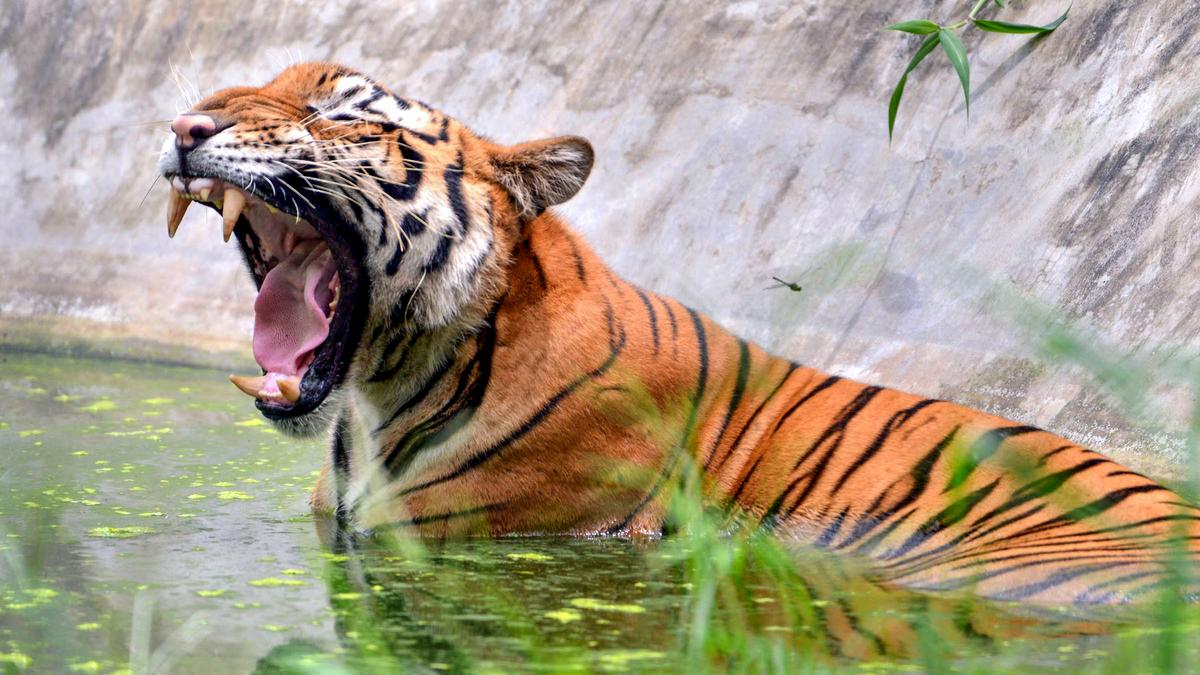
Assam government urges Orang National Park authorities to trace, transfer killer tiger to zoo
The Hindu
Assam government orders capture of tiger that killed home guard, sparking concern over potential man-eater behavior.
GUWAHATI
The Assam government has instructed the authorities of a national park to catch the tiger that killed an armed home guard on August 28 and transfer it to the zoo.
Officials of the Orang National Park and Tiger Reserve did not rule out the possibility of the tiger developing a taste for human blood after pouncing on Dhanmoni Deka and dragging his body for about 3 km inside the 279.83 sq. km wildlife habitat, better known for a sizeable population of the one-horned rhinoceros.
“We have issued an order to trace and transfer the tiger to a zoo, if necessary,” Assam’s Forest and Environment Minister Chandra Mohan Patowary said after Asom Gana Parishad MLA Pradip Hazarika expressed concern over the tiger turning a ‘man-eater’ on August 30.
He also said that the family of the deceased home guard was paid an ex-gratia of ₹6 lakh according to regulations.
Orang, about 110 km northeast of Guwahati, is one of four tiger reserves in Assam and is strategic to the Kaziranga Orang Riverine Landscape along with the Kaziranga National Park and Tiger Reserve across the Brahmaputra River.
Orang’s Field Director, Pradipta Baruah said the forest guards and casual workers who regularly patrol the park on foot have been worried about the tiger preying on humans after killing one of their colleagues. “We are trying to analyse the home guard’s death as Orang has an ample prey base for tigers not to venture out to kill livestock, let alone humans,” he said.


Karnataka government to consult legal experts on pursuing action against Adani Group's ACC Ltd. over ₹850 crore in disputed dues.

The FCRA amendment bill aims to create an authority for managing NGO assets after license loss, addressing misuse of foreign funds.

Telangana Minister assures adequate petroleum stocks for three months, warns against illegal fuel carrying amid panic buying rumors.

TMC calls for the removal of Bhabanipur returning officer, citing alleged ties to BJP and concerns over neutrality.

Kerala CM Pinarayi Vijayan condemns UDF's misogynistic attacks on CPI(M) legislator U. Prathibha, highlighting political degeneration.

Selected from 9,400 submissions across 37 countries, the 100 photographs on display traverse intimate and political terrains. In MRC Nagar, photographer Swastik Pal captures life in the Sundarbans, where severe climate change has brought humans and wildlife into closer contact. Shane Hynan’s Beneath Beofhod reflects on Ireland’s boglands as sites of memory and restoration, while Mateo Trevisan’s More than the Sun examines the impact of coal-driven industrialisation in the Western Balkans.

Hyderabad officials assure sufficient fuel supply for 60 days, warn against misinformation and illegal sales amid panic buying.

Telangana MP urges Centre to expedite ₹1,270 crore dues transfer from Andhra Pradesh for financial fairness and development.

A Karnataka man was detained with ₹62.5 lakh in cash during election checks on NH 544, claiming it was from a property sale.

Telangana Government issued 16 notifications to fill 31,798 vacancies, with 67,763 total recruitments since Congress took power.

Supreme Court directs Tarun Butolia's family to seek safety assessment from Delhi Police after fatal Uttam Nagar clash.

CM Stalin asserts unity in the DMK-led alliance, dismissing division attempts and emphasizing collaborative efforts for the upcoming elections.

Rahul Gandhi to skip Kerala rally due to Sonia Gandhi’s ill health; Kharge to attend Kozhikode event
Rahul Gandhi will miss the Kerala rally due to Sonia Gandhi's health; Congress president Kharge to attend instead.