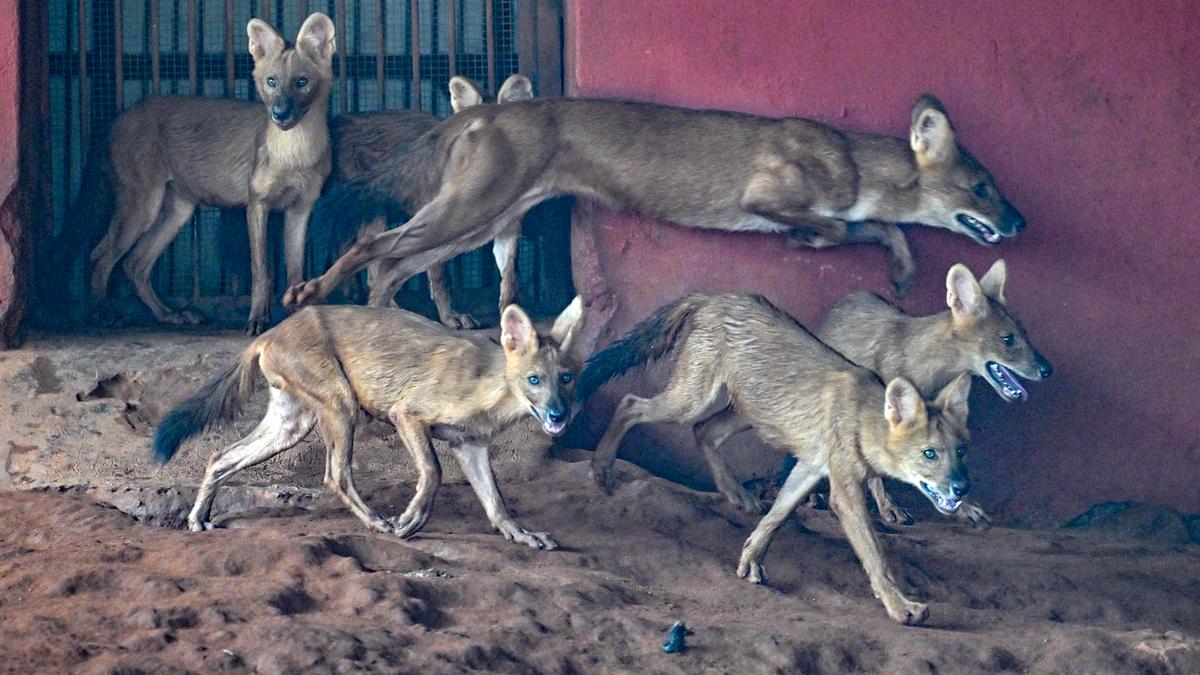
Asiatic wild dog: Reviving India’s elusive predator
The Hindu
India's only conservation breeding centre for endangered Asiatic wild dogs, the dhole, aims to create a genetically diverse captive population.
As dawn breaks over the Eastern Ghats, the rustle of leaves and bird calls merge with a flurry of movement inside the Indira Gandhi Zoological Park in Visakhapatnam. Away from public view in a quiet, forested space of the zoo lies India’s only conservation breeding centre for the endangered Asiatic wild dog, also known as the dhole (Cuon alpinus).
The breeding season has begun, a time of heightened activity and calm. The rust-red dholes, lithe and full of kinetic energy, dart and leap across their large enclosures. Their piercing eyes scan every movement. “They’re incredibly alert, agile and difficult to restrain,” says Dr Bhanu, the zoo’s veterinarian. “Administering vaccines or medical aid is only possible through a blowpipe, due to their fidgety and skittish nature.”
By 8am, animal keeper Chinna arrives, clutching a thick notebook, his log of daily observations. The dholes recognise his presence, as if wired to an internal clock that alerts them it’s feeding time. Among the 40 dholes currently housed at the centre, including 16 pups, a few potential breeding pairs have been identified. “We first allow the pair to get used to each other’s presence by keeping them close, but separated by a partition in the night kraal for two to three weeks,” explains Dr Bhanu. “If no signs of aggression appear, they’re moved into the day kraal together.” The mating ritual is brief, lasting just three to five days. Once pregnant, the female enters a 62 to 63-day gestation period. About three weeks before delivery, she begins exhibiting denning behaviour, a clear signal for keepers to prepare. “A quiet, undisturbed environment is critical,” says G Mangamma, curator of the Indira Gandhi Zoological Park. “That’s why our breeding centre is off-display. We’ve also designed four dens that closely mimic wild dens with natural cover.”
The breeding journey of dholes at Visakhapatnam Zoo began three decades ago. In 1992 and again in 1994, wild dholes from the Eastern Ghats, one male and five cubs, were inadvertently trapped in open moats and retained by the zoo authorities. Over the years, through careful pairing and observation, they grew the stock into a small but genetically valuable population. A key milestone came in December 2006, when the alpha female gave birth to nine pups, a record litter at the time.
Since then, Visakhapatnam’s facility has become a national hub for dhole conservation. In 2006, the Central Zoo Authority sanctioned a Small Grants Fellowship to initiate in-depth research into dhole reproduction and behaviour under the leadership of then curator B Vijay Kumar. Today, the centre operates with a comprehensive mission to breed dholes in captivity, maintain a healthy gene pool, and contribute to global understanding of this elusive canid. Dholes are known for their complex social structures. Unlike solitary predators, they live and breed in packs with a strong hierarchy. “Successful breeding happens in stable groups,” says Mangamma. “Single-pair enclosures rarely work, so we are collaborating with other zoos like Nehru Zoological Park Hyderabad, Arignar Anna Zoological Park Vandalur and Sri Venkateswara Zoological Park Tirupati to establish social groups and bring in new genetic material.”
The breeding enclosures themselves are thoughtfully constructed, sprawled across 2,662 square metres, lined with native trees like jamun, neem, and bamboo. There are shaded patches, water pools, sunlit clearings and enough space for the animals to express their natural behaviour. Dholes here can leap, play, rest and dig, just as they would in the wild.
Post-partum, the mother is rarely seen, emerging briefly for food or to check for predators. Keepers observe from a distance to minimise stress. “Sometimes, if a pup is born weak or the mother feels threatened, she may kill her own young,” says Mangamma. “This is a known behaviour in carnivores. It’s a survival strategy.”


Horses shone at Auroville's 2026 event, showcasing equestrian talent through dressage, derby, and show jumping competitions.

Telangana Governor Shiv Pratap Shukla attends Bihar Foundation Day celebrations in Hyderabad, honoring Bihar's historical and cultural contributions.

Samsung workers protest for the reinstatement of 27 suspended employees, citing unfulfilled promises from the Labour Minister.

The Vice-Chancellor of Rajiv Gandhi University of Health Sciences (RGUHS) B. C. Bhagavan said on Sunday that the university will soon open a research centre on Yoga and Naturopathy on 60-acre land in Bengaluru.

UT Matters: Construction of Uppar drain road overbridge in Puducherry to be completed in four months, amid traffic regulations.

Union Minister Dharmendra Pradhan highlights Bharat Innovates' aim to elevate Indian deep-tech startups to the global stage.

In an exclusive interview, DMK MLA Ezhilan discusses Tamil Nadu's 2026 elections, party structure, and local governance challenges.

Minister Satish Jarkiholi asserts confidence in retaining Davangere and Bagalkot seats in upcoming bypolls amid addressing internal discontent.

Sunil Ambekar of RSS emphasizes national unity, defending road prayer restrictions and promoting awareness of shared ancestry in India.

Opposition MPs and activists voice strong concerns against proposed amendments to the Transgender Persons Act at a Delhi hearing.

Four Assam police commandos injured in an extremist attack during a gunfight in Tinsukia district, officials report.

Campaigning intensifies in Ernakulam district as candidates engage voters ahead of the crucial Assembly polls.

Lord Rama rides Hanumantha Vahanam on sixth day of Brahmotsavams in Tirupati