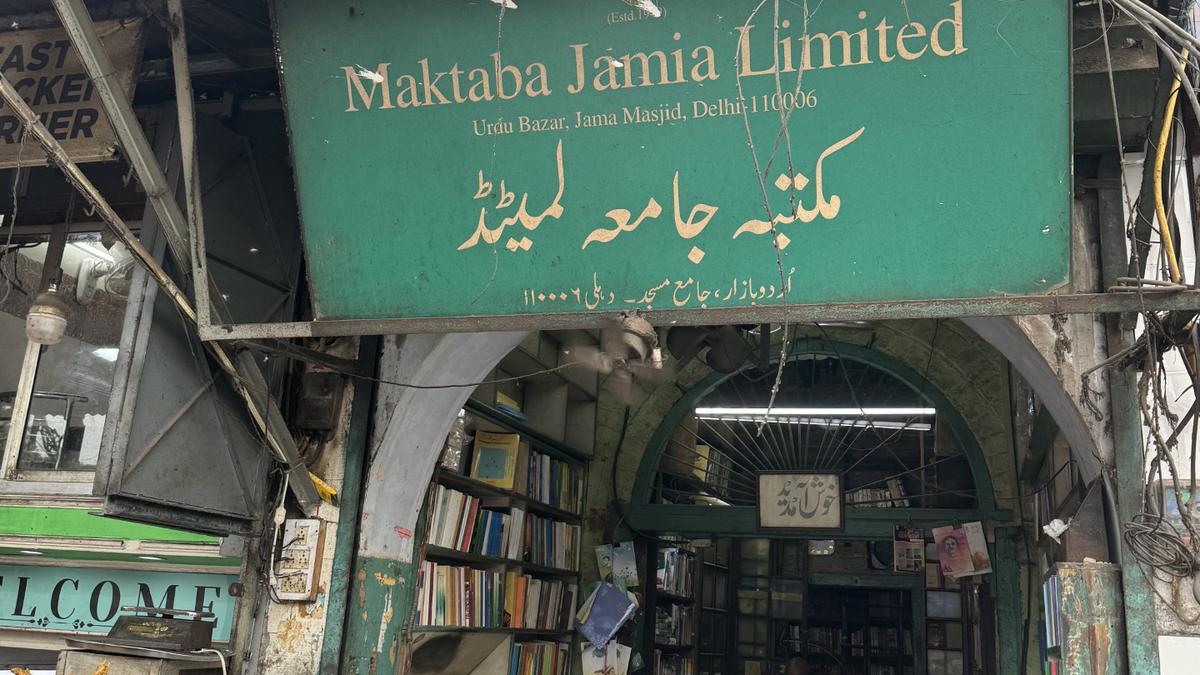
As Urdu Bazaar fades away, bookshop owners mourn the slow decline of heritage
The Hindu
Urdu Bazaar in Chandni Chowk, Delhi, struggles to preserve its rich literary heritage amid declining interest in Urdu.
Nestled in Chandni Chowk, one of the city’s oldest and busiest markets, the Urdu Bazaar seems like a fading relic of Delhi’s rich cultural heritage. The bazaar dedicated to Urdu literature, which once bustled with scholars, poets, and book lovers, is now in decline, mirroring the waning interest in the language itself.
With food stalls replacing the bookstores here, the customers who now throng the market come looking for a quick bite rather than Urdu books. As a bookshop owner quips, “The place has turned into a khaana (food) Bazaar.”
Sitting behind a wooden counter in the dimly lit Maktaba Jamia bookshop, Ali Khusro Zaidi recalled the golden days of Urdu Bazaar. “This place used to be the pride of Urdu literature. Scholars, poets, and students would seek out our shops. Books would fly off the shelves. But now, it feels like we are fighting a losing battle.”
The dusty bookshelves in the bazaar, which once featured a variety of books on poetry, prose, and philosophy, among others,
are now stocked mostly with Islamic texts and books on learning Urdu. Mr. Zaidi said, “We really only sell religious books or those on exams because only such volumes make a profit. There aren’t many takers for Urdu literature books.”
He showed a collection of rare manuscripts, their leather-bound covers worn out with time. “These are from before the Partition,” he said. “But the younger generation is moving away from the language. They prefer to communicate only in English or Hindi.” In fact, Maktaba Jamia sells Hindi versions of many texts that were originally written in Urdu to appeal to newer clientele.
“Urdu is not just a language. It’s our heritage,” Mr. Zaidi said. “As long as there are people who value our culture, there is hope for the language.”


CPI-M accepts DMK's five-seat offer for Tamil Nadu Assembly elections, prioritizing INDIA bloc unity over seat demands.

Ricky Rai, son of former underworld operative Muthappa Rai, on Monday appeared before the Bengaluru Traffic Police for questioning in connection with a case involving a Lamborghini performing dangerous stunts at Anil Kumble Circle on March 21.

The Dispur election heats up as 'CongBJP' defections shape a high-stakes contest between veteran candidates from BJP and Congress.

Bengaluru's M. Chinnaswamy Stadium conducts readiness drill ahead of IPL 2026, ensuring upgrades and technical preparations are complete.

First-level randomisation of EVMs completed in Nagapattinam for upcoming elections, ensuring transparency and security.

A district-level committee in Krishnagiri has been formed to assess and verify seizure claims of goods and cash.

Minister Anam Ramanarayana Reddy pledges government support for local fishermen and farmers facing challenges in Andhra Pradesh.

MP M. Sribharat urges collective efforts to revive Visakhapatnam Steel Plant, highlighting key reforms for crucial recovery and growth.

141 candidates have filed nominations for Kozhikode's Assembly elections, with scrutiny on March 24 and campaigning intensifying.

BJP's Vijayendra accuses Congress of using money to influence Bagalkot bypolls, urging voters to reject their tactics.

First randomization of electronic voting machines completed in Tirunelveli and Tenkasi districts for upcoming Assembly elections.

RPF seizes 10.12 kg of unclaimed cannabis worth ₹5.06 lakh from a train in Mangaluru.

Kolar's groundwater levels rise to 50-100 ft due to the K.C. Valley project, ensuring clean water and improved health outcomes.